
Acceptance and Commitment Therapy (ACT): Clinical Resources for Practitioners
Acceptance and Commitment Therapy (ACT), a third-wave cognitive behavioural approach grounded in Relational Frame Theory, targets psychological flexibility as the mechanism through which symptom reduction and value-driven living become possible. This page is addressed to clinicians who integrate ACT into individual therapy, group work, or brief intervention formats. It gathers worksheets, psychoeducation sheets, structured exercises, multi-session programs, and guided audio resources organised around the six core ACT processes. Whether you are new to the model or looking to deepen an established ACT practice, the materials below are designed to be used directly in session or assigned as between-session work.

The Six Core Processes and Their Therapeutic Logic
Acceptance and Commitment Therapy rests on a coherent transdiagnostic model: six interdependent processes that collectively constitute psychological flexibility. These are acceptance, cognitive defusion, contact with the present moment, the observing self, values clarification, and committed action. None operates in isolation; clinical work typically cycles through several processes within a single session. Understanding their functional relationships is a prerequisite for selecting any specific tool from this library.
The model is most efficiently communicated to clinicians and clients alike through the hexaflex diagram. The ACT Hexaflex: PDF Worksheet, Tools and Exercises for Clinical Practice maps these six processes visually and can anchor psychoeducation in the first or second session. It also serves as a formulation scaffold: identifying which processes are most impaired for a given client orients the entire intervention plan.
Psychological Flexibility as the Primary Clinical Target
Psychological inflexibility, manifesting as experiential avoidance, rigid cognitive fusion, or chronic values disengagement, is the overarching treatment target across presenting problems. The worksheet Psychological Flexibility: PDF Worksheet, Tools and Exercises for ACT Practice operationalises this construct for clinical use, helping clients recognise their own flexibility repertoire and its current limitations. Pairing it with the 12 ACT Schemas and Modes of Thinking: PDF Worksheet, Tools and Exercises allows a more granular mapping of the cognitive patterns that sustain inflexibility.
Identifying ACT Targets During Consultation
Experiential Avoidance and Cognitive Fusion
Experiential avoidance, the persistent effort to reduce contact with unwanted internal events (thoughts, sensations, memories, emotions), is often the first clinical signal pointing toward an ACT framework. Clients present with elaborate behavioural strategies designed to suppress or escape internal discomfort: compulsive phone use, procrastination, rumination loops, or interpersonal conflict that temporarily externalises distress. The Problematic Phone Use: A Structured Clinical Exercise and the Procrastination in Therapy: A Guided Clinical Exercise address two of the most common avoidance topographies you will encounter.
Cognitive fusion, the state in which a client relates to thoughts as literal facts rather than transient psychological events, is identifiable through clinical observation: absolute language, inability to consider alternative perspectives, or a strong pull toward certainty. The Certainty of Being Right: A Guided Exercise for Clinicians makes this process explicit without pathologising the client, and the Worry and Attentional Capture: A Guided Clinical Exercise targets the attentional narrowing that fusion produces.
Values Disengagement and the Role of Feared Emotions
Clients who present with values disengagement often describe a persistent sense of flatness, purposelessness, or the feeling that nothing really matters. This profile is distinct from anhedonia, though the two can co-occur. The Personal Values Clarification: A Guided Clinical Exercise and the Cultivating Values: A Guided Action-Alignment Exercise are particularly useful here, moving the client from abstract identification of values toward concrete behavioural commitments. The My Future Inventory: A Clinical Values and Time Exercise adds a temporal dimension, prompting reflection on how present avoidance is foreclosing future possibility.
Fear and intolerance of uncertainty frequently function as barriers to values-based action. The structured program Fear in Clinical Practice: A Five-Session Psychoeducation Program and the Guided Exercise on Intolerance of Uncertainty in Anxiety address these barriers directly, helping clients make room for uncomfortable internal states rather than reorganising their lives around avoiding them.
Comorbidities and Differential Diagnostic Considerations
Transdiagnostic Relevance and Appropriate Populations
ACT's transdiagnostic design means it is applicable across a wide range of presentations: depression, generalised anxiety disorder, social anxiety, chronic pain, health anxiety, OCD, and substance-related disorders. The program ACT for Depression: A Psychoeducation Program for Clinicians and the Social Anxiety in Relationships: A 4-Session Psychoeducation Program illustrate how the same hexaflex processes translate into disorder-specific clinical language.
When rumination is a dominant feature, ACT and metacognitive therapy share overlapping targets, though their rationales differ. The Rumination: A Structured Psychoeducation Program for Clinicians can be used within either framework. Similarly, the Intolerance of Uncertainty: A 4-Session Psychoeducation Program addresses a transdiagnostic maintaining factor relevant to both ACT and CBT case conceptualisations.
Distinguishing ACT from Overlapping Approaches
ACT shares vocabulary with mindfulness-based cognitive therapy (MBCT) and dialectical behaviour therapy (DBT), and clinicians should be precise about which model is driving formulation and intervention. The observing self and defusion techniques in ACT are functionally similar to decentring in MBCT, but the explicit emphasis on values and committed action differentiates ACT's clinical agenda. When a client's presentation is dominated by interpersonal schemas and relational patterns, the 12 Beliefs That Damage Relationships: PDF Worksheet, Tools and Exercises and the Emotional Dependency: A Guided Self-Reflection Exercise help to bridge ACT with schema-informed or attachment-oriented work.
Using ACT Worksheets and Exercises In Session
Defusion, Choice Points, and In-Session Experiential Work
ACT is an experiential model; its tools are most effective when worked through in session rather than simply assigned as homework. Cognitive defusion techniques aim to alter the function of a thought without challenging its content, a departure from classical CBT restructuring. The ACT Cognitive Defusion: PDF Worksheet, Tools and Exercises for Clinical Practice provides a structured menu of defusion strategies graded by intensity, suitable for clients at different stages of contact with the model.
The The Choice Point: PDF Worksheet, Tools and Exercises for ACT Practice is one of the most clinically versatile tools in this collection. It maps the moment between a triggering internal event and a behavioural response, making the choice architecture visible to both client and clinician. It is particularly useful mid-treatment, when the client has sufficient awareness of their internal landscape to use the tool in real time.
> A client with longstanding health anxiety describes spending two hours each morning checking her pulse and reading medical websites. In session, the Choice Point worksheet reveals that the checking behaviour is fused with the thought "if I don't check, something bad will happen." Rather than disputing the thought, work focuses on noticing it as a thought, identifying what value (safety for her children) she could move toward instead, and taking one small committed action before the urge to check is resolved. The defusion exercise is introduced at the same session; the between-session audio is assigned for the following week.
Self-Acceptance, Growth Mindset, and Emotional Processing
Self-critical fusion and fixed self-concept are common barriers to committed action. The Self-Acceptance Work: A Five-Question Guided Clinical Exercise and Adopting a Growth Mindset: PDF Worksheet, Tools and Exercises for Clinical Practice address these barriers from complementary angles: the first works at the level of the observing self and self-compassion; the second targets the functional belief that qualities are fixed and cannot develop. Both are appropriate from mid-treatment onward, once the client has some experiential contact with defusion.
For affective presentations, the Processing a Bad Workday: A Structured Clinical Exercise, Feeling Useless: A Guided Exercise for Clinical Practice, and Guided Exercise: Helping Patients Rediscover Hope When Stuck offer session-ready tools for working with difficult emotional states in an ACT-consistent way, prioritising acceptance and values reconnection over mood repair.
Structured Programs: Sequencing ACT Over Multiple Sessions
Using Multi-Session Programs as Treatment Backbones
The multi-session programs in this category are designed to sequence psychoeducation and experiential work across four to five appointments. They are not scripts; they are clinical maps. Each session in a program builds on the previous one, allowing progressive exposure to ACT concepts without overloading early sessions.
Recommended sequencing for a moderate-complexity presentation:
- Introduce the hexaflex and establish a shared formulation language.
- Psychoeducation on the primary presenting emotion (sadness, fear, anxiety) using the relevant program.
- Values clarification and identification of avoidance patterns.
- Defusion and present-moment work, with audio support between sessions.
- Committed action planning with regular review of the Choice Point.
The Understanding Sadness: A Clinical Psychoeducation Program and Emotion Regulation: A 4-Session Psychoeducation Program pair well with the affective-focused exercises, while Working with Judgment in Therapy: A 3-Session Program addresses the self-evaluative processes that frequently undermine committed action.
Audio Resources: Present-Moment Work and Between-Session Practice
Mindfulness Audios as Extensions of In-Session Experiential Work
ACT's present-moment awareness process requires repeated practice, and audio resources support this between sessions without placing the full burden of practice on client self-direction. The Present-Moment Anchoring: Long Guided Audio for Clinicians and the Short Guided Audio for Present-Moment Grounding in Therapy are calibrated for different use cases: the longer format suits a structured mindfulness block in a program; the short format is practical for daily practice or in-session regulation.
The Anti-Negative Thoughts Bubble: Guided Audio for Clinicians translates cognitive defusion into an auditory experiential format, reinforcing in-session work without requiring the client to read or complete a written exercise. The Boredom Guided Audio: A Clinical Meditation for In-Session Use targets a less commonly addressed clinical phenomenon: boredom tolerance, which in ACT terms is a form of acceptance of low-stimulation internal states.
Points of Vigilance and Clinical Limits
When ACT Requires Adaptation or Supplementation
ACT is not universally indicated without modification. Clients with acute psychosis, severe dissociation, or currently active trauma symptoms may find defusion and observing-self exercises destabilising, particularly if the distinction between the self and its contents is not yet clinically stable. In these cases, present-moment work should be introduced gradually and grounded in somatic anchoring before any defusion technique is attempted.
The model's emphasis on values and committed action can inadvertently activate guilt in clients with depression or chronic illness, if the gap between current functioning and valued living feels too large. Clinicians should monitor for this and adjust pacing accordingly, prioritising acceptance-based work before action-oriented assignments.
- Avoid introducing values clarification exercises before a functional level of defusion has been established.
- Reassess experiential avoidance regularly; avoidance strategies are often context-specific and shift as treatment progresses.
- Distinguish between genuine values engagement and compliance behaviour disguised as committed action.
- In group formats, ensure that the observing-self exercises are introduced after sufficient group cohesion is present.
Finally, ACT is a skills-based model with a clear evidence base, but clinical outcome is still substantially mediated by the therapeutic alliance. The tools in this collection support the model; they do not replace the relational context in which ACT is most effective.
Tools in this category
Handout
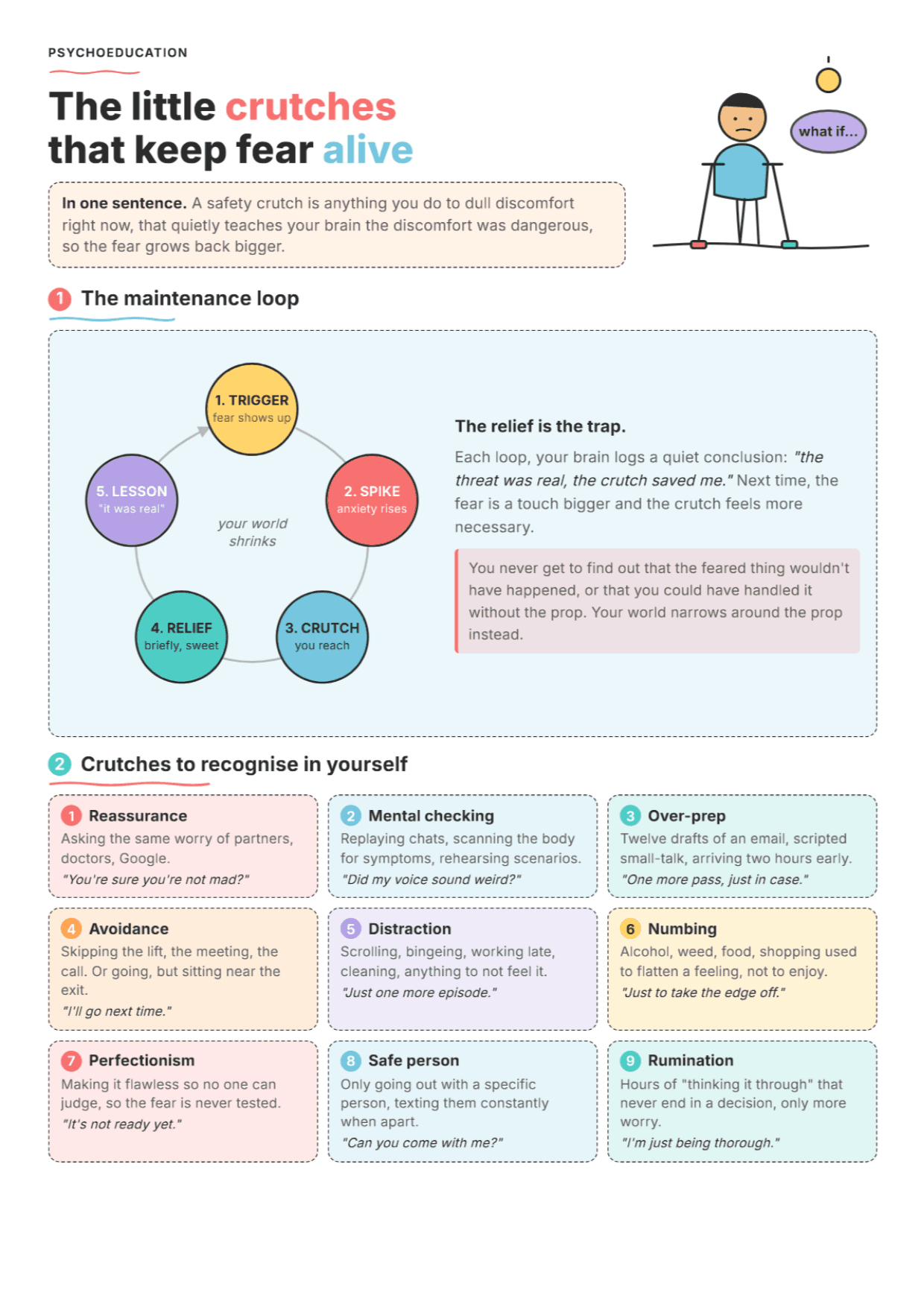
Psychological Safety Crutches: PDF Worksheet, Tools and Exercises
A visual PDF fiche for explaining safety behaviors in session: tools and exercises to help patients recognise the maintenance loop keeping their fear alive.
AnxietyMood & depression
Handout
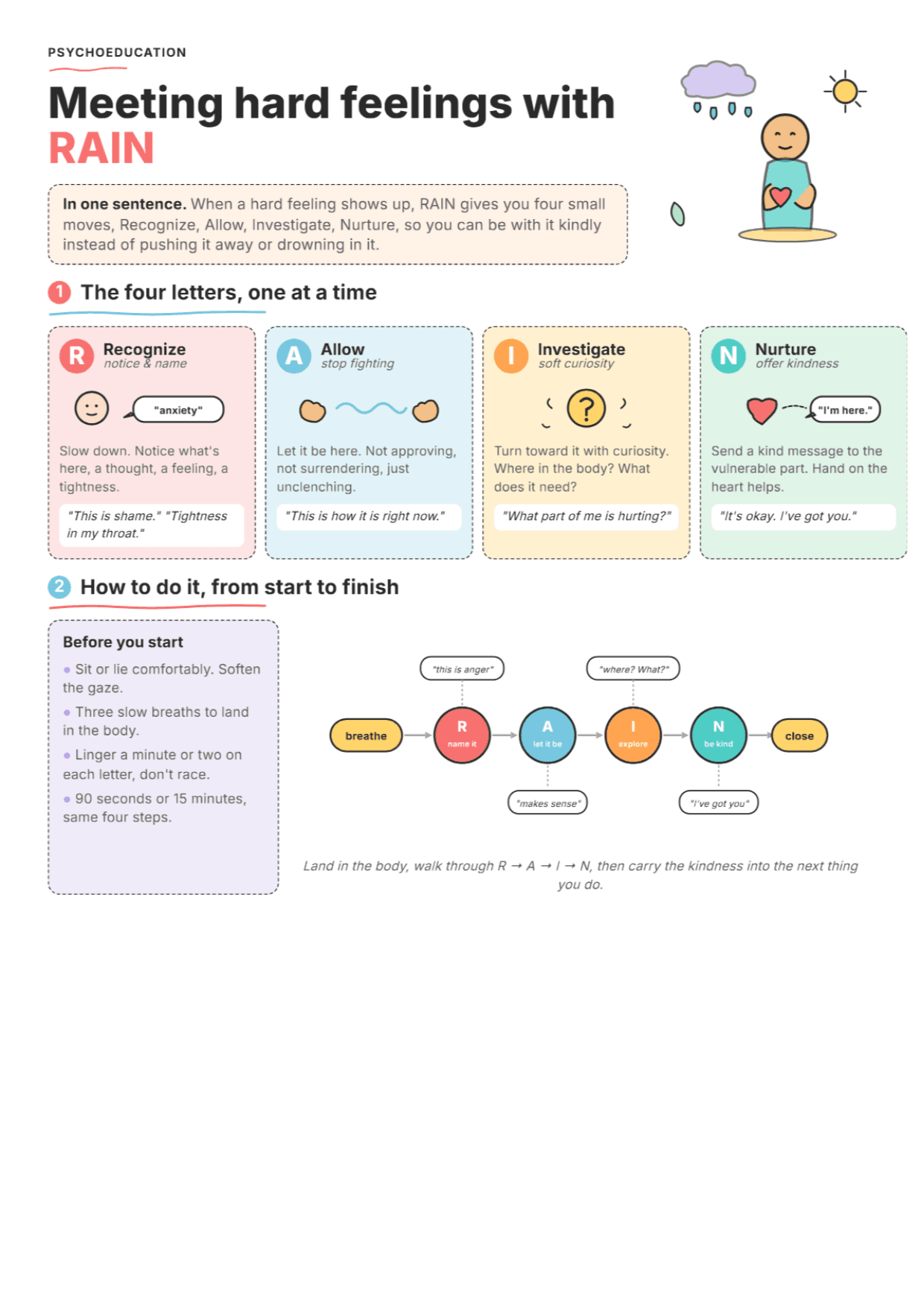
RAIN Mindfulness Technique: PDF Worksheet, Tools and Exercises
A printable PDF worksheet, clinical tools, and exercises to explain the RAIN mindfulness technique in session and give patients a durable self-compassion map.
AnxietyMood & depression
Handout
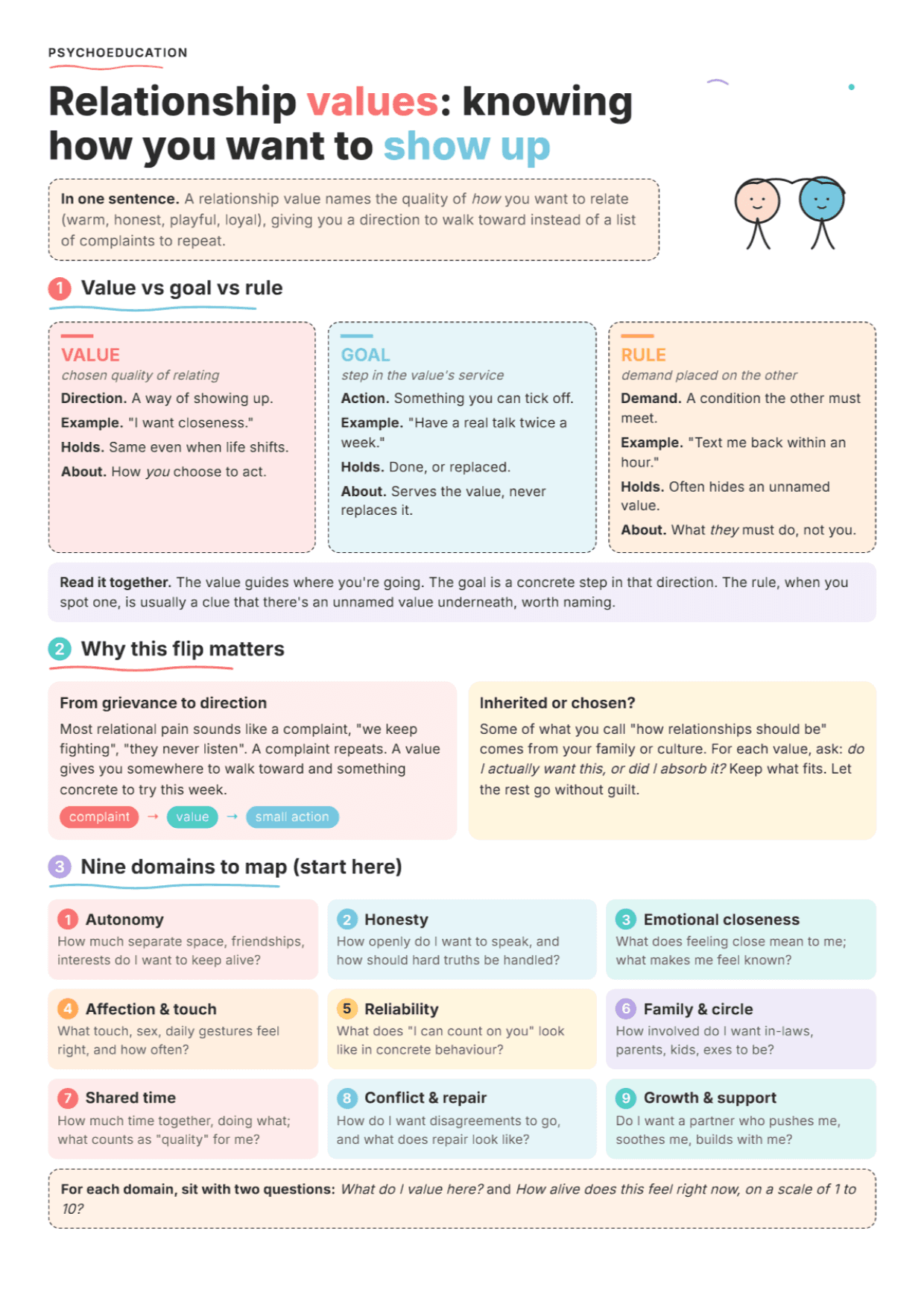
Relationship Values: PDF Worksheet, Tools and Exercises
A visual PDF worksheet, tools and exercises to help patients clarify how they want to show up in their relationships and turn recurring complaints into workable directions.
RelationshipsSelf & identity
Handout
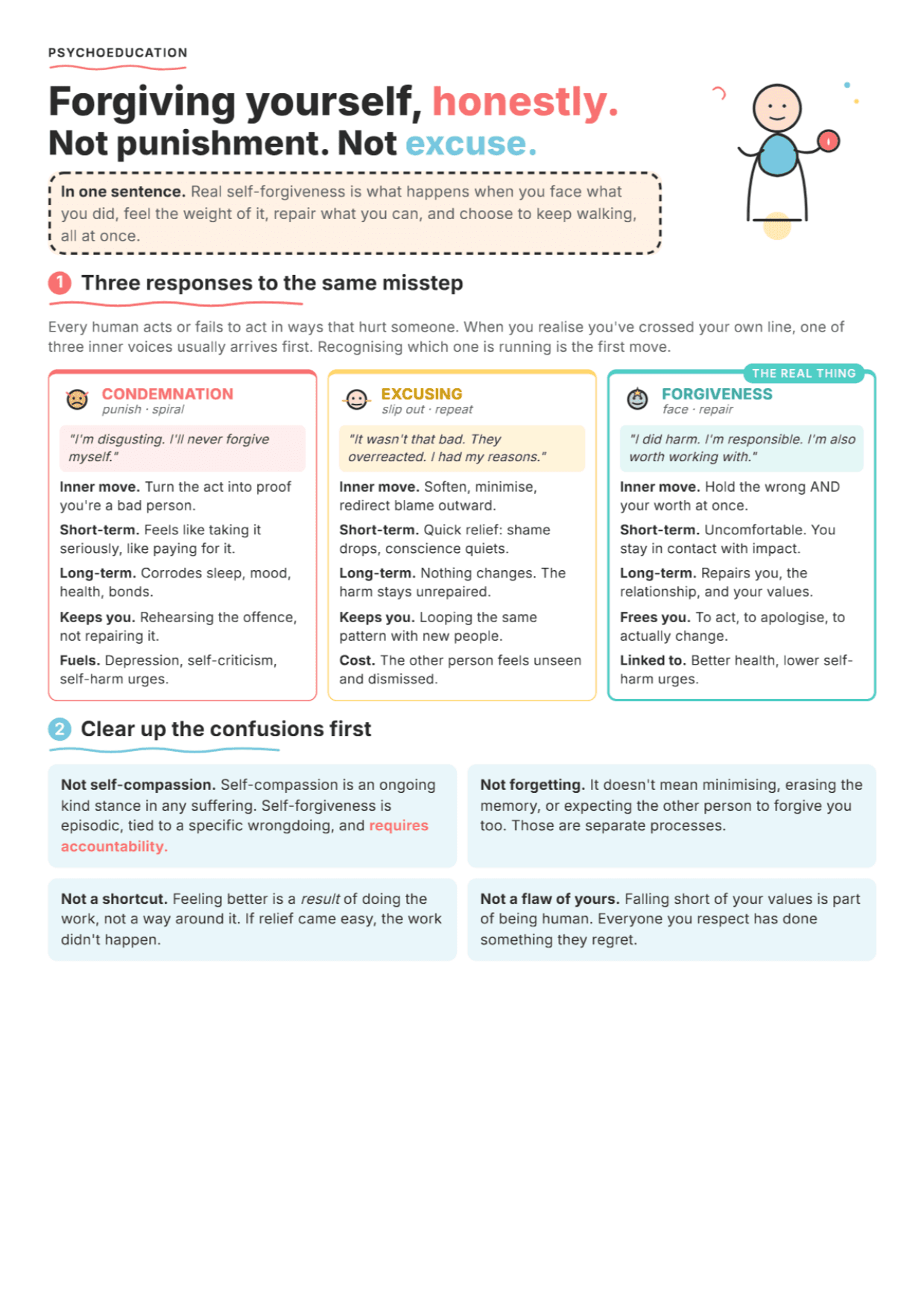
Self-Forgiveness: PDF Worksheet, Tools and Exercises for Clinicians
A structured PDF worksheet, clinical tools, and practical exercises to help patients move from self-condemnation to genuine moral repair in therapy.
Self & identityMood & depression
Handout
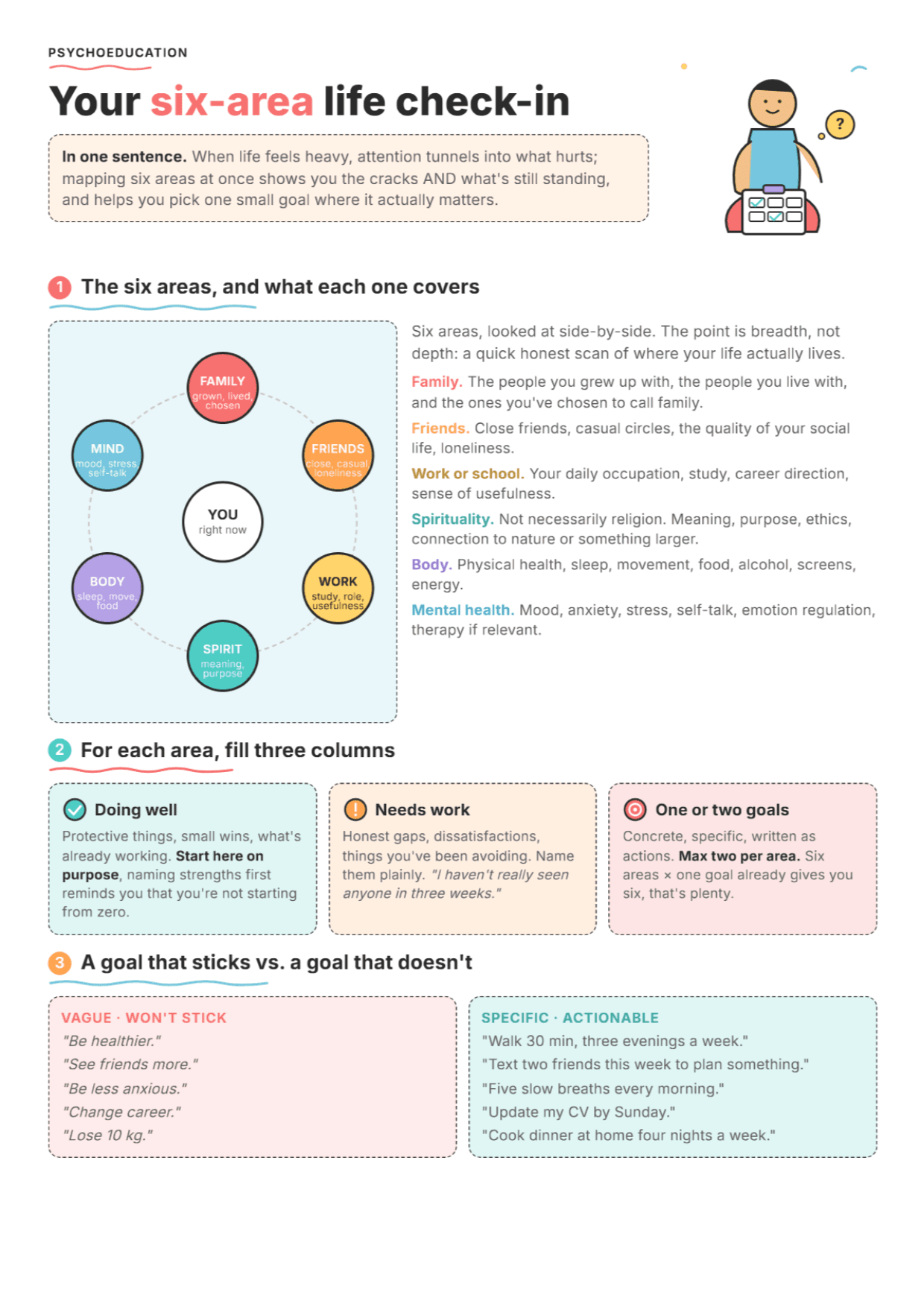
Setting Life Goals: PDF Worksheet, Tools and Exercises for Clinicians
A structured six-area visual check-in helping patients break attentional tunnel vision, name strengths alongside gaps, and commit to specific, actionable goals in session.
Life transitionsSelf & identity
Handout
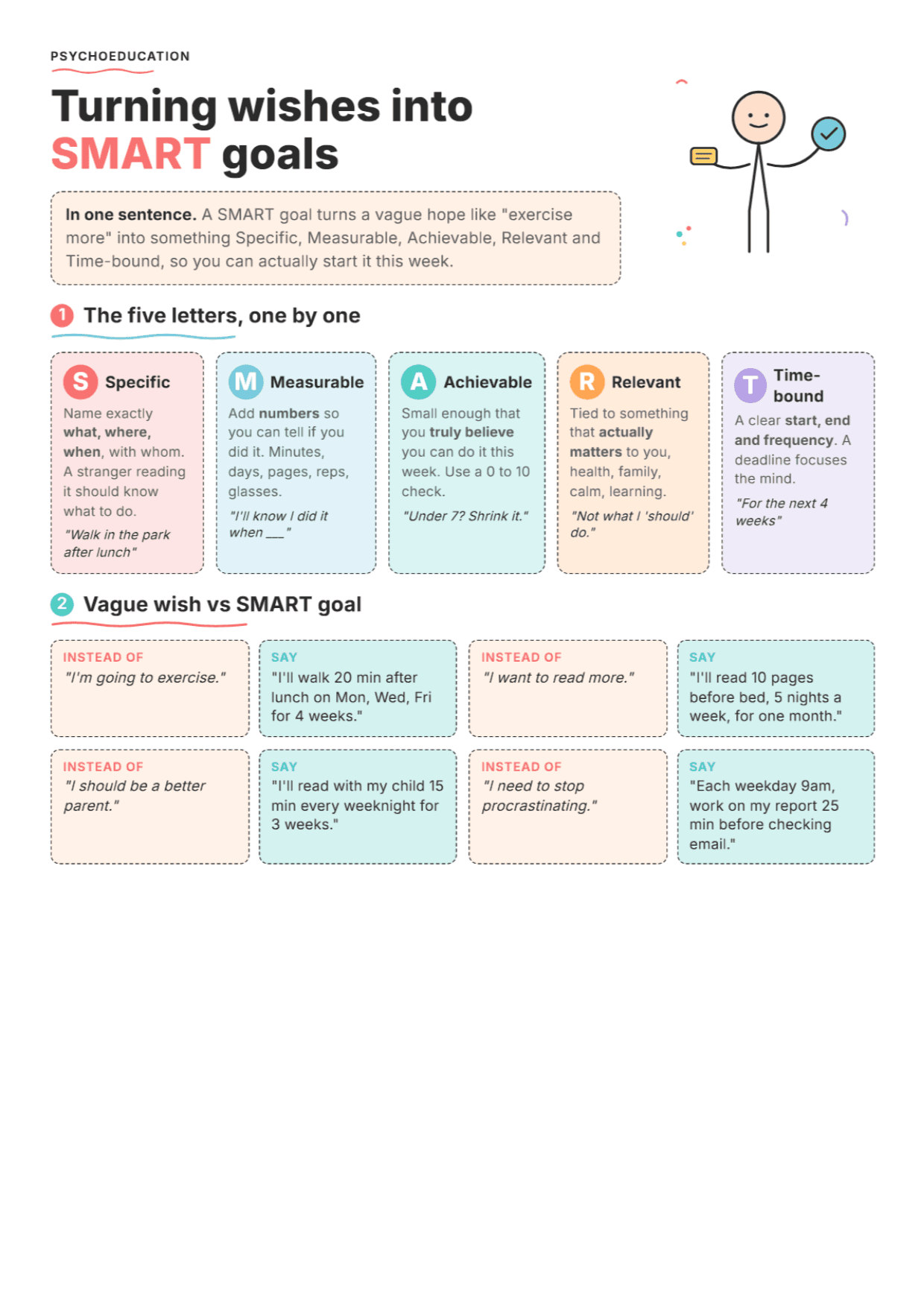
SMART Goals: PDF Worksheet, Tools and Exercises for Clinical Practice
A printable PDF worksheet, clinical tools, and concrete exercises to help patients turn vague intentions into structured, achievable SMART goals in therapy.
Life transitionsMood & depression
Handout
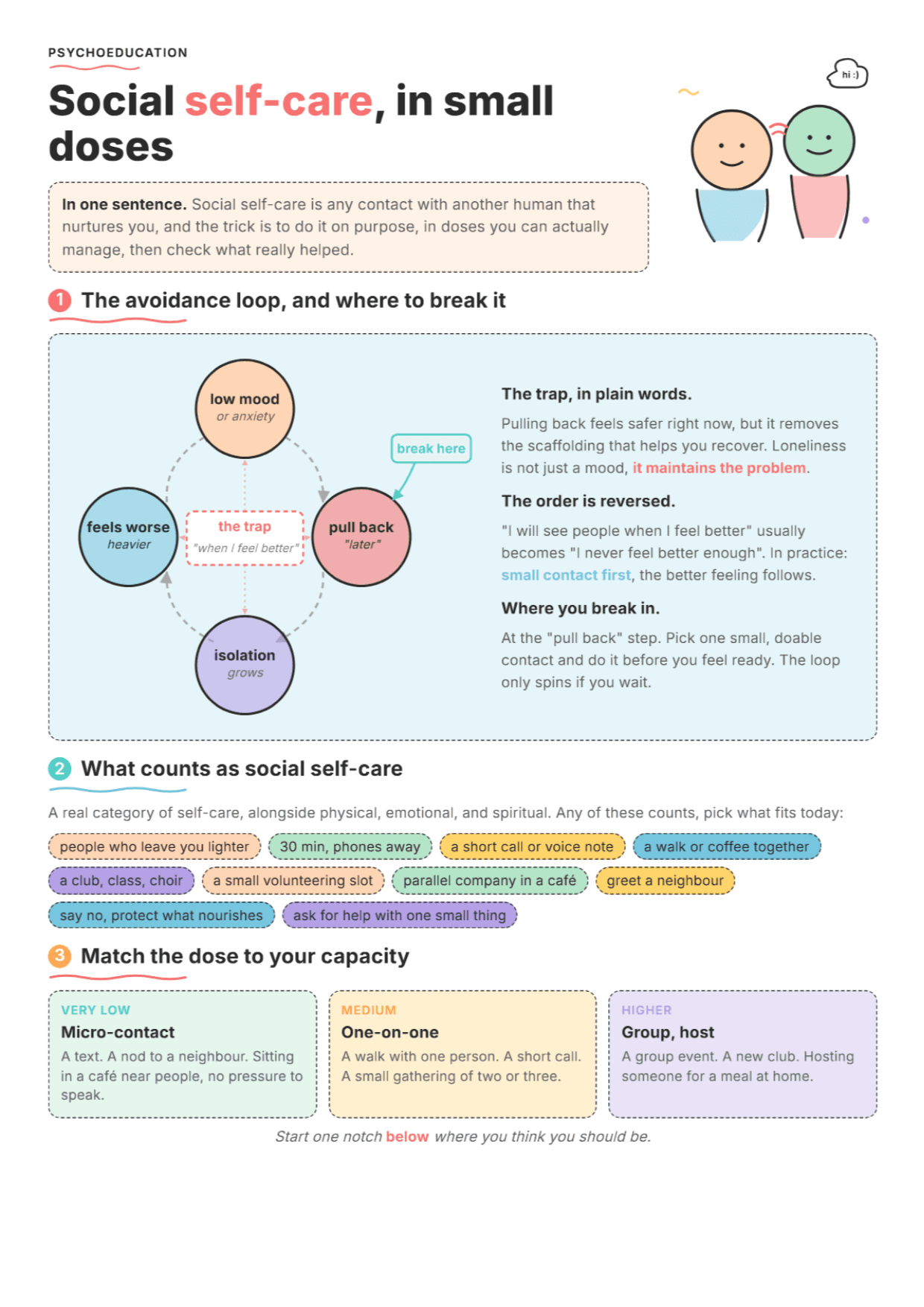
Social Self-Care Activities: PDF Worksheet, Tools and Exercises
A printable PDF worksheet, clinical tools, and structured exercises to help patients break isolation, dose social contact, and track what genuinely restores them.
Mood & depressionTrauma & PTSD
Handout
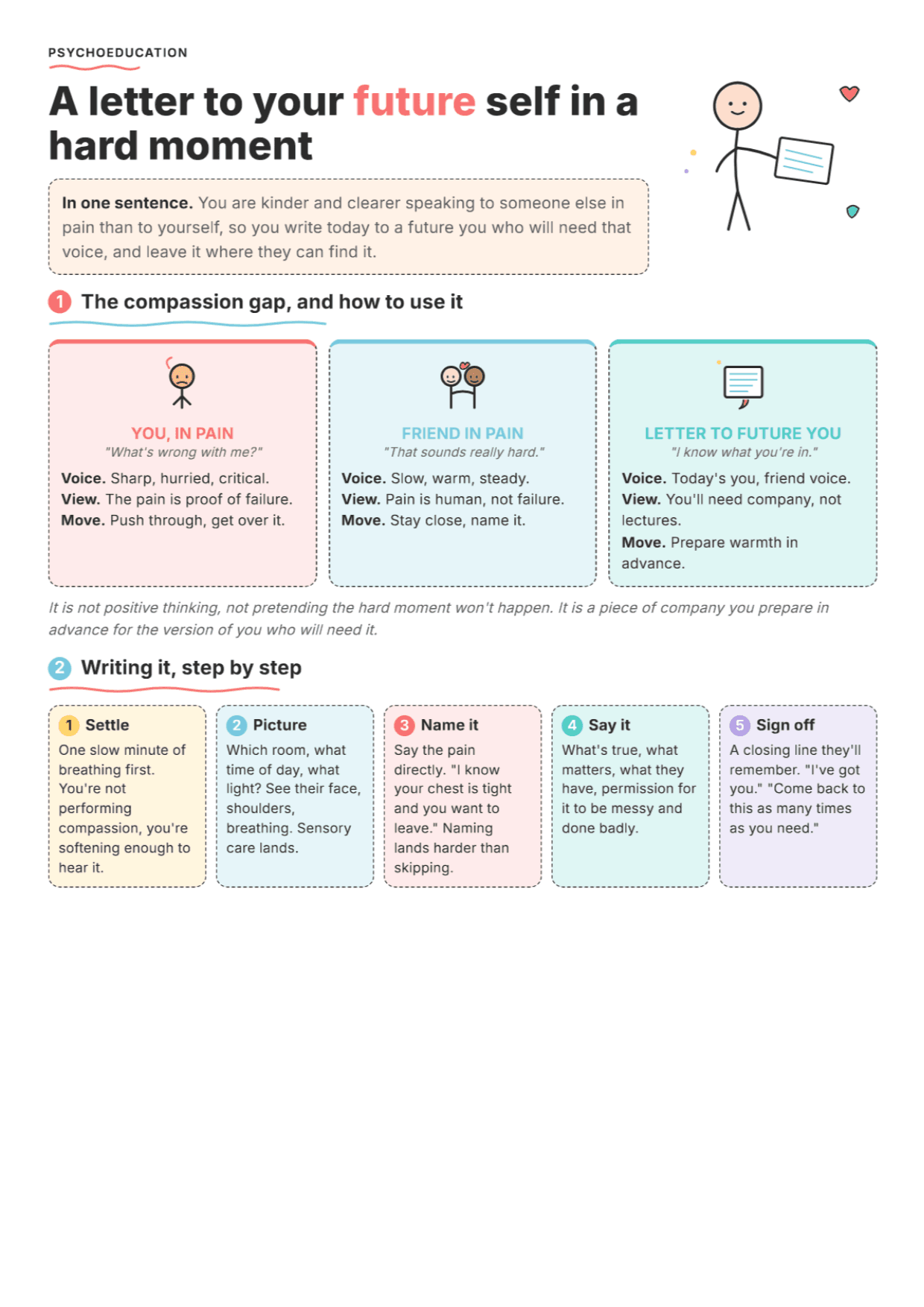
Speaking to Your Future Self: PDF Worksheet, Tools and Exercises
A printable PDF worksheet, clinical tools and guided exercises helping patients prepare compassionate self-talk for their most predictable hard moments, before the crisis arrives.
AnxietyMood & depression
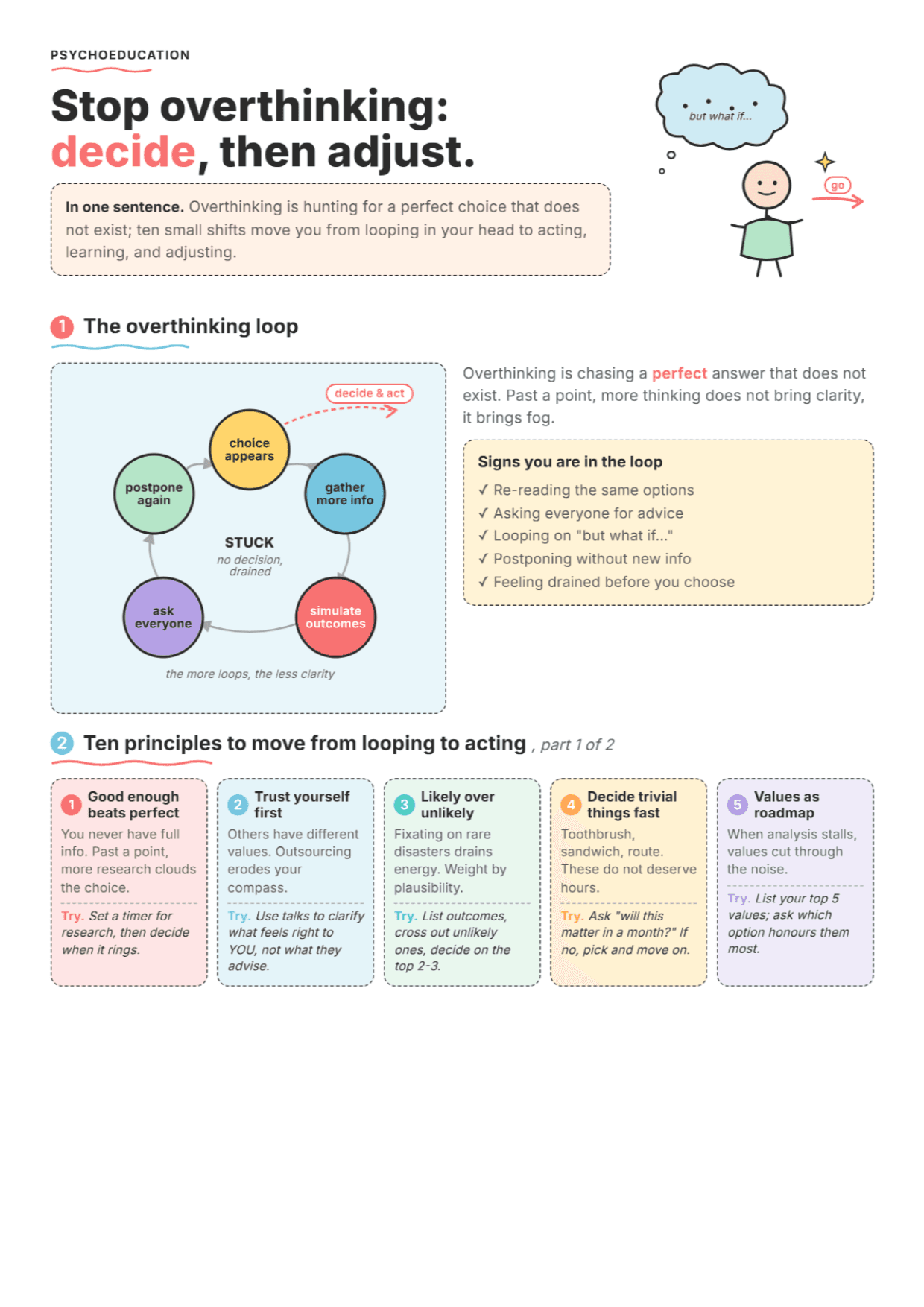
Handout
Stop Overthinking: PDF Worksheet, Tools and Exercises for Clinical Practice
A printable PDF worksheet, practical tools, and clinical exercises to help patients break the decision loop, move from analysis paralysis to action, and trust their own judgment.
Thoughts & cognitionBehaviours & addictions