
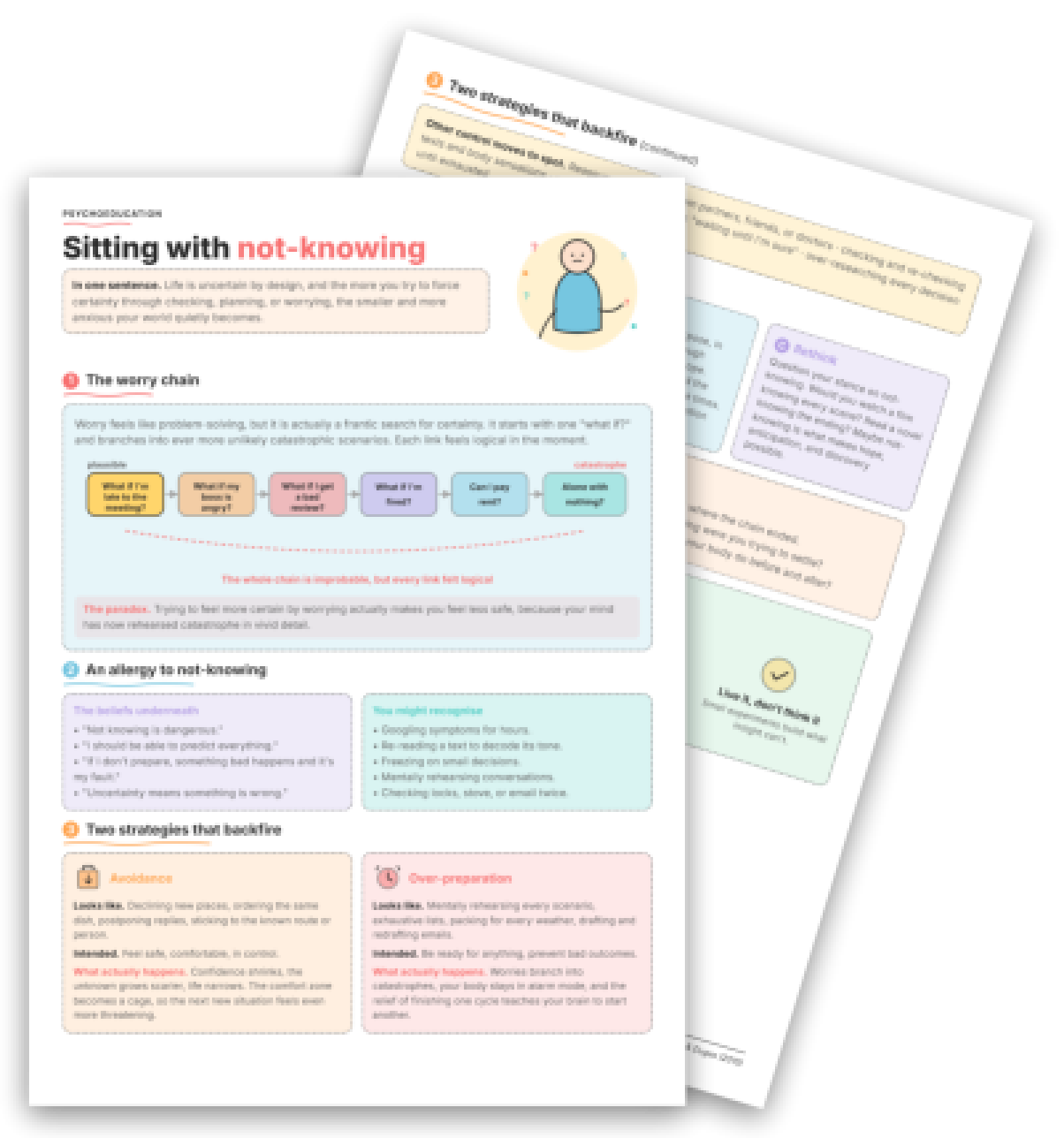
Clinical picture. A, a woman in her late thirties, presented with generalized anxiety and reported spending most evenings mentally rehearsing the following day at work, rarely sleeping before midnight. Using the informational sheet on intolerance of uncertainty, the clinician walked through the worry-chain diagram with her, tracing a single "what if I make a mistake in the report?" through six branching steps to an imagined scene of financial ruin and social isolation. A recognized the pattern immediately but noted, "each step felt completely reasonable at the time," which opened a productive discussion about how the chain functions as a search for certainty rather than genuine problem-solving. By the end of the session she could name the process when it started, which she described as "at least knowing what I'm doing, even if I can't stop it yet."
Intolerance of Uncertainty: PDF Worksheet, Tools and Exercises
A printable PDF fiche and clinical tools to explain intolerance of uncertainty in session, name its maintaining behaviors, and open the way toward graduated exposure.
Clinical vignettes
Worry Chain Mapped in Session
Avoidance Reframed as Narrowing
Clinical picture. M, a man in his mid-forties referred for low mood, disclosed during assessment that he had stopped attending team lunches, always ordered the same two dishes at restaurants, and had not taken a different route to work in over a year. The clinician introduced the concept of intolerance of uncertainty using the sheet's avoidance section, framing these behaviours not as preferences but as attempts to eliminate unpredictability. M was initially resistant, viewing his routines as practical efficiency; the diagram showing the comfort zone contracting over time gave him pause and he said, "I hadn't thought of it as getting smaller." No behavioural experiment was agreed upon in that session, though M asked to keep the sheet and return to it the following week, which the clinician noted as a meaningful shift in his engagement.
Patients who score high on intolerance of uncertainty (IU) often arrive in session with one thing in common: they can recite that uncertainty is unavoidable, yet they spend hours checking, planning, and seeking reassurance anyway. The gap between intellectual acknowledgment and behavioral change is wide, and oral explanation alone rarely closes it. This fiche PDF gives you a concrete visual support to bridge that gap directly in session.
Use this resource with your patients
Handout, exercises and materials ready to use, right inside SessionFuel.
Why Intolerance of Uncertainty Is Hard to Explain at the Verbal Level
In the model developed by Dugas and Robichaud, IU functions as a transdiagnostic vulnerability, not a symptom-specific trait. It maintains Generalized Anxiety Disorder, health anxiety, OCD checking rituals, and perfectionism simultaneously. That breadth is part of the clinical problem: patients don't see a single pattern, they see many unrelated habits.
The second difficulty is the central paradox. Worrying feels like problem-solving, so patients experience it as functional. Showing them that the same behavior that promises certainty actively produces more alarm, rehearsing catastrophe in vivid detail, requires more than a spoken metaphor. A visual chain makes the mechanism impossible to argue with.
Finally, patients rarely frame their behaviors in terms of uncertainty at all. The person who re-reads every email before sending, freezes on restaurant choices, or seeks reassurance repeatedly on the same worry doesn't describe themselves as intolerant of uncertainty. They describe themselves as careful, responsible, or "just anxious." Naming the underlying driver changes the therapeutic conversation entirely.
What the Fiche Contains: A Visual Map of the IU Cycle
The fiche is organized into four clearly sequenced panels that you work through with the patient rather than handing over for independent reading.
- The worry chain: a branching diagram that traces a single "what if?" through a cascade of increasingly unlikely catastrophes, ending at "Alone with nothing?". The chain makes visible, at a glance, what is almost impossible to convey orally: every link felt plausible in the moment, yet the whole chain is improbable.
- An allergy to not-knowing: the beliefs driving IU ("Not knowing is dangerous", "If I don't prepare, something bad happens and it's my fault"), alongside a recognition list (symptom-checking online for hours, decoding a text's tone, checking locks or email twice, freezing on small decisions).
- Two strategies that backfire: avoidance and over-preparation are mapped with their intended purpose alongside what actually happens, including the classic over-preparation loop where finishing one worry cycle teaches the brain to start another.
- Three stances that help: Accept, Approach, Rethink, each given a concrete behavioral translation rather than an abstract instruction, e.g., "Order something new. Send the email without re-reading five times."
At the bottom, a four-item Remember panel anchors the session: "The goal isn't zero uncertainty, it's bigger capacity." The "To discuss in session" prompts are embedded in the fiche itself, so they naturally become your debrief scaffold.
> Key takeaway: this fiche is a visual support that makes the IU maintenance cycle explicit in session; it is not an autonomous self-assessment. Its clinical value is in the conversation it structures, not the reading it replaces.
750+ clinical tools
A library built with and for clinicians, ready to use in session and extend between appointments.
Access all the toolsWhen and How to Introduce the Fiche
Timing. Introduce it once the formulation has identified IU as a maintaining factor, typically from the second or third session onward, after you have gathered enough behavioral data to anchor each panel in the patient's own examples. It works well as a bridge into graded exposure work or the 4-lesson psychoeducation program on IU.
Profiles. Most useful in GAD, health anxiety, and OCD with prominent checking. Also relevant for patients presenting with perfectionism who don't initially identify anxiety as a concern.
How to frame it. A simple opener that avoids labeling: "I'd like to show you a diagram that maps what's happening behind a lot of the patterns you've described. Tell me as we go through it whether it resonates." Let the worry chain diagram carry the psychoeducation; most patients recognize themselves in it before you finish the first panel.
Debrief. Use the embedded "To discuss in session" prompts directly: track when the patient catches themselves in a "what if?" chain that week, ask what feeling they were trying to settle when they sought reassurance more than once, and identify one small uncertainty to approach as a between-session experiment. The worry and attention capture exercise and the need-to-control worksheet pair naturally as follow-up homework.
One limit worth noting. In acute crisis or with marked dissociation, delay the fiche until the patient has enough window of tolerance to engage with the paradox. Presenting the "relief is a trap" panel to a patient in active distress can feel invalidating rather than clarifying.
The fiche does not replace the therapeutic frame. It makes a complex, counterintuitive mechanism visually concrete and leaves the patient with a reference they can return to between sessions.
Use it with your patients
Share this tool in the mobile app and follow the work between sessions.
Sources
- Robichaud, M., Koerner, N., & Dugas, M. J. (2019). Cognitive Behavioral Treatment for Generalized Anxiety Disorder: From Science to Practice (2nd ed.). Routledge.
- Robichaud, M., & Dugas, M. J. (2015). The Generalized Anxiety Disorder Workbook: A Comprehensive CBT Guide for Coping with Uncertainty, Worry, and Fear. New Harbinger Publications.
Your session continues in your patients' pocket
Use with a patientYour resources, available everywhere
The handouts, exercises, programs and audios above: you choose which ones to make available to your patients, in the mobile app dedicated to them.
And far more than a library
The app goes well beyond resources, to support your patients every day:
Related categories
Explore other clinical resources by category.
Anxiety
Clinical hub for anxiety disorders: CBT and ACT worksheets, psychoeducation sheets, and exercises for assessment and treatment across the anxiety spectrum.

Mood
Evidence-based worksheets and clinical tools for mood disorders: CBT, ACT, and positive psychology resources for psychologists and therapists.

Cognition
Printable cognitive therapy worksheets and clinical tools for therapists: CBT, ACT, schema work, defusion, distortions, and belief restructuring.

Understand
Clinical hub for the therapeutic aim 'Understand': worksheets and tools to build patient insight across CBT, ACT, schema therapy and more.

Build awareness
Clinical worksheets and tools to build awareness in therapy: cognitive distortions, schemas, emotions, ACT and CBT resources for practitioners.

ACT
Clinical hub for Acceptance and Commitment Therapy (ACT): worksheets, exercises, programs and audio resources for practitioners using the ACT model.