
Clinical picture. A, a man in his late thirties, presented with longstanding social anxiety and a well-established pattern of declining work invitations, which he described as a reasonable personal preference rather than a symptom. In session, the clinician introduced the Understanding My Anxiety informational sheet, walking through the smoke-detector metaphor and the intention-versus-effect table together. A recognised, with some surprise, that his refusals reliably brought short-term calm but had steadily narrowed his professional relationships over two years. He did not immediately commit to change, but he began using the sheet's three questions between sessions to notice the cycle in real time. By the following appointment, he reported one instance of attending a brief team lunch while acknowledging the anxiety rather than acting on it.
Understanding My Anxiety: PDF Worksheet, Tools and Exercises
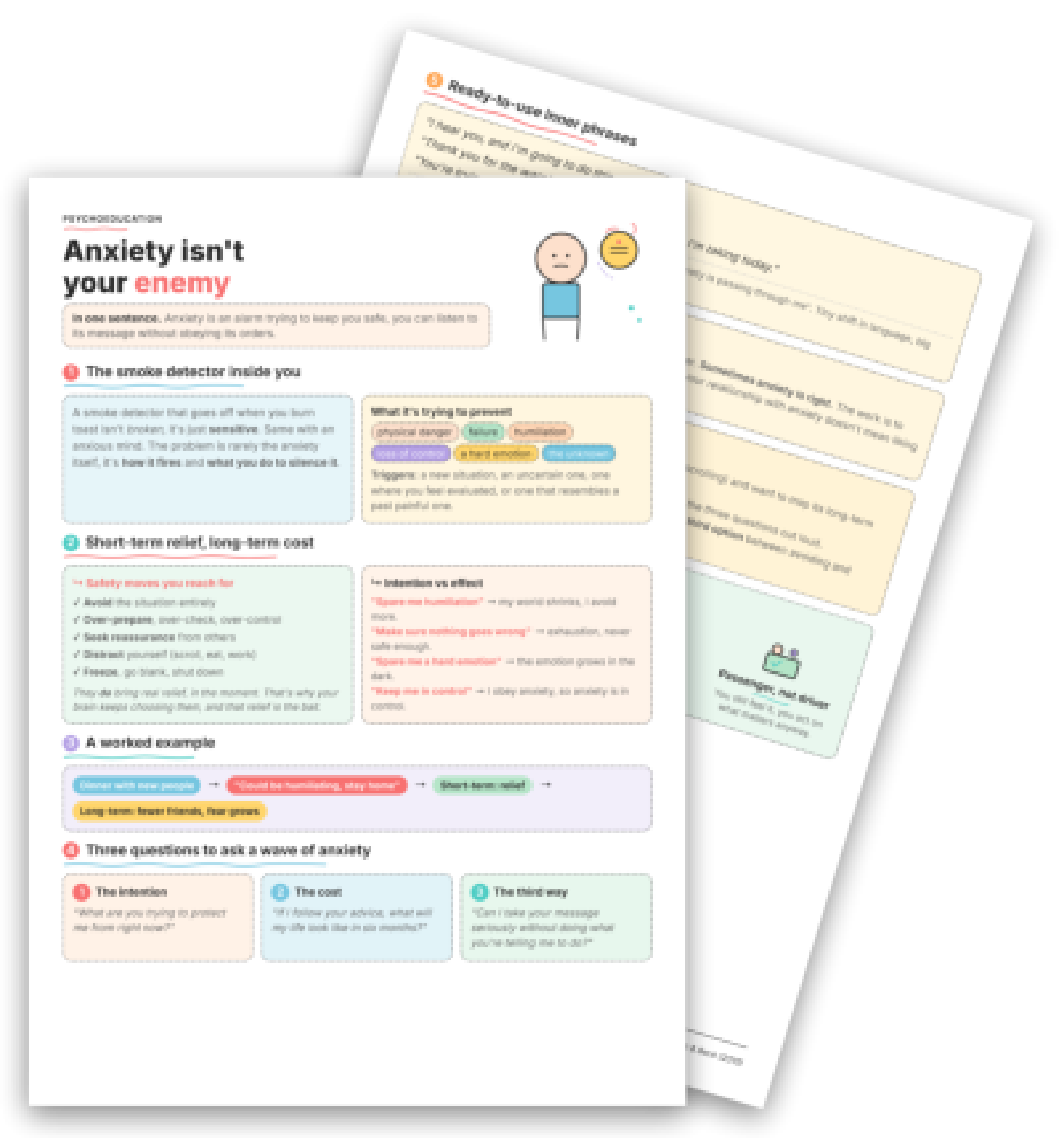
A psychoeducation fiche that makes the anxiety alarm-versus-avoidance loop visible in session, giving patients a concrete reference they can carry between appointments.
Clinical vignettes
Psychoeducation Shifts Avoidance Framing
Reassurance-Seeking Reframed Through the Worksheet
Clinical picture. M, a woman in her mid-twenties managing health-related anxiety, attended sessions partly to obtain repeated reassurance from the clinician that her physical sensations were benign. The clinician offered the Understanding My Anxiety sheet as shared reading material rather than as an assignment, focusing specifically on the section linking reassurance-seeking to the maintenance of the anxiety cycle. M found the framing non-blaming and said it helped her see the behaviour as understandable rather than a character flaw. She began experimenting with the ready-to-use phrases from the sheet, particularly 'Thank you for the warning. I've got it from here.' Requests for reassurance within sessions decreased over the following month, though they did not disappear entirely, which the clinician noted as a realistic and clinically meaningful shift.
Explaining the anxiety maintenance loop verbally often produces polite agreement without real traction: the patient grasps the concept intellectually, then goes home and avoids the situation anyway. This fiche PDF gives you a concrete visual support to make the alarm-versus-avoidance dynamic legible in session, not just audible.
Use this resource with your patients
Handout, exercises and materials ready to use, right inside SessionFuel.
Why anxiety resists explanation in session
The central clinical difficulty is not defining anxiety but disrupting the automatic equation "anxiety = danger = obey." Most patients present already convinced that their anxiety carries reliable information. Sketching the cycle of avoidance on a whiteboard rarely shifts that conviction on its own. The difficulty is partly perceptual: short-term relief from safety behaviors is viscerally real, while the long-term cost of a progressively narrower life remains abstract.
Patients who over-check, seek reassurance, or freeze rarely see their behavior as a maintenance strategy. They see it as reasonable self-protection. That conflation is exactly what makes psychoeducation difficult to deliver orally, and exactly what a well-structured visual layout can interrupt.
What the fiche contains: a visual tool for the alarm-versus-avoidance loop
Six structured panels build a cumulative clinical narrative. Panel 1 introduces the smoke detector metaphor: anxiety fires when it detects physical danger, failure, humiliation, loss of control, a hard emotion, or the unknown. That single reframe, "it's just sensitive," often reduces shame enough to open the rest of the conversation.
Panel 2 lists the safety moves patients reach for (avoiding entirely, over-preparing, seeking reassurance, distracting, freezing) and maps each to its stated intention and its actual long-term effect. The intention vs. effect layout does something oral explanation rarely achieves: it shows in one glance how the behavior meant to "spare me humiliation" produces "my world shrinks, I avoid more" instead. Patients with high reassurance-seeking profiles will recognize themselves immediately, making this a strong entry point before assigning the reassurance-seeking exercise.
Panel 3 walks through a worked example to anchor the mechanism in lived experience. Panel 4 presents three questions for working with an anxiety wave: "What are you trying to protect me from right now?", "If I follow your advice, what will my life look like in six months?", and "Can I take your message seriously without doing what you're telling me to do?" Clinicians working within ACT will recognize this as défusion cognitive made operationally concrete; it maps directly onto the Choice Point model and the defusion techniques framework. Panel 5 introduces the observer stance: shifting from "I am anxious" to "a wave of anxiety is passing through me," a formulation grounded in Hayes (2005) and Harris (2008).
A closing "To discuss in session" checklist orients the patient toward the next appointment rather than autonomous problem-solving, preserving the therapeutic frame.
> To remember: This fiche is a visual support that facilitates the explanation of the anxiety alarm-versus-avoidance dynamic in session. It is not a self-help handout to read at home; it is a psychoeducation tool the clinician uses actively, panel by panel, and leaves with the patient as a concrete anchor between sessions.
750+ clinical tools
A library built with and for clinicians, ready to use in session and extend between appointments.
Access all the toolsWhen and how to introduce it
The fiche fits naturally in the early psychoeducation phase, typically sessions 2 to 4, once the anamnèse has surfaced at least one recurring safety behavior. It is particularly useful with patients who intellectually accept the anxiety-avoidance link but continue obeying anxiety automatically, and with intolerance of uncertainty profiles where the mechanism is highly over-controlled.
Introduce it without labeling the patient: "I'd like to show you a diagram that maps something most people with anxiety never quite see clearly." Work through the panels together before handing the sheet over. Panel 2's intention-versus-effect layout is worth a deliberate pause: ask which safety move the patient recognizes first. The answer will guide the rest of the session and signal where graded exposure work or coping skills for anxiety should begin.
For patients who need a more structured autonomous follow-through, the fiche pairs well with the Anxiety Psychoeducation Program and the Anxiety Self-Assessment exercise. One clinical caveat: with patients in acute crisis or with very limited distress tolerance, hold off on the six-month cost framing in panel 2 until the alliance is secure enough to tolerate that confrontation without triggering dropout.
The fiche does not replace the therapeutic frame. It makes the explanation sharper, saves session time, and leaves the patient with a reference that keeps the conceptual work alive between appointments.
Use it with your patients
Share this tool in the mobile app and follow the work between sessions.
Sources
- Salkovskis, P. M. (1991). The Importance of Behaviour in the Maintenance of Anxiety and Panic: A Cognitive Account. Behavioural and Cognitive Psychotherapy.
- Clark, D. A., Beck, A. T. (2023). The Anxiety and Worry Workbook: The Cognitive Behavioral Solution (2nd ed.). Guilford Press.
- Hayes, S. C., Strosahl, K. D., Wilson, K. G. (2012). Acceptance and Commitment Therapy: The Process and Practice of Mindful Change (2nd ed.). Guilford Press.
- National Institute for Health and Care Excellence (NICE) (2011). Generalised Anxiety Disorder and Panic Disorder in Adults: Management (CG113).
Your session continues in your patients' pocket
Use with a patientYour resources, available everywhere
The handouts, exercises, programs and audios above: you choose which ones to make available to your patients, in the mobile app dedicated to them.
And far more than a library
The app goes well beyond resources, to support your patients every day:
Related categories
Explore other clinical resources by category.
Anxiety
Clinical hub for anxiety disorders: CBT and ACT worksheets, psychoeducation sheets, and exercises for assessment and treatment across the anxiety spectrum.

Emotions
Clinical resources on emotion regulation: worksheets, coping tools, CBT, REBT, and ACT exercises for therapists working across diagnoses and age groups.

Understand
Clinical hub for the therapeutic aim 'Understand': worksheets and tools to build patient insight across CBT, ACT, schema therapy and more.

Build awareness
Clinical worksheets and tools to build awareness in therapy: cognitive distortions, schemas, emotions, ACT and CBT resources for practitioners.

Restructure
Clinical hub for cognitive restructuring worksheets: distortion identification, belief disputation, ABC model, and schema work for evidence-based practice.

ACT
Clinical hub for Acceptance and Commitment Therapy (ACT): worksheets, exercises, programs and audio resources for practitioners using the ACT model.