
Clinical picture. M., a 34-year-old marketing analyst, presents with longstanding social anxiety and a pattern of declining work events, attributed each time to plausible logistical reasons. During the third session, the clinician introduces the cycle of avoidance worksheet and walks through the four stages using M.'s most recent cancellation as a worked example: the anticipatory dread on Sunday evening, the decision to decline on Monday morning, the immediate drop in tension, and the subsequent tightening of avoidance across the following weeks. M. recognises, with some discomfort, that the relief he experienced had felt indistinguishable from problem-solving. The clinician notes this as a useful entry point for discussing the maintenance function of avoidance before any behavioural work is introduced.
The Cycle of Avoidance: PDF Worksheet, Tools and Exercises for Clinical Practice
A visual psychoeducation tool clinicians can use in session to make the avoidance loop legible, name safety behaviours, and prepare patients for graded approach work.
Clinical vignettes
Avoidance Maintaining Social Anxiety
Safety Behaviours Obscuring the Loop
Clinical picture. A., a 28-year-old postgraduate student, seeks help for what she describes as a fear of medical emergencies, reporting that she googles symptoms daily and carries anxiolytics she rarely takes but cannot leave home without. The clinician uses the informational sheet on the cycle of avoidance to map A.'s reassurance-seeking and medication-carrying as subtle avoidance, helping her see that these behaviours produce short-term relief while preventing disconfirmation of her feared outcomes. A. is initially reluctant to classify the medication-carrying as avoidance, given that it was originally prescribed, and the clinician acknowledges this complexity without pressing. Naming the loop does not resolve the ambivalence, but it gives the dyad shared language for the work ahead.
Most patients arrive already knowing they avoid things. What they cannot see, and what is genuinely difficult to convey in words alone, is the reinforcement architecture: why each avoidance episode makes the next one more likely, and why relief is the mechanism that drives the loop, not the escape from it. This PDF worksheet provides a ready-made visual scaffold for exactly that explanation, so session time goes toward mapping the patient's own cycle rather than constructing the model from scratch.
Use this resource with your patients
Handout, exercises and materials ready to use, right inside SessionFuel.
Why the Avoidance Cycle Resists Verbal Explanation
The core problem is counterintuitive. Relief is neurobiologically correct: the amygdala signal drops, the body settles, the patient feels better. Telling someone that this good feeling is the problem, without showing them the maintenance loop, tends to land as a paradox they accept politely without internalizing.
Safety behaviours create a second layer of difficulty. Patients readily identify obvious avoidance: cancelling, leaving early, postponing indefinitely. They rarely spot the subtler variants without support: reassurance-seeking, over-preparation, drinking before a social event, keeping a phone in hand. The clinical boundary between a coping response and a maintaining behaviour stays blurry in conversation. On paper, the two sit side by side and the distinction becomes workable.
A visual also short-circuits the common derailment where patients argue whether their avoidance "really counts." Once the four-stage loop is visible on the page, the session moves from debating the label to locating the patient's specific pattern, which is where the formulation actually advances.
What the Fiche Contains: Five Panels for In-Session Use
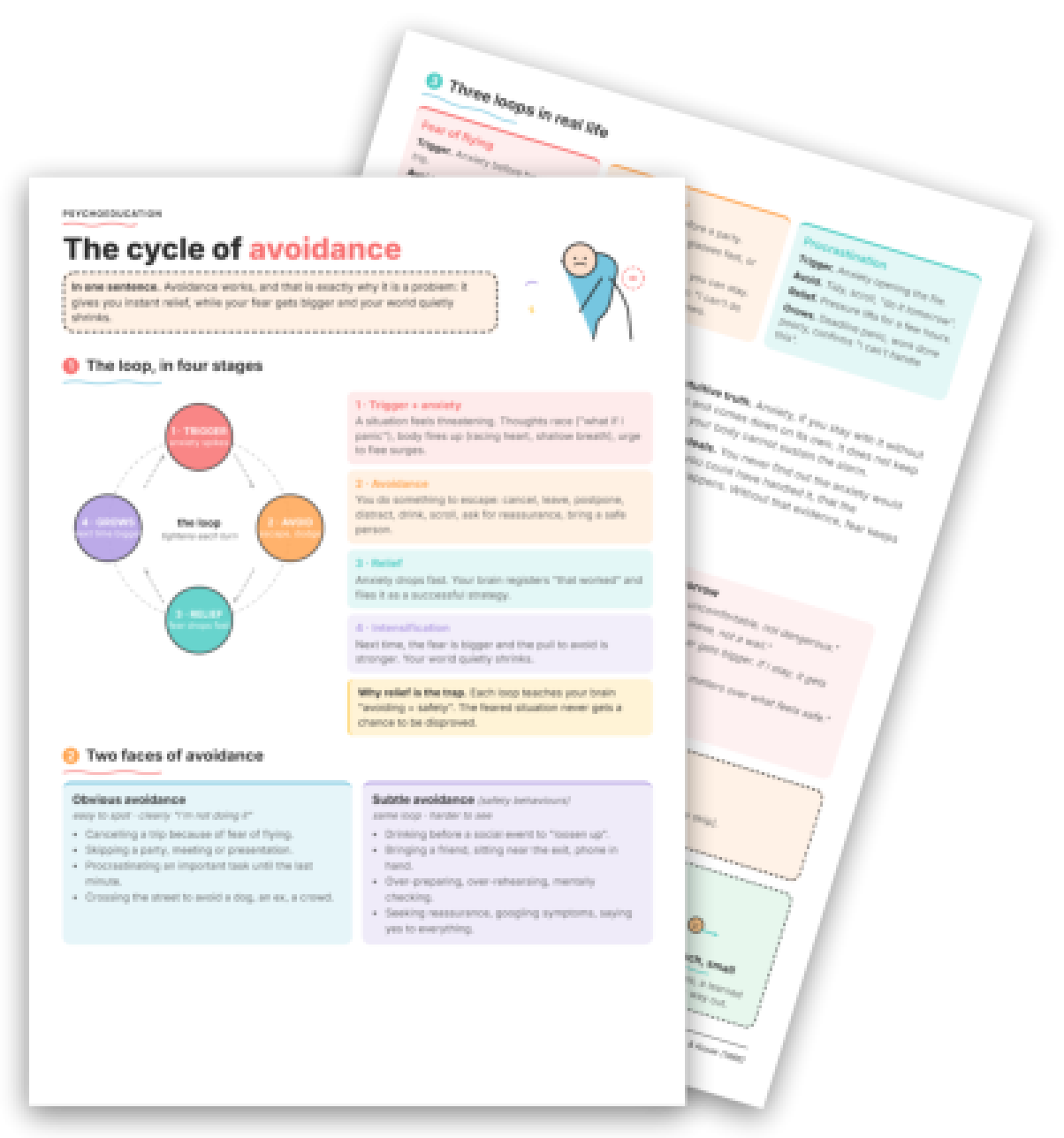
The fiche opens with a framing sentence that does the conceptual work immediately: "Avoidance works, and that is exactly why it is a problem: it gives you instant relief, while your fear gets bigger and your world quietly shrinks." No paraphrase needed; you can read it aloud together and observe the patient's reaction.
Panel 1 presents the four-stage loop: Trigger (anxiety spikes) → Avoid (escape, dodge) → Relief (fear drops fast) → Grows (next time, bigger). The layout shows the loop tightening with each turn, making the escalation legible at a glance in a way that a verbal description rarely achieves.
Panel 2 separates obvious avoidance from subtle avoidance in two columns, each with concrete examples. This is the panel most useful for patients who insist they are not avoiding, because the list of avoidance patterns makes safety behaviours visible rather than abstract.
Panel 3 traces the loop through three real-life scenarios: fear of flying, social anxiety, and procrastination. Patients self-locate without being labelled directly.
Panel 4 introduces the anxiety wave diagram, showing that anxiety peaks and then comes down on its own if the patient stays with it. "Your body cannot sustain the alarm" is the fiche's exact formulation. Clinically, this single image does significant work in panic presentations and in generalized anxiety, where catastrophic misappraisal of physical sensations maintains the loop.
Panel 5 closes with a small action section: naming the top three avoidance behaviours including subtle ones, picking one lower-stakes situation to approach, and a set of phrases the patient can use between sessions ("My anxiety is a wave, not a wall"). A "To discuss in session" box points explicitly toward the next appointment.
> To remember: This fiche is a visual support that facilitates the explanation of the avoidance cycle in session. It is not a form the patient completes alone. You walk through it together and leave it with them as a concrete reference point.
750+ clinical tools
A library built with and for clinicians, ready to use in session and extend between appointments.
Access all the toolsWhen and How to Introduce It
The fiche fits the case formulation stage, once the alliance is established and the maintenance processes are identifiable, typically the second or third session for most anxiety presentations. For patients presenting with depressive avoidance, it works as a bridge toward behavioural activation.
A useful introduction: "I'd like to show you a diagram that maps something we see very frequently. Let's look at it together and you can tell me how much of this fits your experience." That framing positions the fiche as collaborative hypothesis-testing rather than a diagnosis handed down.
Walk through the loop, then use the two-column panel to invite patients to name their own safety behaviours. Introduce the wave diagram before any discussion of graded exposure. The fiche pairs naturally with an exposure hierarchy, which becomes the logical next step once the patient understands why approach is the only route that actually shrinks the loop. For patients with very low distress tolerance, consider pairing it first with confronting avoidance work and anxiety coping skills before moving toward graded approach.
The fiche does not replace your formulation. It gives the explanation traction, leaves a reference in the patient's hands, and closes the gap between understanding the loop and being willing to step out of it.
Use it with your patients
Share this tool in the mobile app and follow the work between sessions.
Sources
- Salkovskis, P. M. (1991). The Importance of Behaviour in the Maintenance of Anxiety and Panic: A Cognitive Account. Behavioural and Cognitive Psychotherapy.
- Barlow, D. H. (2002). Anxiety and Its Disorders: The Nature and Treatment of Anxiety and Panic (2nd ed.). Guilford Press.
Your session continues in your patients' pocket
Use with a patientYour resources, available everywhere
The handouts, exercises, programs and audios above: you choose which ones to make available to your patients, in the mobile app dedicated to them.
And far more than a library
The app goes well beyond resources, to support your patients every day:
Related categories
Explore other clinical resources by category.

Anxiety
Clinical hub for anxiety disorders: CBT and ACT worksheets, psychoeducation sheets, and exercises for assessment and treatment across the anxiety spectrum.

Behaviours
Clinical hub for behaviors in therapy: worksheets and tools for coping, eating disorders, CBT formulation, and maladaptive behavioral patterns.

Cognition
Printable cognitive therapy worksheets and clinical tools for therapists: CBT, ACT, schema work, defusion, distortions, and belief restructuring.

Understand
Clinical hub for the therapeutic aim 'Understand': worksheets and tools to build patient insight across CBT, ACT, schema therapy and more.

Build awareness
Clinical worksheets and tools to build awareness in therapy: cognitive distortions, schemas, emotions, ACT and CBT resources for practitioners.

ACT
Clinical hub for Acceptance and Commitment Therapy (ACT): worksheets, exercises, programs and audio resources for practitioners using the ACT model.