
Clinical picture. R., a woman in her mid-thirties, presents with longstanding social anxiety centred on eating in public and attending work meetings. She reports that her avoidance has expanded steadily over two years, and she now declines most social invitations. In session, the clinician introduces the exposure hierarchy worksheet, asking R. to list situations she avoids and rate each on a 0-to-100 distress scale before sorting them into a ladder. R. identifies subtle safety behaviours she had not previously labelled as avoidance, including texting a friend throughout lunch and always sitting near the exit in meetings. She agrees to begin with a step rated around 45, sitting alone at a café table for fifteen minutes without her phone, and repeats this four times across the following week with modest but noticeable reduction in anticipatory distress.
Building an Exposure Hierarchy: PDF Worksheet, Tools and Exercises
A printable PDF worksheet with concrete tools and exercises to help clinicians explain graded exposure clearly in session, build a personalized fear ladder, and guide patients step by step.
Clinical vignettes
Mapping Avoidance in Social Anxiety
Structuring Steps in Health Anxiety
Clinical picture. T., a man in his late forties, meets criteria for health anxiety and has stopped exercising after interpreting normal cardiac sensations as dangerous. His GP has confirmed no cardiac pathology. The clinician uses the exposure hierarchy framework to help T. distinguish genuinely unsafe acts from situations that are merely uncomfortable, noting that interoceptive triggers can be graded like external ones. Together they draft a ten-step ladder ranging from brisk walking for five minutes at home (rated 42) to a thirty-minute jog in the park without carrying his phone (rated 78). T. initially requests that his wife accompany him on early steps; the clinician names this as a safety behaviour and they agree to begin unaccompanied from the outset, which T. finds harder than anticipated but manageable after the third repetition.
Most patients grasp the principle of graded exposure quickly enough in session, then arrive the following week having avoided everything, unsure how to build a single concrete step. This fiche PDF gives you a structured visual support to close that gap: a printable you can work through together in session, so the patient leaves holding a real, personalised ladder rather than a vague instruction.
Use this resource with your patients
Handout, exercises and materials ready to use, right inside SessionFuel.
Why the Exposure Hierarchy Resists Verbal Explanation
The conceptual logic of exposure is simple to state and surprisingly hard to operationalise. Two problems recur. First, patients conflate distress rating with danger rating: they either place every feared situation at 80+ (no gradient) or underrate to appear cooperative. Second, safety behaviours are invisible to them until named: the patient who technically enters the shop but grips their phone, checks exits, and rushes through has done the exposure on paper and maintained the fear in practice.
A verbal explanation of the avoidance loop rarely sticks. The trigger → spike → avoid → relief → fear grows sequence makes immediate clinical sense to you; for the patient, it tends to blur into a general acknowledgement that avoidance is bad. When the cycle is laid out visually, with each node labelled and the trap made explicit, you can point and say "show me where you are right now". The conversation shifts from abstract to concrete in a way that oral psychoeducation alone rarely achieves. Patients working with social anxiety or panic disorder are particularly prone to skipping this grounding step and jumping straight to catastrophic predictions about the top rungs.
What the Fiche Contains: A Visual Support for In-Session Work
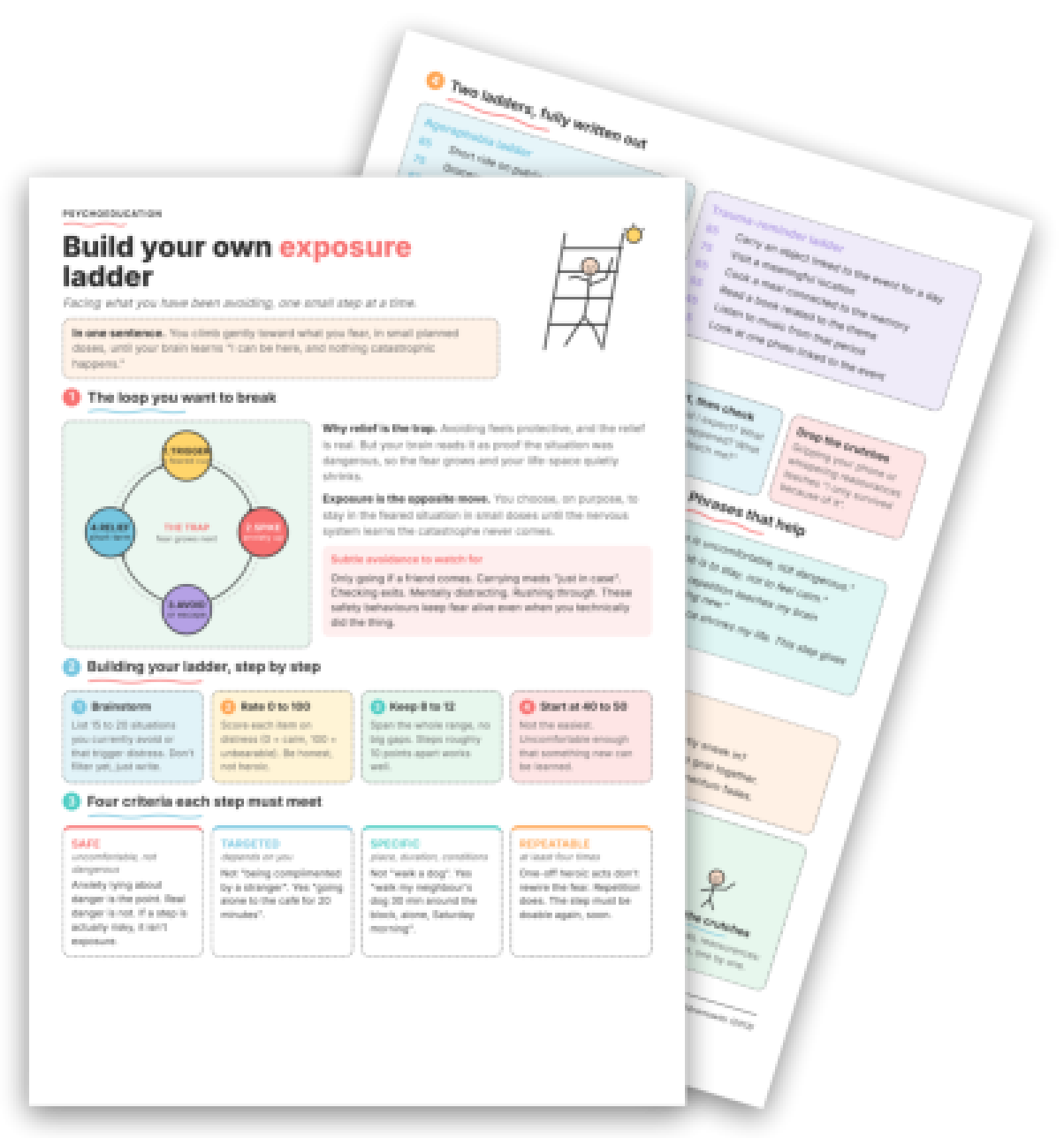
The fiche PDF opens with the avoidance loop rendered as a four-node diagram (trigger, anxiety spike, avoidance or escape, short-term relief), captioned "The trap: fear grows next." This single visual is worth several minutes of explanation, because it externalises the maintenance cycle and makes the logic of exposure self-evident.
The ladder-building section walks through four numbered steps: brainstorm 15 to 20 situations without filtering, rate each on a 0-to-100 distress scale, trim to 8 to 12 items spanning the full range, and start at "40 to 50, not the easiest." That last instruction, printed on the sheet, often pre-empts the common error of starting at the bottom rung and habituating to nothing.
Four quality criteria are laid out for each step: safe (uncomfortable, not dangerous), targeted (depends on the patient, not on a companion), specific (place, duration, conditions), and repeatable (at least four times). Seeing these side by side makes it easy to audit a proposed step together and spot what is missing before the patient tries it alone. Two fully written sample ladders, one for agoraphobia and one for trauma reminders, anchor the abstract criteria in concrete examples patients can compare their own ideas against.
The sheet closes with in-session and between-session guidance: "Rate before, peak, after", "Success = stayed", "Drop the crutches", and a set of phrases ("My job is to stay, not to feel calm") designed to replace reassurance-seeking with corrective self-talk. There is also a "To discuss in session" checklist the patient can bring back, structuring the debrief for you.
> To retain: this fiche is a visual support that facilitates the explanation of the exposure hierarchy in session; it is not a homework questionnaire the patient completes alone, but a shared working document you build together and the patient keeps as a concrete reference.
750+ clinical tools
A library built with and for clinicians, ready to use in session and extend between appointments.
Access all the toolsWhen and How to Introduce the Fiche
The fiche fits naturally in the second or third session, once the functional analysis is done and avoidance patterns have been named but before the patient has attempted any exposure. For patients already engaged in a structured exposure program, it can be introduced mid-treatment to reset a hierarchy that has stalled.
A low-threshold introduction: "I'd like to work through something with you today that maps out exactly which situations we'll target and in what order. We'll build it together." This framing positions the fiche as collaborative, not prescriptive, which matters for patients with control-driven anxiety who resist feeling managed.
Debrief the ladder at the next session using the "predict, then check" prompt on the sheet: what did the patient expect, what actually happened, and what does that teach them. Pair it with the Graded Exposure Self-Report exercise to track anxiety ratings across repetitions. For patients who minimise avoidance, the Adaptive vs. Maladaptive Coping worksheet can prepare the ground before the ladder is built.
One contraindication worth flagging: for patients with active dissociation or insufficient emotional regulation skills, the fiche should follow, not precede, stabilisation work. In those cases, pair it with the Fear Psychoeducation Program or an anticipatory fear decatastrophizing exercise to ensure the groundwork is solid before climbing the first rung.
The fiche does not replace clinical formulation or the therapeutic relationship; it makes the exposure rationale visible, portable, and revisable, which is precisely what most patients need to move from understanding the model to actually using it.
Use it with your patients
Share this tool in the mobile app and follow the work between sessions.
Sources
- Barlow, D. H., & Craske, M. G. (2007). Mastery of Your Anxiety and Panic: Therapist Guide (4th ed.). Oxford University Press.
- Craske, M. G., Antony, M. M., & Barlow, D. H. (2006). Mastering Your Fears and Phobias: Therapist Guide (2nd ed.). Oxford University Press.
- Springer, K. S., & Tolin, D. F. (2020). The Big Book of Exposures: Innovative, Creative, and Effective CBT-Based Exposures for Treating Anxiety-Related Disorders. New Harbinger Publications.
Your session continues in your patients' pocket
Use with a patientYour resources, available everywhere
The handouts, exercises, programs and audios above: you choose which ones to make available to your patients, in the mobile app dedicated to them.
And far more than a library
The app goes well beyond resources, to support your patients every day:
Related categories
Explore other clinical resources by category.

Anxiety
Clinical hub for anxiety disorders: CBT and ACT worksheets, psychoeducation sheets, and exercises for assessment and treatment across the anxiety spectrum.

Trauma
Clinical hub on trauma and PTSD: assessment, differential diagnosis, treatment phases, and printable resources for practitioners. 155 chars.

Understand
Clinical hub for the therapeutic aim 'Understand': worksheets and tools to build patient insight across CBT, ACT, schema therapy and more.

Exposure
Exposure therapy clinical resources for practitioners: worksheets, hierarchies, and psychoeducation tools for anxiety, PTSD, OCD, and avoidance-based presentations.

CBT
CBT worksheets, cognitive restructuring exercises & behavioral tools for clinicians. Evidence-based resources for every phase of cognitive behavioral therapy.

Mood
Evidence-based worksheets and clinical tools for mood disorders: CBT, ACT, and positive psychology resources for psychologists and therapists.