
Clinical picture. A, a man in his early 50s, presented with persistent health anxiety centred on breathlessness following a brief hospitalisation for pneumonia two years prior. He had stopped using stairs, carried a rescue inhaler he did not medically require, and left any warm or crowded space at the first sign of chest tightness. After psychoeducation on the fear loop, the clinician introduced interoceptive exposure using a thin straw: A breathed exclusively through it for 90 seconds during session, rating his distress every 30 seconds. He reported peak anxiety of 7/10 at 45 seconds, which dropped to 3/10 by the end without any safety behaviour. He agreed to repeat the exercise twice daily at home, and by the following session described the sensation as "boring rather than scary," with a spontaneous reduction in stair avoidance.
Fear of Breathlessness: PDF Worksheet, Tools and Exercises for Clinical Practice
A visual PDF worksheet with structured exercises and tools to help clinicians explain interoceptive exposure for fear of breathlessness clearly and efficiently in session.
Clinical vignettes
Straw Breathing Breaks the Avoidance Loop
Imaginal Script Reduces Anticipatory Distress
Clinical picture. M, a woman in her late 30s with panic disorder and prominent fear of suffocation, avoided aerobic exercise and cancelled a planned holiday because the flight felt too confined. She met criteria for no respiratory illness on medical review. The clinician guided her to write a detailed first-person script of her most feared breathless episode, describing the sensation, the catastrophic thoughts, and the imagined outcome in full. She read the script aloud in session on three consecutive exposures, each lasting four minutes, while the clinician prompted her to stay with the imagery rather than shift attention away. Her subjective distress across the three readings fell from 8/10 to 4/10 within the single session; she subsequently completed a brisk 15-minute walk without stopping, which she had not done in over a year.
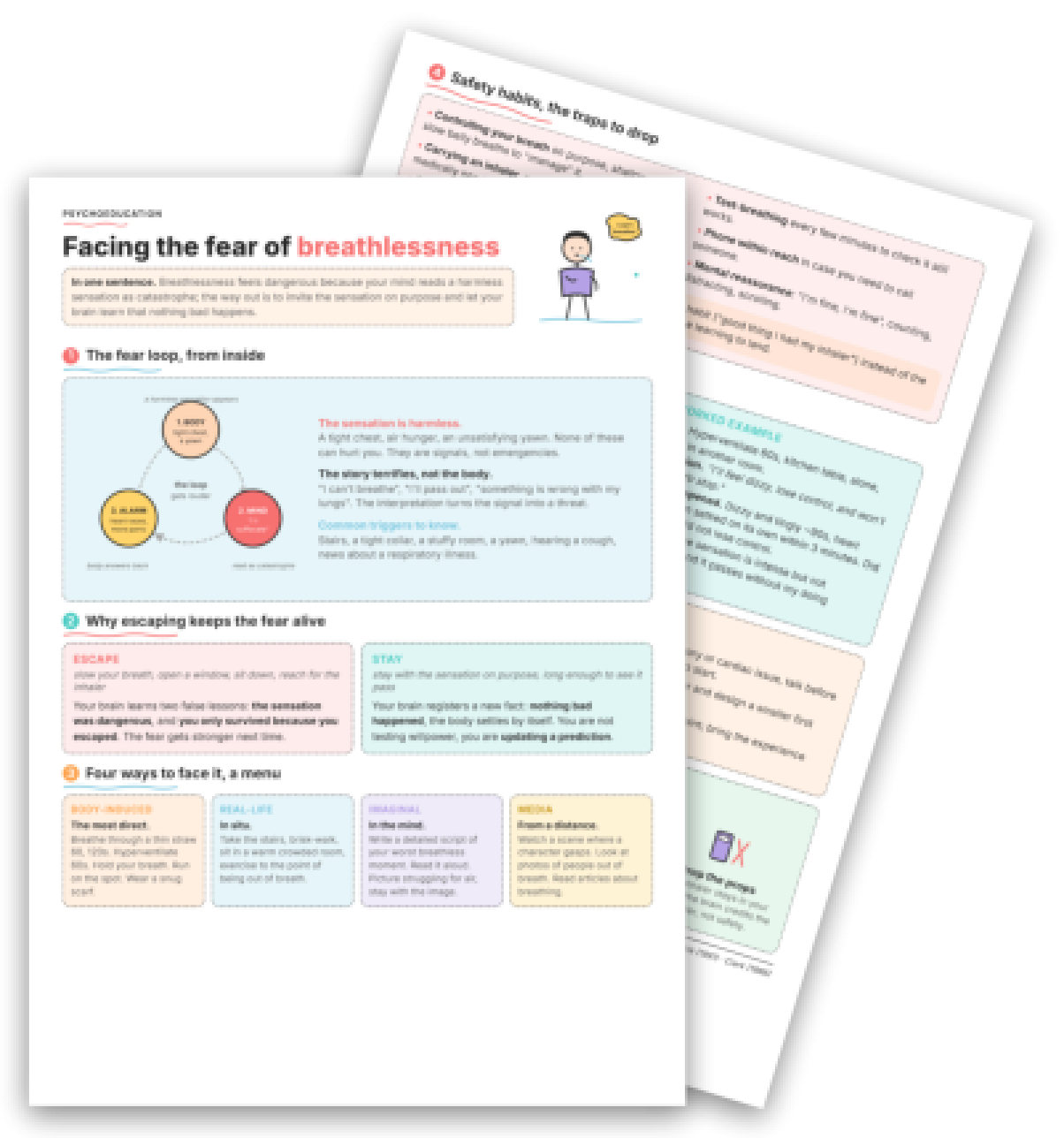
Explaining interoceptive exposure to a patient who catastrophically misinterprets breathlessness is one of those moments where a purely verbal account tends to fall flat: the patient understands the logic abstractly, then goes home and avoids anyway. This fiche PDF gives you a visual scaffold to make the mechanism clear in the room, agree on a concrete plan, and leave the patient with something to consult between sessions.
Use this resource with your patients
Handout, exercises and materials ready to use, right inside SessionFuel.
Why Fear of Breathlessness Resists Verbal Explanation
The core difficulty is not ignorance on the patient's part. It is the felt certainty that the sensation signals danger, which no amount of reassurance recalibrates. Clark's cognitive model of panic (Salkovskis, 1991; Clark, 1986) describes exactly this: a benign interoceptive cue, a catastrophic appraisal, an autonomic surge that confirms the appraisal, and a tightening loop. Patients who meet criteria for panic disorder or who present with prominent fear of body sensations are especially entrenched in this loop because escape works in the short term, the sensation subsides, the patient attributes survival to the escape, and the fear consolidates.
When you explain this at the whiteboard, patients nod. The piece they consistently miss is why dropping the escape (and the safety behavior) is what produces the updating of the threat prediction, not just the passage of time. They also underestimate how many of their habitual responses count as safety behaviors. A visual support that lays all of this out at once changes the conversation.
What the Fiche Contains: A Visual Tool for In-Session Psychoeducation
The fiche PDF is organized into five numbered panels, designed to be read with the patient, not filled in alone.
- Panel 1: "The fear loop, from inside" renders the three-stage cycle (body signal, catastrophic appraisal, alarm response) as a closed-loop diagram, making immediately visible what a verbal account leaves implicit: "the loop gets louder" with each pass.
- Panel 2: "Why escaping keeps the fear alive" places Escape and Stay side by side, with the false lessons the brain draws from each path. This is the conceptual hinge of the whole worksheet and deserves slow reading together.
- Panel 3: "Four ways to face it, a menu" distinguishes body-induced tasks (breathing through a thin straw, hyperventilation, breath-holding), real-life situations, imaginal scripts, and media exposure. Having the four exposure modalities mapped visually lets you and the patient quickly locate a workable entry point.
- Panel 4: "Safety habits, the traps to drop" lists the specific props most commonly preserved (inhaler carried "just in case," test-breathing, mental reassurance). Many patients have never framed these behaviors as obstacles; seeing them enumerated shifts the frame efficiently.
- Panel 5: "Build your ladder, write the prediction" walks through the five-step hierarchy construction and includes a fully worked example, "Hyperventilate 60s, kitchen table, alone, phone in another room. Prediction: I'll feel dizzy, lose control, and won't be able to stop. What happened: dizzy and tingly ~90s, then settled on its own within 3 minutes." That gap between feared outcome and actual outcome is, as the fiche names it, "the learning", which you can then debrief directly against the patient's own predictions.
> Key point: the fiche is a visual support that facilitates in-session explanation; it is not a self-directed questionnaire. Use it to walk through the mechanism in real time, annotate it together if helpful, and hand it to the patient as a concrete reference between appointments.
750+ clinical tools
A library built with and for clinicians, ready to use in session and extend between appointments.
Access all the toolsWhen and How to Introduce the Fiche
The worksheet fits naturally after an initial anamnesis has confirmed that avoidance of breathlessness sensations is a maintaining process, whether the presentation is panic disorder, health anxiety, or a residual post-COVID or post-respiratory illness fear. It pairs well with Clark's cognitive model of panic if you have already introduced that framework, and complements a graded exposure hierarchy the patient is building in parallel.
You can introduce it simply: "I want to show you a diagram that maps exactly what keeps this fear running, and then we'll use it to plan the first step you'll try this week." That framing positions it as a shared clinical tool, not a homework assignment. For patients presenting with comorbid fear of losing control or fear of appearing anxious, panels 3 and 4 can be cross-referenced to other exposure worksheets in the same session.
One clinical limit to name explicitly: the "To discuss in session" section of the fiche flags that symptom-induction tasks require screening first in patients with asthma, cardiac conditions, or pregnancy. For those profiles, the imaginal and graded real-life columns of panel 3 are safer starting points, and the graded exposure self-report can structure between-session tracking. For patients who have worked through avoidance patterns before, the prediction-writing step in panel 5 often lands quickly because they already have a working model of how exposure produces change.
The fiche does not replace the formulation or the alliance; it makes the rationale for interoceptive exposure concrete enough that the patient leaves the session able to explain it back to themselves.
Use it with your patients
Share this tool in the mobile app and follow the work between sessions.
Sources
- Livermore, N., Sharpe, L., McKenzie, D. (2014). A review of cognitive behavioral therapy for panic disorder in patients with chronic obstructive pulmonary disease: the rationale for interoceptive exposure. Journal of Clinical Psychology in Medical Settings, 22(1), 70-83.
Your session continues in your patients' pocket
Use with a patientYour resources, available everywhere
The handouts, exercises, programs and audios above: you choose which ones to make available to your patients, in the mobile app dedicated to them.
And far more than a library
The app goes well beyond resources, to support your patients every day:
Related categories
Explore other clinical resources by category.
Anxiety
Clinical hub for anxiety disorders: CBT and ACT worksheets, psychoeducation sheets, and exercises for assessment and treatment across the anxiety spectrum.

Health
Somatic health clinical resources for practitioners: worksheets, psychoeducation, and exercises for somatic symptom disorder, chronic pain, and more.

Understand
Clinical hub for the therapeutic aim 'Understand': worksheets and tools to build patient insight across CBT, ACT, schema therapy and more.

Exposure
Exposure therapy clinical resources for practitioners: worksheets, hierarchies, and psychoeducation tools for anxiety, PTSD, OCD, and avoidance-based presentations.

CBT
CBT worksheets, cognitive restructuring exercises & behavioral tools for clinicians. Evidence-based resources for every phase of cognitive behavioral therapy.

Trauma
Clinical hub on trauma and PTSD: assessment, differential diagnosis, treatment phases, and printable resources for practitioners. 155 chars.