
Clinical picture. M., a woman in her late twenties, presented with recurrent derealization episodes and a persistent conviction that if the feelings of unreality lasted long enough, she would "never come back to herself." She had been avoiding mirrors, dimly lit rooms, and any situation that might trigger the familiar spaced-out sensation. The clinician introduced the rationale for interoceptive exposure, framing the sensations as uncomfortable rather than dangerous, and they agreed to begin with one minute of mirror staring in session. M. reported a moderate rise in discomfort and the expected feeling of unreality, yet the predicted catastrophe did not materialise before the minute ended. Over three further sessions she progressed to sitting alone in a darkened room, and her avoidance behaviour outside sessions reduced noticeably.
Fear of Losing Control of the Mind: PDF Worksheet, Tools and Exercises
A structured visual worksheet clinicians can use in session to explain interoceptive exposure, build a graded ladder, and dismantle the avoidance loop sustaining this hard-to-treat fear.
Clinical vignettes
Mirror Staring for Derealization Fear
Spinning Exercise to Test Snapping Beliefs
Clinical picture. T., a man in his mid-thirties with health anxiety and obsessive features, described a specific fear that dizziness would cause him to "snap" and lose his mind permanently; he had stopped drinking coffee and avoided any physical activity that raised his heart rate. After psychoeducation on the avoidance loop, the clinician proposed a brief in-session spinning trial, starting at thirty seconds with eyes closed, explicitly eliciting T.'s prediction beforehand: "I will lose control of my thoughts and not recover." T. completed the exercise, noted dizziness and mild cognitive fog, then observed that both resolved within two minutes of sitting still. He recorded this outcome on his monitoring sheet, and the gap between predicted and actual consequences became a concrete reference point for subsequent sessions.
In CBT for panic disorder, health anxiety, and OCD, one presentation consistently resists verbal psychoeducation: the fear of losing control of the mind. Dissociative sensations, cognitive fog, and derealization are difficult to normalize with words alone, and every attempt at reassurance risks reinforcing the very safety-seeking the therapy is trying to dismantle. This PDF worksheet gives you a structured visual framework to shift that dynamic, in session, side by side with the patient.
Use this resource with your patients
Handout, exercises and materials ready to use, right inside SessionFuel.
Why This Fear Is So Hard to Address Verbally
The core problem is epistemic. The patient's belief that a foggy or unreal sensation signals imminent mental collapse is, from inside the experience, unfalsifiable. "You won't go crazy from feeling dizzy" lands as reassurance, not evidence. The prediction stays intact.
A second layer complicates the work. The avoidance loop here is fast and automatic: sensation arises, the catastrophic prediction fires, escape follows, brief relief cements the interpretation. Safety behaviors are unusually covert in this presentation: a hand on a chair, a silent reassurance loop, a grounding technique deployed during rather than after the induction. Patients rarely identify these without a concrete visual prompt.
The exposure rationale is also harder to convey verbally. Most patients arrive expecting to reduce or manage the sensation. The idea of deliberately inducing it requires a frame shift that a well-designed diagram achieves faster than three paragraphs of explanation.
What the Worksheet Contains: a Visual Guide Through Interoceptive Exposure
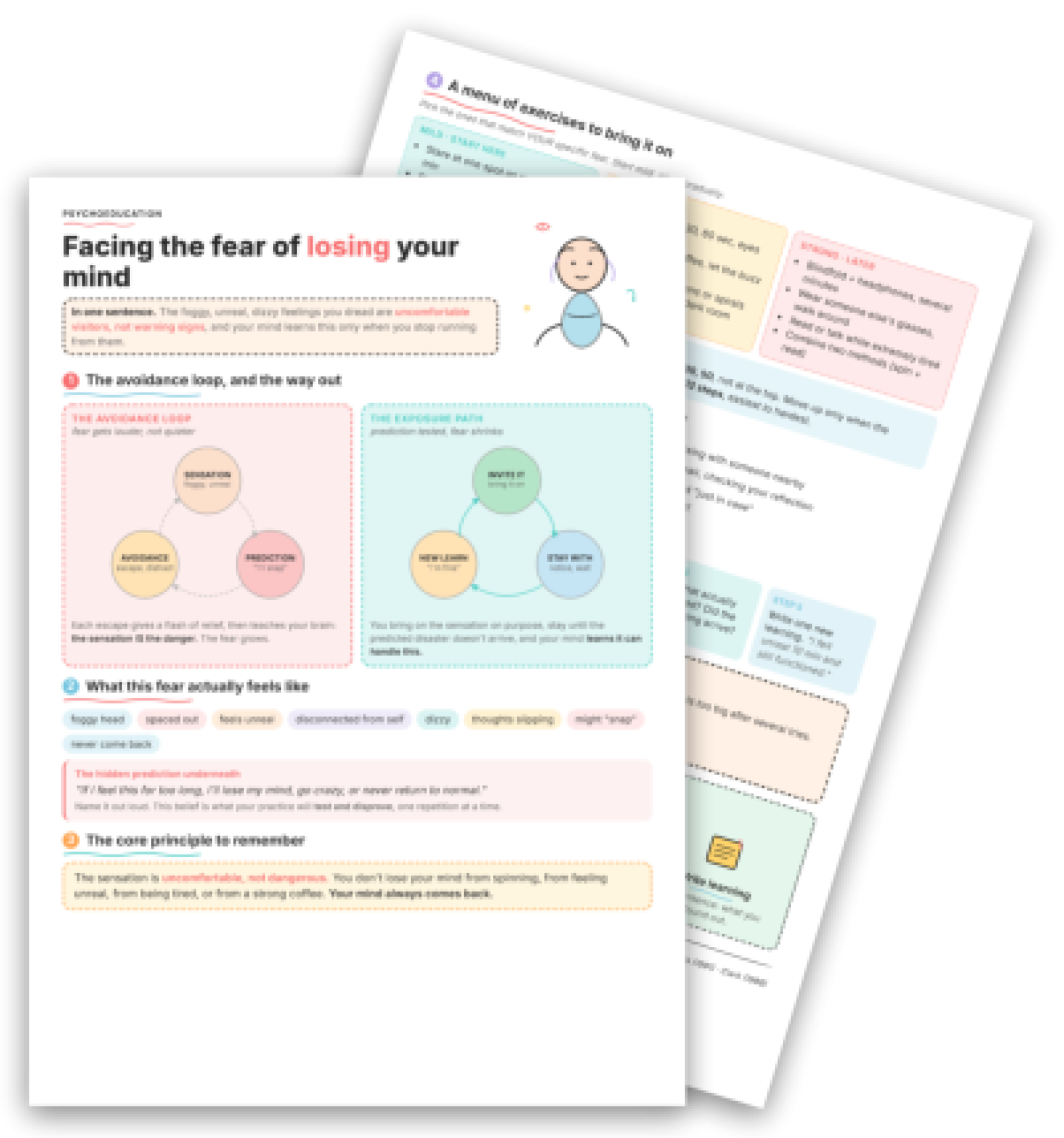
The fiche opens with two parallel flow diagrams placed side by side: the avoidance loop and the exposure path. The first traces the maintaining cycle, "foggy, unreal → 'I'll snap' → escape → fear gets louder, not quieter." The second shows the corrective sequence: invite the sensation, stay with it, write a new learning. Seeing both on paper makes the inhibitory learning logic immediately legible, without a lecture.
Section two lists the specific sensations patients most commonly report (disconnection from self, thoughts slipping, dizziness, feeling they might "never come back") and names the hidden prediction beneath them: "If I feel this for too long, I'll lose my mind, go crazy, or never return to normal." Getting that statement visible and written, in the patient's own session, is often the first time the fear has been articulated with enough precision to work on.
Section four provides a tiered exercise menu organized across three difficulty levels (mild, medium, strong), with concrete tasks at each: staring at one spot for one minute, spinning with eyes closed, combining two methods. Paired with the ladder-building instructions (rate each exercise 0-100 for fear, start at 30-50, aim for 8-12 steps), this is a session-ready tool for co-constructing the exposure hierarchy with the patient. The graded exposure list for anxiety and the post-exposure self-report exercise extend this work between sessions.
Section five addresses safety behaviors specifically: grounding during the exercise, holding a surface, the phone kept nearby "just in case." A fade protocol is included ("phone in hand → in pocket → in another room → off") for patients who cannot drop coping behaviors immediately. Pairing this with the cycle of avoidance worksheet reinforces why fading matters beyond just completing the steps.
Section six lays out a five-step practice protocol: name a falsifiable prediction, run the exercise without safety behaviors, stay with the sensation, debrief what actually happened, write one new learning sentence. This maps cleanly onto the Craske et al. (2014) inhibitory learning framework.
> Key takeaway: The worksheet is a visual psychoeducation support that facilitates the explanation of interoceptive exposure in session; not a self-administered exercise, but a shared document the clinician and patient build together, panel by panel.
750+ clinical tools
A library built with and for clinicians, ready to use in session and extend between appointments.
Access all the toolsWhen and How to Introduce It in Session
This fiche fits naturally in the early-to-mid phase of work with panic disorder, depersonalization, health anxiety, and OCD presentations without overt contamination themes. It works best once the patient understands the basic CBT model of fear of body sensations and has identified at least one avoidance pattern.
A low-threat introduction: "I want to show you something that explains why the practice we're building works, it's a diagram, not a form to fill in." Start with the dual flow diagram before moving to the exercise menu. Patients who are visually oriented often find the avoidance loop clarifying in one session what several weeks of verbal discussion had not resolved.
Debrief centers on section six: what was the patient's falsifiable prediction, and what did they actually discover? For clinicians wanting to deepen the formulation, the Clark cognitive model of panic and the comfort, stretch and panic zones worksheet provide complementary framing.
One contraindication is stated explicitly on the fiche: discuss before practising with patients who have a heart condition, epilepsy, or active psychosis. For patients in a decompensated or destabilized state, the interoceptive menu should wait. The fiche does not replace clinical judgment; it makes the exposure rationale visible, portable, and testable.
Use it with your patients
Share this tool in the mobile app and follow the work between sessions.
Sources
- Springer, K. S., Tolin, D. F. (2020). The Big Book of Exposures: Innovative, Creative, and Effective CBT-Based Exposures for Treating Anxiety-Related Disorders. New Harbinger Publications.
- Barlow, D. H., Craske, M. G. (2022). Mastery of Your Anxiety and Panic: Therapist Guide (5th ed.). Oxford University Press.
Your session continues in your patients' pocket
Use with a patientYour resources, available everywhere
The handouts, exercises, programs and audios above: you choose which ones to make available to your patients, in the mobile app dedicated to them.
And far more than a library
The app goes well beyond resources, to support your patients every day:
Related categories
Explore other clinical resources by category.
Anxiety
Clinical hub for anxiety disorders: CBT and ACT worksheets, psychoeducation sheets, and exercises for assessment and treatment across the anxiety spectrum.

Build awareness
Clinical worksheets and tools to build awareness in therapy: cognitive distortions, schemas, emotions, ACT and CBT resources for practitioners.

Exposure
Exposure therapy clinical resources for practitioners: worksheets, hierarchies, and psychoeducation tools for anxiety, PTSD, OCD, and avoidance-based presentations.

CBT
CBT worksheets, cognitive restructuring exercises & behavioral tools for clinicians. Evidence-based resources for every phase of cognitive behavioral therapy.

Trauma
Clinical hub on trauma and PTSD: assessment, differential diagnosis, treatment phases, and printable resources for practitioners. 155 chars.

Mood
Evidence-based worksheets and clinical tools for mood disorders: CBT, ACT, and positive psychology resources for psychologists and therapists.