
Clinical picture. T., a 28-year-old graduate student, presented after three months of recurrent depersonalization episodes triggered by exam stress and poor sleep. He described watching himself from above during seminars and was increasingly convinced his brain was permanently damaged. The clinician introduced the two-road appraisal model from the psychoeducational sheet, asking T. to map his own sequence: stress trigger, detachment sensation, catastrophic reading, anxiety spike, intensified symptom. T. recognized that his immediate thought, "something is broken," was functioning as a second trigger rather than an accurate conclusion, and he practised labelling it as a thought rather than a fact during a brief in-session recall exercise. By the following week he reported two episodes that had faded within minutes once he applied the situational read; he noted the fog lifting was unremarkable, which itself was instructive.
Depersonalization: PDF Worksheet, Tools and Exercises for Clinical Practice
A printable PDF worksheet, tools, and exercises built on the CBT model of depersonalization to explain the maintenance loop visually and open the first behavioral commitment in session.
Clinical vignettes
Reappraising the 'Going Mad' Thought
Avoidance Maintaining the Loop
Clinical picture. M., a 41-year-old nurse, sought help for persistent derealization she dated to a period of night-shift overload. Familiar hospital corridors had begun to feel like a film set, and she had quietly started requesting indoor, low-stimulation assignments to avoid fluorescent lighting and busy wards. Using the maintenance-loop diagram from the fiche, the clinician and M. mapped how each avoided environment prevented her from learning that the sensation was survivable and self-limiting. A graded exposure hierarchy was agreed, beginning with a single supervised shift on a moderately busy ward, with an explicit instruction to refrain from any checking behaviour during the episode. M. tolerated the shift; the derealization peaked and subsided within roughly twenty minutes, and she described the outcome as "anticlimactic in a useful way."
Explaining the CBT model of depersonalization verbally tends to go flat at the worst moment: the patient already finds the experience disorienting, and the second you introduce attentional amplification or the role of safety behaviours, the conversation risks becoming abstract when concrete anchors are exactly what is needed. This fiche PDF gives you a structured visual to carry the psychoeducation in session, building a shared map from trigger to maintenance loop to practical exit.
Use this resource with your patients
Handout, exercises and materials ready to use, right inside SessionFuel.
Why the Model Resists Verbal Explanation
Depersonalization and derealization sit at an unusual clinical intersection: insight is preserved (the patient knows the world has not literally changed), yet the experience is profoundly alarming. That paradox is precisely what fuels the maintenance cycle, and it is difficult to convey through spoken explanation alone.
Three things routinely collapse at the oral level. Patients frequently conflate the experience with psychosis, and the distinction between "I know it isn't real" and "I believe it is real" dissolves under anxiety. The role of inward attentional monitoring as a maintenance factor is counterintuitive; most patients assume symptom-checking is a reasonable safety response rather than an amplifier. And the four catastrophic appraisals ("I'm losing my mind", "I'm fading away", "I can't steer", "something is broken") blur together without a visual that names and separates each one. A diagram makes those distinctions visible, stickable, and clinically workable.
What the Fiche Contains: Five Panels, One Coherent Map
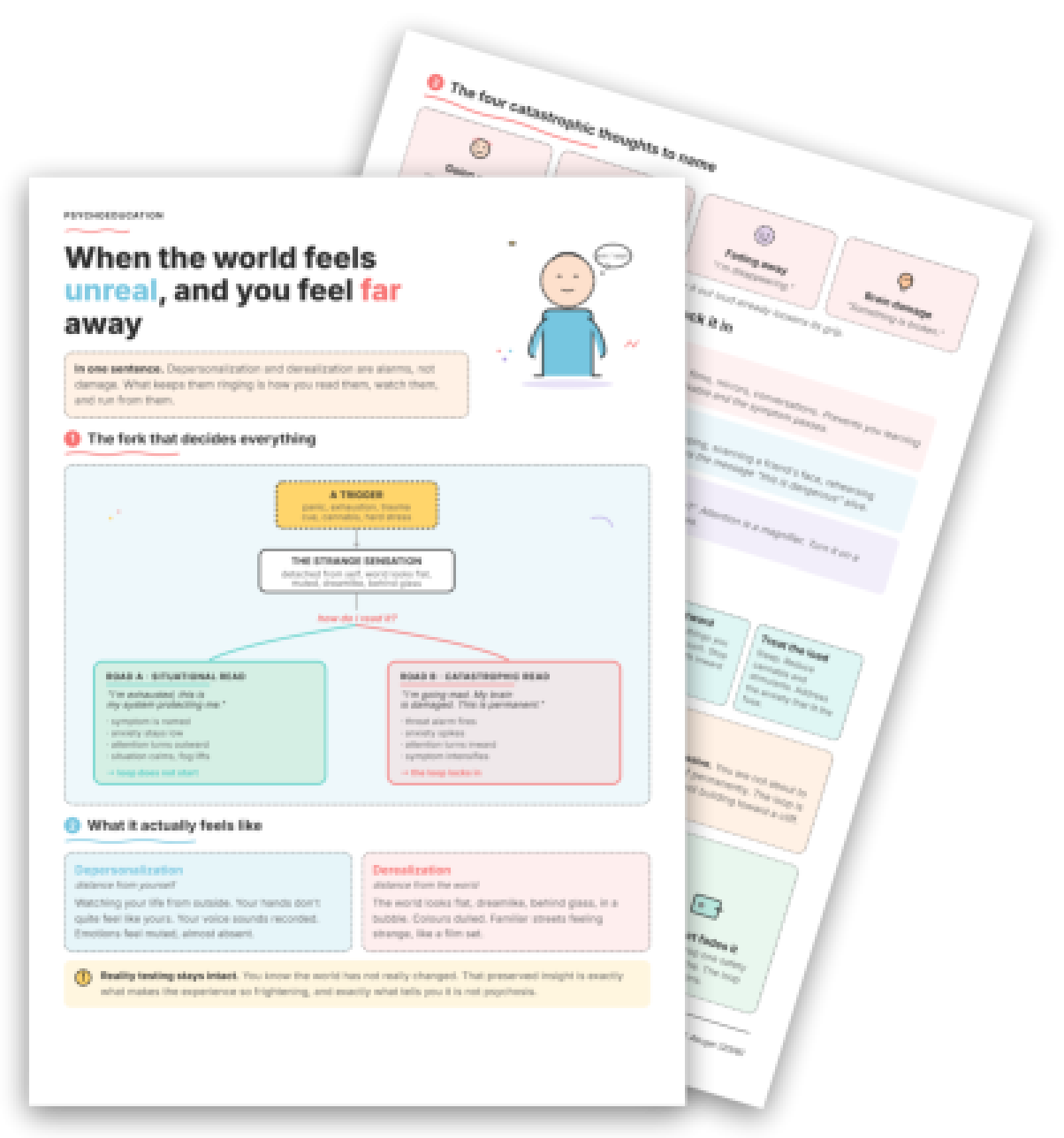
The fiche is structured around five numbered panels that follow the CBT formulation developed by Hunter, Sierra, and Simeon, each representing a distinct step from trigger to exit.
Panel 1 presents the central fork. A trigger (panic, exhaustion, trauma cue, cannabis, acute stress) produces the strange sensation, and the patient hits a crossroads: "Road A: situational read" keeps anxiety low, attention outward, and the fog lifts; "Road B: catastrophic read" fires the threat alarm and locks the loop in. Seeing both roads side by side makes the appraisal moment legible in a way that verbal description cannot, and locates intervention exactly at the fork.
Panel 2 separates depersonalization (distance from self, watching from outside, muted emotions) from derealization (world looks flat, dreamlike, behind glass), with an explicit note that reality testing stays intact. This single distinction cleanly differentiates the experience from psychotic phenomena without requiring a long detour in session.
Panel 3 names the four catastrophic thoughts individually, framing each as "a thought, not a fact". That formulation hands you a ready-made cognitive defusion move and connects directly to automatic thought restructuring work.
Panel 4 diagrams the maintenance loop as a cycle: avoidance (world shrinks), safety behaviours (pinching, tapping, scanning a friend's face), and symptom monitoring (inward checking as attentional magnifier). The visual circularity makes each element's contribution visible, much as you would use the loop structure with health anxiety or panic disorder.
Panel 5 lists five practical exits: relabel, drop one safety behaviour, re-enter avoided situations gradually, turn attention outward, and treat the underlying load (sleep, stimulants, the anxiety that lit the fuse). Each exit maps to a concrete between-session task, pairing naturally with a graded exposure hierarchy or a sensory grounding exercise for the "turn outward" step.
> Key point: This fiche is a visual psychoeducation support you use in session to explain the CBT model of depersonalization. It is not a self-report questionnaire. The patient leaves with a printed map of their own loop, a shared vocabulary, and a concrete starting point, not a homework form to complete alone.
750+ clinical tools
A library built with and for clinicians, ready to use in session and extend between appointments.
Access all the toolsWhen and How to Propose the Fiche
The clearest window is after the initial assessment, once you have a provisional formulation and the patient has described the experience in their own words. Waiting until that point prevents the fiche from landing as a generic handout.
A low-threshold introduction: "I want to show you a diagram that maps exactly what you've been describing. Let's go through it together." Walk panels 1 to 4 as a collaborative formulation, inviting the patient to locate their specific triggers, their dominant catastrophic thought, and their main maintenance behaviours. Panel 5 then becomes a selection exercise: which exit do we trial this week?
The fiche is particularly well-suited to patients with comorbid panic attacks, social anxiety, or checking and certainty-seeking patterns (see the checking and doubt worksheet), since monitoring and safety behaviours are already in the clinical picture. It pairs well with stopping avoidance work, building an exposure hierarchy, and a decatastrophizing exercise for patients whose appraisals are deeply entrenched.
One limit worth naming: patients with active dissociative presentations or significant trauma history may find the CBT framing insufficient without concurrent trauma-focused work. In those cases, use the fiche selectively and anchor it explicitly in the broader formulation rather than as a standalone psychoeducation tool.
The fiche sharpens the psychoeducation, gives the patient a take-home map, and opens the first behavioral commitment in the same session.
Use it with your patients
Share this tool in the mobile app and follow the work between sessions.
Sources
- Medford, N., Sierra, M., Baker, D., & David, A. S. (2005). Understanding and treating depersonalisation disorder. Advances in Psychiatric Treatment, 11(2), 92-100.
- Simeon, D., & Abugel, J. (2006). Feeling Unreal: Depersonalization Disorder and the Loss of the Self. Oxford University Press.
Your session continues in your patients' pocket
Use with a patientYour resources, available everywhere
The handouts, exercises, programs and audios above: you choose which ones to make available to your patients, in the mobile app dedicated to them.
And far more than a library
The app goes well beyond resources, to support your patients every day:
Related categories
Explore other clinical resources by category.

Anxiety
Clinical hub for anxiety disorders: CBT and ACT worksheets, psychoeducation sheets, and exercises for assessment and treatment across the anxiety spectrum.

Trauma
Clinical hub on trauma and PTSD: assessment, differential diagnosis, treatment phases, and printable resources for practitioners. 155 chars.

Cognition
Printable cognitive therapy worksheets and clinical tools for therapists: CBT, ACT, schema work, defusion, distortions, and belief restructuring.

Understand
Clinical hub for the therapeutic aim 'Understand': worksheets and tools to build patient insight across CBT, ACT, schema therapy and more.

Build awareness
Clinical worksheets and tools to build awareness in therapy: cognitive distortions, schemas, emotions, ACT and CBT resources for practitioners.

CBT
CBT worksheets, cognitive restructuring exercises & behavioral tools for clinicians. Evidence-based resources for every phase of cognitive behavioral therapy.