
Clinical picture. M., a man in his late twenties, presents with longstanding social anxiety and a pattern of withdrawing from colleagues after perceived slights. In session, the clinician introduces the four-box map and asks him to pick a single moment from the previous week that still carries a charge. M. chooses an occasion when a colleague walked past without making eye contact; working through the boxes, he articulates the thought "She thinks I'm incompetent", an anxious feeling rated at 65/100 with a tight chest, and the behaviour of leaving the kitchen early and avoiding that colleague for two days. Naming the loop aloud, specifically that avoidance prevented any disconfirming information, shifted M. from a global sense of social failure to a more bounded, workable description of one interaction. He left the session with the worksheet partially filled in and an agreement to complete a second box-set before the next appointment.
CBT Here-and-Now Model: PDF Worksheet, Tools and Exercises
A printable PDF worksheet and clinical tools to map thoughts, feelings, and behaviours in one specific moment, for use in CBT sessions.
Clinical vignettes
Mapping a Loop Around Social Anxiety
Rumination Cycle in Recurrent Depression
Clinical picture. T., a woman in her mid-forties with recurrent depressive episodes, describes low mood that feels formless and unshakeable. The clinician uses the here-and-now map to anchor one concrete moment: an evening when T. sat alone after a short phone call with her sister. Starting from the body, as recommended for patients who find thoughts elusive, T. identified a heavy chest and flatness rated at 55/100 before she could name the thought "I'm a burden to everyone around me". Her behaviour, cancelling a planned walk and replaying the phone call, had reinforced the thought rather than tested it. Recognising the withdrawal-to-loneliness loop did not resolve the mood, but it gave T. a specific point of entry rather than a diffuse sense that "everything is wrong", which she reported as moderately relieving in itself.
Presenting the CBT cognitive model verbally tends to produce polite nodding. Patients understand that thoughts affect feelings in the abstract, but struggle to apply that to a specific moment from their own week. This PDF worksheet gives you a concrete visual scaffold to do that mapping in session, in real time, on paper the patient can keep.
Use this resource with your patients
Handout, exercises and materials ready to use, right inside SessionFuel.
Why the cognitive model resists verbal explanation
When you explain the model orally, most patients register it as a linear chain: event triggers thought, thought produces feeling, feeling drives behaviour. The circularity, the part that actually explains symptom maintenance, rarely lands without something to point at. The idea that a behaviour confirms a thought, which sharpens a feeling, which drives more of the same behaviour, requires seeing the arrows close on themselves. A diagram does that in three seconds; ten minutes of explanation rarely does.
A second persistent sticking point is the fusion between cognition and affect. Without a structure that explicitly separates thoughts, emotions, and body sensations into distinct columns, patients default to statements like "I felt like she was annoyed with me", where the interpretive bias and the emotional response are blurred into one. That fusion is exactly what makes the formulation vague, and it is precisely what a well-designed visual can pull apart.
What the worksheet contains: four boxes, four loops, one nudge
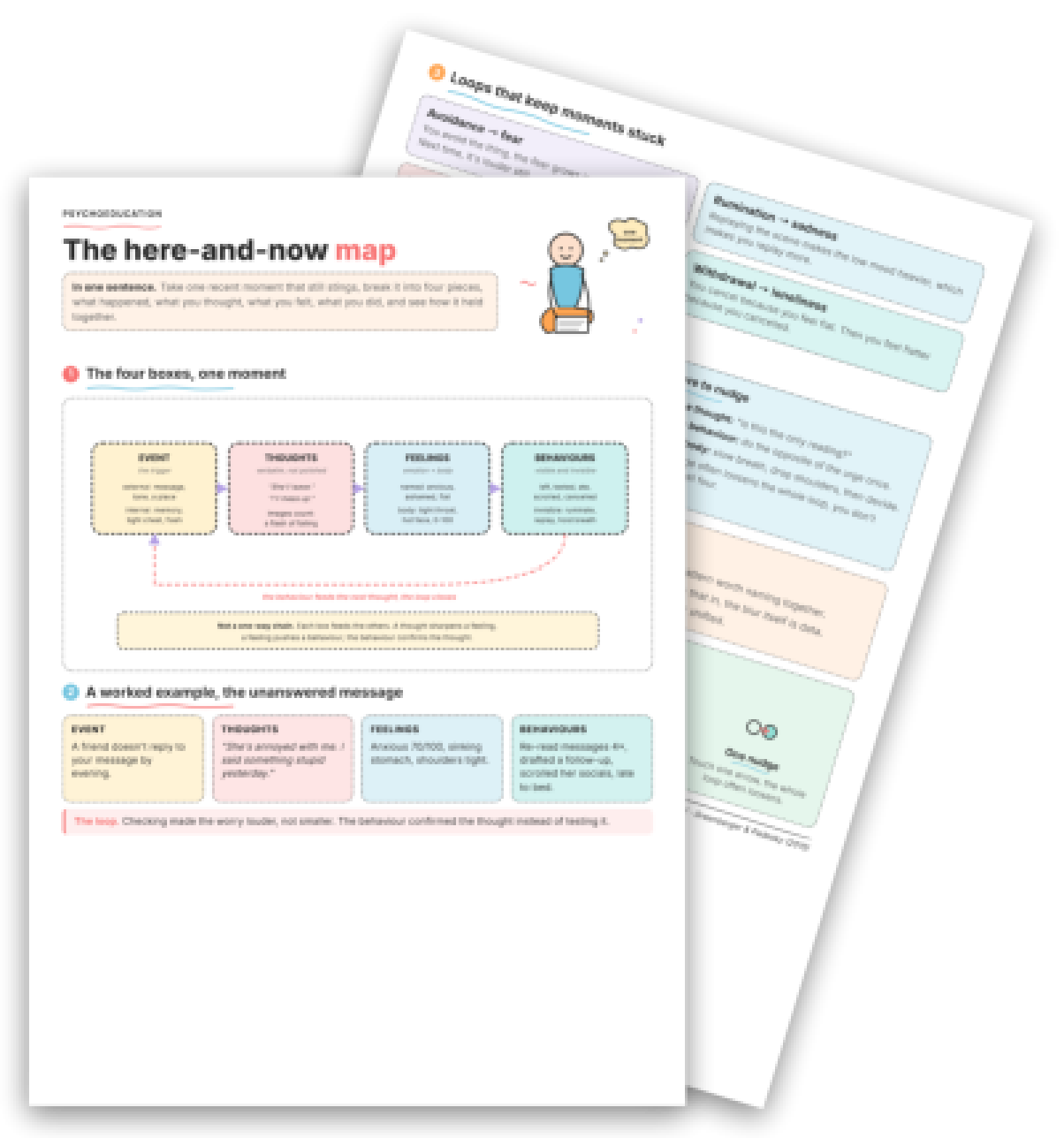
The fiche opens with a single clinical instruction: "Take one recent moment that still stings, break it into four pieces." The four boxes, laid out on one page, are EVENT (with an explicit split between external and internal triggers), THOUGHTS (verbatim, not polished, with mental images counted alongside verbal cognitions), FEELINGS (emotion word plus body sensation, rated 0-100), and BEHAVIOURS (visible and invisible, with rumination and breath-holding listed alongside overt avoidance).
A worked example runs through all four boxes using the scenario of an unanswered message, then closes with a key observation: "Checking made the worry louder, not smaller." That single sentence, visible on the page in front of the patient, carries more clinical weight than a lengthy explanation of the maintenance cycle.
The third panel names four specific loops that keep moments stuck: avoidance feeding fear, rumination deepening sadness, reassurance-seeking generating rebound doubt, and social withdrawal compounding loneliness. Clinicians working in standard TCC, ACT, or schema therapy will recognise these immediately; the visual makes them legible to patients without requiring technical vocabulary. The fourth panel, "Finding the nudge," lists four possible intervention points, one per box, and explicitly flags that "one nudge often loosens the whole loop." That framing reduces the patient's sense of overwhelm when everything feels tangled.
> Key point: This worksheet is a visual support for psychoeducation in session, not a self-administered questionnaire. You use it to point, annotate, and redirect in real time. The patient leaves with a concrete reference they can read back on their own, not a blank form to decode alone at home.
The three prompts marked "to discuss in session" give you clear debriefing structure: recurring thoughts across multiple maps signal a pattern worth naming, emotional blurring ("the blur itself is data") becomes an invitation rather than a dead end, and effective nudges can be debriefed arrow by arrow.
750+ clinical tools
A library built with and for clinicians, ready to use in session and extend between appointments.
Access all the toolsWhen and how to introduce it in session
This fiche fits naturally early-to-mid treatment, once the alliance is established and you are moving from anamnesis to shared formulation. It is particularly well suited to patients who intellectualise the model but cannot personalise it, to those whose automatic thoughts feel disconnected from their triggers, and to patients presenting with pronounced avoidance or rumination loops.
Introduce it by anchoring it in a moment the patient has already described: "Let's take that scene from Tuesday and map it together, using these four boxes." That grounding in lived experience prevents the exercise from feeling abstract.
For patients whose affect-cognition fusion is pronounced, the four-box structure prepares the ground for automatic thought restructuring work and deepens the foundation before moving to core belief clarification. When the dominant loop is avoidance, the nudge panel connects naturally to graded exposure exercises. For younger patients or those entirely unfamiliar with CBT, the CBT for Kids: Thoughts, Feelings & Actions worksheet offers a lighter entry point before moving to this version.
The here-and-now map is deliberately cross-sectional. Once repeated use begins revealing stable patterns, pair it with the Longitudinal Case Formulation (5 Ps) to tie situational loops back to early learning. It also builds the shared vocabulary that makes later work on all-or-nothing thinking, maladaptive coping, and catching distorted thoughts in real time faster and more precise. The worksheet does not replace the broader formulation; it makes the first step toward it concrete enough to actually happen.
Use it with your patients
Share this tool in the mobile app and follow the work between sessions.
Sources
- Beck, J. S. (2021). Cognitive Behavior Therapy: Basics and Beyond (3rd ed.). The Guilford Press.
- Greenberger, D., Padesky, C. A. (2016). Mind Over Mood: Change How You Feel by Changing the Way You Think (2nd ed.). The Guilford Press.
- Padesky, C. A., Mooney, K. A. (1990). Presenting the cognitive model to clients. International Cognitive Therapy Newsletter, 6, 13-14.
- Beck Institute for Cognitive Behavior Therapy. Understanding CBT: The Cognitive Model.
Your session continues in your patients' pocket
Use with a patientYour resources, available everywhere
The handouts, exercises, programs and audios above: you choose which ones to make available to your patients, in the mobile app dedicated to them.
And far more than a library
The app goes well beyond resources, to support your patients every day:
Related categories
Explore other clinical resources by category.

Anxiety
Clinical hub for anxiety disorders: CBT and ACT worksheets, psychoeducation sheets, and exercises for assessment and treatment across the anxiety spectrum.

Mood
Evidence-based worksheets and clinical tools for mood disorders: CBT, ACT, and positive psychology resources for psychologists and therapists.

Emotions
Clinical resources on emotion regulation: worksheets, coping tools, CBT, REBT, and ACT exercises for therapists working across diagnoses and age groups.

Cognition
Printable cognitive therapy worksheets and clinical tools for therapists: CBT, ACT, schema work, defusion, distortions, and belief restructuring.

Understand
Clinical hub for the therapeutic aim 'Understand': worksheets and tools to build patient insight across CBT, ACT, schema therapy and more.

Build awareness
Clinical worksheets and tools to build awareness in therapy: cognitive distortions, schemas, emotions, ACT and CBT resources for practitioners.