
Clinical picture. M., a man in his mid-thirties, presents with longstanding social anxiety centred on work meetings, which he manages by sending written summaries instead of speaking in group settings. In session, the clinician introduces the four-channel mapping framework, walking M. through a recent episode: an unplanned team meeting (trigger), chest tightness and dry mouth (body), the thought "I will go blank and they will see it" (mind), and a last-minute request to dial in by phone instead (behaviour). M. recognised quickly that the phone workaround had felt like a solution but had kept the alarm cycle intact. By the following session he had used the worksheet independently to map two further episodes, noting that labelling each channel reduced the sense that the anxiety "came out of nowhere."
Exploring Your Anxiety Experience: PDF Worksheet, Tools and Exercises
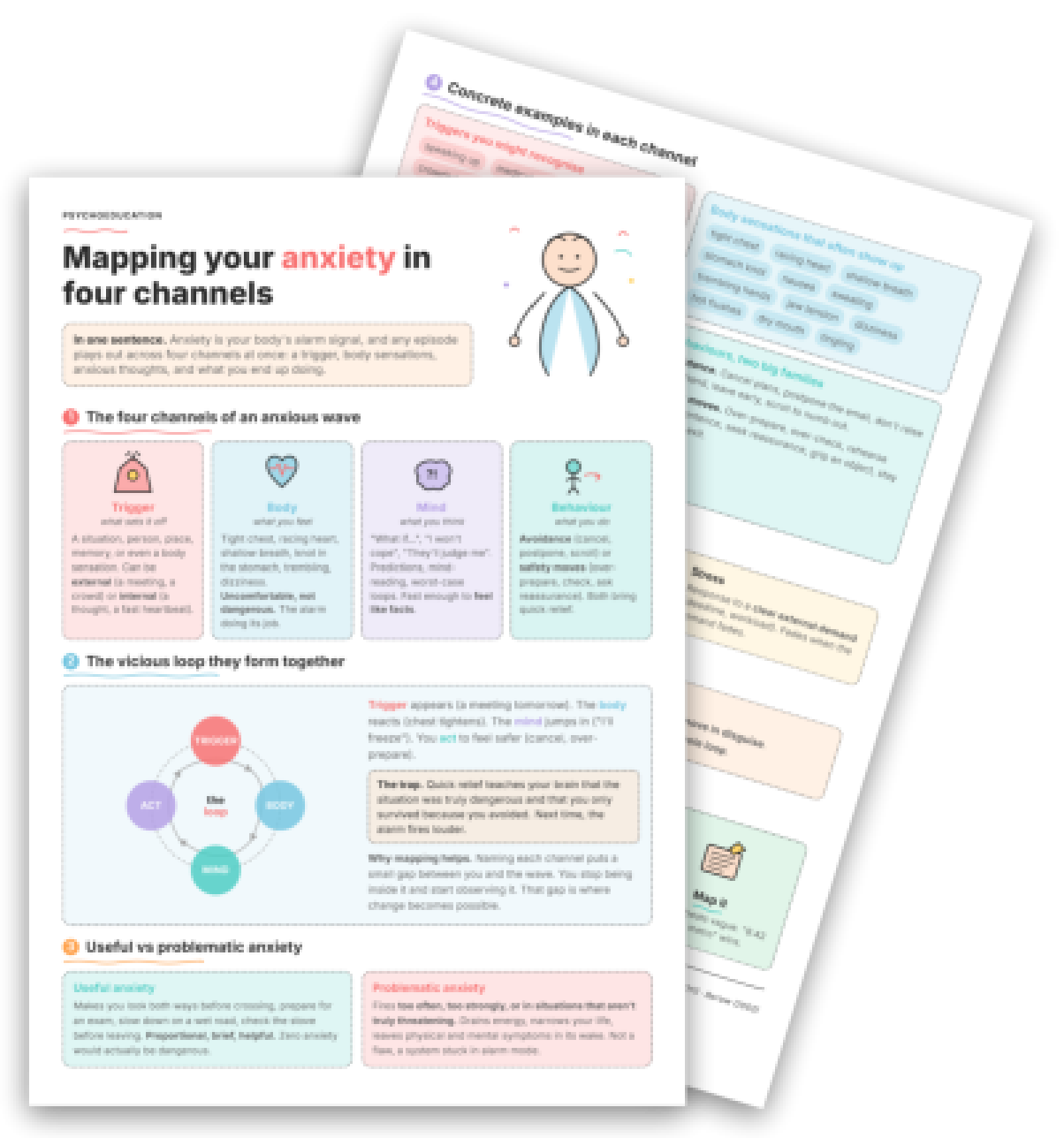
A visual PDF worksheet mapping anxiety across four channels, trigger, body, mind, behaviour, to anchor psychoeducation in session and give patients a concrete reference they can keep.
Clinical vignettes
Naming the Loop in Social Anxiety
Distinguishing Useful from Problematic Anxiety
Clinical picture. A., a woman in her late forties referred for generalised worry, initially described her anxiety as "always there" and resisted the idea that any part of it could be functional. The clinician used the informational sheet to draw a distinction between proportional, time-limited anxiety (checking travel times before an appointment) and the stuck-alarm pattern she was experiencing (hours of looping thoughts about the same appointment weeks in advance). Mapping a concrete episode across trigger, body, mind, and behaviour helped A. see that her avoidance of planning activities was providing brief relief while amplifying the signal. She left the session with the worksheet to complete between appointments, with the explicit frame that the goal was observation, not immediate change.
Explaining anxiety in session is rarely the bottleneck. The real friction comes earlier: patients listen, nod, and leave without a workable map of what is actually happening to them. This PDF worksheet gives the explanation a structure they can hold onto, follow with their eyes, and take home, without you needing to sketch it from scratch every time.
Use this resource with your patients
Handout, exercises and materials ready to use, right inside SessionFuel.
Why Anxiety Resists Oral Explanation Alone
Most patients arrive with a fragmented picture. They report a body sensation (racing heart, tight chest) OR a thought ("I'll freeze") OR a behaviour (cancelled the meeting, again), rarely all three, almost never the trigger that set the chain off. The cognitive-behavioural framework is elegant, but spoken aloud it tends to flatten into abstraction. The maintenance loop is especially hard to grasp verbally: patients understand avoidance brings relief, but they do not feel how that relief is itself the mechanism that sustains the alarm.
There is also the chronic confusion between anxiety, fear, and stress, three distinct constructs that patients use interchangeably, muddying the formulation and blurring the rationale for any intervention. Disentangling them at the whiteboard takes more time than most sessions can spare. A visual reference cuts that conversation in half.
750+ clinical tools
A library built with and for clinicians, ready to use in session and extend between appointments.
Access all the toolsWhat the Worksheet Contains, and What the Visual Layout Shows
The fiche opens with a one-sentence psychoeducation anchor: "Anxiety is your body's alarm signal, and any episode plays out across four channels at once." From there, seven numbered panels do the clinical work.
Panel 1 maps the four channels side by side, Trigger, Body, Mind, Behaviour, each with a short definition and concrete sensory examples. Seeing them arranged spatially, rather than listed sequentially, makes their simultaneity legible in a way that oral explanation rarely achieves.
Panel 2 renders the vicious loop: Trigger → Body → Mind → Act → relief that reinforces danger. The fiche names the trap plainly: "Quick relief teaches your brain that the situation was truly dangerous and that you only survived because you avoided." This formulation maps directly onto the cycle of avoidance and gives you a shared vocabulary for exposure work without needing to introduce new terms.
Panel 3 draws the useful vs. problematic anxiety distinction, a clinically necessary reframe that shifts the patient's relationship to their own system. Panel 4 offers dense lists of concrete examples across all four channels, twelve body sensations, ten common triggers, four anxious thought patterns including "I won't cope" and "What if it happens again?", and two families of behaviour (avoidance and safety moves). Panel 4 alone often prompts the first moment of genuine recognition in patients who have been struggling to name what they experience.
Panel 5 cleanly separates anxiety, fear, and stress, a distinction that supports differential formulation and is directly relevant when you are working with generalised anxiety, social anxiety, or panic disorder. Panel 6 offers three session discussion prompts, including whether a body sensation alone is sufficient to start the full loop, a useful gateway into Clark's cognitive model of panic. Panel 7 closes with a four-point summary the patient can scan between sessions.
> Key takeaway: this fiche is a visual support that facilitates the explanation of anxiety in session, it is not a self-administered questionnaire. The clinician guides the patient through the panels; the patient leaves with a concrete reference, not a homework assignment to complete alone.
Use it with your patients
Share this tool in the mobile app and follow the work between sessions.
How and When to Introduce It
The worksheet fits naturally in sessions two to four, once the initial anamnesis is done and you are building the psychoeducational layer of the formulation. It is particularly useful before introducing cognitive restructuring of anxious thoughts or graded exposure, since both techniques depend on the patient being able to locate their experience within the four-channel model.
For patients presenting with health anxiety or prominent somatic complaints, Panel 1 (Body channel) and Panel 2 (the loop) are worth spending extra time on, with Panel 5's anxiety-vs-fear distinction serving as a gentle reframe of interoceptive catastrophising.
A simple introduction: "I want to show you a map of what happens inside you when anxiety hits, it will make what we do next easier to follow." After walking through the panels together, debrief what the patient recognised: which triggers feel familiar, which body sensations they had not connected to anxiety, which behaviours they had not identified as safety moves. That debrief often surfaces avoidance patterns worth directly addressing with tools like the Changing Avoidance worksheet or the Anxiety Self-Reflection exercise.
For younger patients or those with limited psychological literacy, pair the fiche with the Anxiety Psychoeducation Program as a structured between-session complement. For more cognitively oriented patients, it bridges naturally into the CBT Cognitive Model and the Restructuring Anxious Thoughts worksheet.
The fiche does not replace the formulation conversation; it makes that conversation more efficient, more concrete, and more likely to stick.
Your session continues in your patients' pocket
Use with a patientYour resources, available everywhere
The handouts, exercises, programs and audios above: you choose which ones to make available to your patients, in the mobile app dedicated to them.
And far more than a library
The app goes well beyond resources, to support your patients every day:
Related categories
Explore other clinical resources by category.

Anxiety
Clinical hub for anxiety disorders: CBT and ACT worksheets, psychoeducation sheets, and exercises for assessment and treatment across the anxiety spectrum.

Understand
Clinical hub for the therapeutic aim 'Understand': worksheets and tools to build patient insight across CBT, ACT, schema therapy and more.

Build awareness
Clinical worksheets and tools to build awareness in therapy: cognitive distortions, schemas, emotions, ACT and CBT resources for practitioners.

CBT
CBT worksheets, cognitive restructuring exercises & behavioral tools for clinicians. Evidence-based resources for every phase of cognitive behavioral therapy.

Trauma
Clinical hub on trauma and PTSD: assessment, differential diagnosis, treatment phases, and printable resources for practitioners. 155 chars.

Mood
Evidence-based worksheets and clinical tools for mood disorders: CBT, ACT, and positive psychology resources for psychologists and therapists.