
Clinical picture. M., a 34-year-old accountant, presented with recurrent panic attacks triggered by noticing his own heartbeat during quiet moments at his desk. He had attended two emergency departments in three months, each time receiving normal cardiac investigations, yet his conviction that he was experiencing a life-threatening arrhythmia remained intact. Using Clark's five-step loop as a shared visual reference, the clinician traced with M. how a brief ectopic beat (trigger) narrowed his attention onto his chest (apprehension), amplified the sensation through hypervigilance, and locked in the reading "I am having a heart attack" within seconds. M. identified, without prompting, that the same palpitation during a football match never produced fear, which allowed the clinician to introduce the concept of the catastrophic misinterpretation as the hinge point rather than the sensation itself. By the end of the session M. could describe the loop in his own words, a modest but clinically useful step toward engaging in subsequent behavioural experiments.
Clark's Cognitive Model of Panic: PDF Worksheet, Tools and Exercises
A visual PDF worksheet, clinical tools, and exercises to explain the panic loop to patients and anchor psychoeducation in session.
Clinical vignettes
Palpitations Misread as Cardiac Danger
Derealisation Fuelling a Losing-Control Belief
Clinical picture. T., a 28-year-old postgraduate student, reported episodes of derealisation in seminar rooms that she consistently interpreted as early signs of psychosis, despite no clinical evidence supporting that formulation. She had quietly withdrawn from most in-person teaching and was carrying anxiolytic medication she rarely took but would not leave home without. The clinician introduced the Clark model to explain how scanning for further signs of "going crazy" (hypervigilance) reliably intensified the derealisation, and how the unfinished tablet in her bag functioned as a safety behaviour that prevented her from learning that the sensation would pass on its own. T. acknowledged feeling some relief at seeing her experience mapped onto a recognisable cycle rather than treated as a symptom of severe mental illness. She agreed to monitor one episode between sessions using a brief thought record, noting the sensation, her interpretation, and what actually happened over the following ten minutes.
Explaining Clark's 1986 model verbally in session is rarely enough. Patients nod, then leave still convinced their racing heart is evidence of a cardiac event. This fiche PDF gives you a concrete visual support to map the panic loop in real time, with your patient, during the consultation.
Use this resource with your patients
Handout, exercises and materials ready to use, right inside SessionFuel.
Why the Panic Loop Is Hard to Convey Without a Visual
The central clinical challenge is not complexity, it is circularity. Patients cannot easily grasp that the catastrophic interpretation itself generates the very sensations it fears, because that causality runs in both directions simultaneously. Spoken explanations flatten the loop into a linear sequence, which tends to land as "you're anxious because you think anxious thoughts," a framing patients rightly find unconvincing when their chest is tight and their hands are tingling.
The second obstacle is attribution. By the time most patients reach consultation, they carry a firmly medicalized reading of their symptoms. Palpitations mean cardiac risk. Dizziness means an impending faint. Derealisation means they are "going crazy." Shifting that attribution requires more than argument; it requires a structure the patient can literally see. A spoken model is easy to dismiss. A diagram of a five-step loop, with their own sensations mapped onto it, is harder to argue with.
This is precisely what interoceptive exposure work and graded exposure hierarchies depend on: a shared formulation the patient has already internalized. The fiche builds that shared language before the behavioral work begins.
750+ clinical tools
A library built with and for clinicians, ready to use in session and extend between appointments.
Access all the toolsWhat the Fiche Contains
The PDF worksheet is structured around four panels, each serving a distinct clinical function.
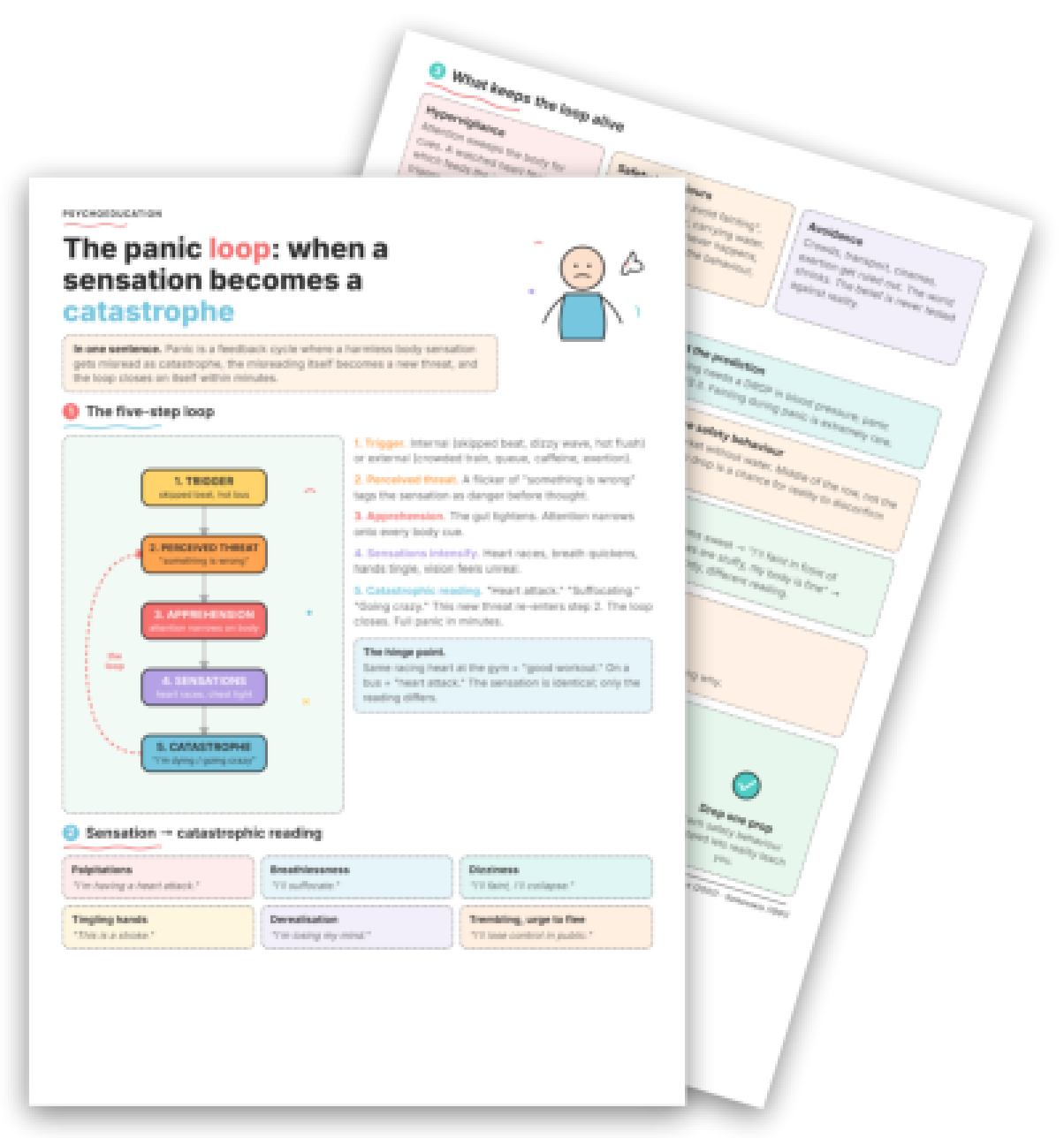
Panel 1 presents the five-step loop as a circular diagram: trigger (internal or external), perceived threat, apprehension, intensified sensations, catastrophic reading, back to step 2. The visual makes the closed circuit immediately apparent. The fiche notes the "hinge point" with precision: "Same racing heart at the gym = 'good workout.' On a bus = 'heart attack.' The sensation is identical; only the reading differs." That single observation often produces the first genuine shift in a patient's explanatory model.
Panel 2 maps six sensation-to-catastrophe pairings in a clean table: palpitations ("heart attack"), breathlessness ("I'll suffocate"), dizziness ("I'll faint"), tingling hands ("stroke"), derealisation ("losing my mind"), trembling and urge to flee ("lose control in public"). Used alongside tools like anxiety physical sensations monitoring, this panel allows patients to locate their own profile within the model without feeling pathologised.
Panel 3 names the three maintenance mechanisms: hypervigilance, safety behaviours, and avoidance. This section connects directly to the CBT maintaining processes framework and gives you clear clinical targets for subsequent sessions. Safety behaviours in particular are often invisible to the patient until they are listed this explicitly.
Panel 4 outlines four loop-breaking strategies: re-labelling the sensation, testing the prediction (the fiche notes that "fainting needs a DROP in blood pressure; panic RAISES it"), interoceptive exposure, and dropping one safety behaviour. A closing "To discuss in session" section provides three ready-made prompts around body-scanning habits, safety behaviour accumulation, and quiet avoidance.
> Key takeaway: The fiche is a visual support that facilitates the explanation of Clark's panic model in session. It is not a self-administered questionnaire; it is a psychoeducation tool you work through with the patient, leaving them with a concrete reference they can consult between appointments.
Use it with your patients
Share this tool in the mobile app and follow the work between sessions.
When and How to Use It in Session
The optimal moment is early in the formulation phase, typically session two or three, once the anamnèse has surfaced the symptom profile and you have ruled out primary medical aetiology. Introducing it too early, before the patient feels heard, risks the explanation landing as dismissive of real physical suffering.
A useful frame to introduce it: "I'd like to show you a diagram that describes, step by step, what happens in your body and mind during an attack. Most people find it changes how they read their symptoms." That framing positions the fiche as collaborative sense-making, not as a refutation of the patient's experience.
Work through the loop diagram together, asking the patient to identify their own trigger, their own catastrophic reading, and at least one safety behaviour. The panic attack psychoeducation program can then extend the work across sessions, while tools like anticipatory fear decatastrophizing and graded exposure self-report build on the model in subsequent homework assignments.
For patients with comorbid health anxiety or generalized anxiety, the panel on hypervigilance warrants particular attention: the mechanism of body-scanning maintaining the very arousal it monitors maps cleanly onto their broader attentional profile. For adolescents or patients with lower health literacy, the coping strategies for children and adolescents fiche may serve as a gentler parallel entry point.
The fiche does not replace the therapeutic frame. What it does is make a genuinely counterintuitive model legible, give the patient a vocabulary for self-monitoring, and accelerate the collaborative formulation that exposure-based work requires.
Your session continues in your patients' pocket
Use with a patientYour resources, available everywhere
The handouts, exercises, programs and audios above: you choose which ones to make available to your patients, in the mobile app dedicated to them.
And far more than a library
The app goes well beyond resources, to support your patients every day:
Related categories
Explore other clinical resources by category.

Anxiety
Clinical hub for anxiety disorders: CBT and ACT worksheets, psychoeducation sheets, and exercises for assessment and treatment across the anxiety spectrum.

Understand
Clinical hub for the therapeutic aim 'Understand': worksheets and tools to build patient insight across CBT, ACT, schema therapy and more.

CBT
CBT worksheets, cognitive restructuring exercises & behavioral tools for clinicians. Evidence-based resources for every phase of cognitive behavioral therapy.

Trauma
Clinical hub on trauma and PTSD: assessment, differential diagnosis, treatment phases, and printable resources for practitioners. 155 chars.

Mood
Evidence-based worksheets and clinical tools for mood disorders: CBT, ACT, and positive psychology resources for psychologists and therapists.

Identity
Clinical resources for self-identity work in therapy: CBT, ACT, schema tools for clinicians addressing self-concept, core beliefs, and identity disruption.