
Clinical picture. T., a woman in her early forties, presents with generalised anxiety and long-standing low mood. She describes a recent promotion at work, then immediately adds that she expects to be found out as incompetent within months. In session, the clinician introduces the psychoeducational sheet on the negativity/pessimism schema and asks T. to read the section contrasting the "pessimism lens" with realistic appraisal. T. pauses at the phrase "good news is immediately scanned for the catch" and says, quietly, that she has never considered this a learned pattern rather than accurate perception. By the following session she identifies three recent instances of the scanning behaviour, which gives the work a concrete entry point.
HandoutMood & depressionAnxietyThoughts & cognitionSelf & identityRelationshipsUnderstandBuild awarenessRestructureSchema therapyCBTIntegrative
Negativity/Pessimism Schema: PDF Worksheet, Tools and Exercises
A printable PDF worksheet, clinical tools, and session exercises to help patients recognize and work with the pessimism schema in therapy.
Clinical vignettes
Good News, Braced Against
Vigilance Mistaken for Safety
Clinical picture. M., a man in his mid-thirties, was raised by a parent who narrated daily life as a series of risks and rarely allowed positive anticipation to go unremarked upon. He enters therapy reporting chronic tension, disrupted sleep, and difficulty enjoying time with his young children. The clinician shares the informational sheet and invites M. to read the section on the childhood origins of the schema, in particular the phrases he may have absorbed. M. recognises "don't laugh too loud, you'll be disappointed" almost word for word from his upbringing and becomes visibly still. This moment of recognition does not resolve the schema, yet it shifts his framing: the vigilance he had experienced as protective begins to look like an outdated instruction rather than a character trait.
Explaining the Negativity/Pessimism Schema at the verbal level rarely lands. Patients nod, agree they "tend to see the glass half-empty," and then spend the rest of the session demonstrating exactly the schema you just named. This fiche PDF gives the concept a visual structure that makes the gap between pessimistic filtering and realistic appraisal immediately visible, without the conversation stalling in abstract self-description.
Use this resource with your patients
Handout, exercises and materials ready to use, right inside SessionFuel.
Why the Pessimism Schema Is So Hard to Explain in Session
The central clinical difficulty is that the schema presents itself as evidence-based reasoning. Patients are not catastrophising randomly; they have, in many cases, genuinely experienced loss, instability, or caregivers who narrated the world as dangerous. The belief system feels earned. When you describe it as a schema, the patient's inner voice immediately files that as naïve optimism on your part.
The second difficulty is confirmation bias, named explicitly in the fiche: positive outcomes get coded as luck or the calm before the storm, while negative outcomes count as proof. This means the schema is essentially unfalsifiable at the experiential level, and any purely oral explanation is arguing against a closed loop. Patients following the failure schema or the abandonment schema often carry this same self-sealing logic: "I saw it coming" feels protective, not distorted.
The third difficulty is somatic. The schema is not just a belief; it is "background dread, shoulders up, light sleep, waiting for impact" (the fiche's exact words). Describing that body state aloud in session is far less efficient than letting the patient read it and say "yes, that's exactly it." That moment of recognition is what a visual support creates that oral explanation alone cannot.
What the Fiche Contains: A Visual Support for the Session
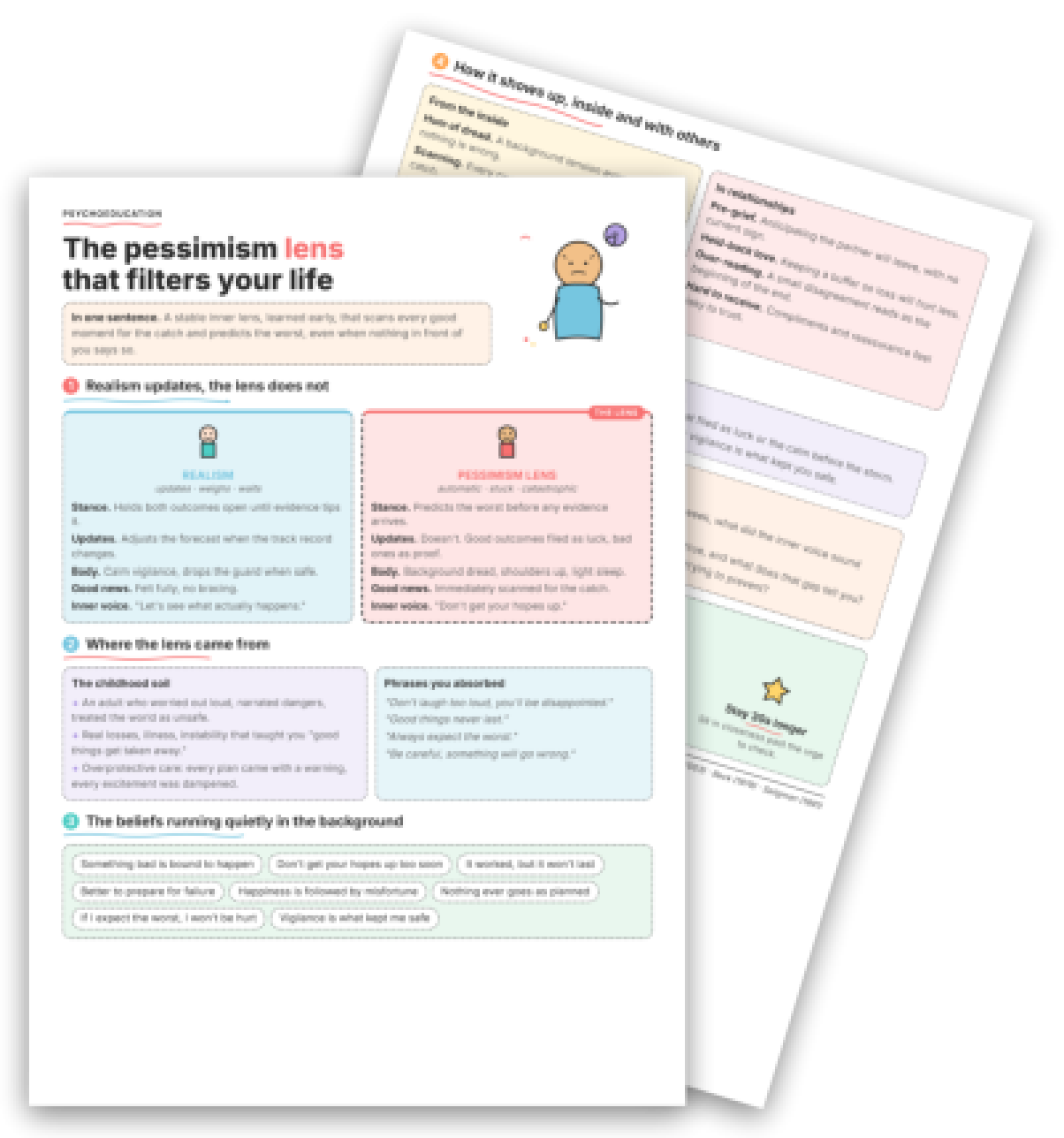
The fiche PDF is built around one core organising image: a side-by-side panel contrasting Realism and the Pessimism Lens. Each column runs across four dimensions: stance, how the framework updates (or fails to), body state, and inner voice. The realism column carries the phrase "Let's see what actually happens," while the lens column carries "Don't get your hopes up." Placed side by side, the visual makes the functional asymmetry legible in seconds, which is exactly what a purely oral comparison struggles to achieve.
The fiche then moves through four additional sections. The childhood origins panel lists specific caregiver phrases patients may have absorbed ("Good things never last," "Always expect the worst"), which is useful for the historical formulation and often produces immediate recognition responses. A background beliefs panel names eight core assumptions, including "If I expect the worst, I won't be hurt" and "Vigilance is what kept me safe", framing the schema's protective logic explicitly.
A fourth section maps internal experience and relational expression side by side: catch-scanning, rehearsing worst cases, pre-grieving a partner's departure, holding back attachment to buffer anticipated loss. For patients where the schema is colliding with early maladaptive schemas more broadly, this panel links the intrapsychic and interpersonal dimensions efficiently. The fifth section names why the lens is so sticky, covering confirmation bias and the partial reinforcement of over-preparation, which is the mechanism most patients need named before any cognitive work makes traction.
The closing section provides three session discussion questions and four concrete behavioural anchors: Name it, Track it, Un-brace, and Stay 30 seconds longer in closeness. These are not self-directed homework in the psychoeducation sense; they are formulated as prompts you guide. Tools like the fortune-telling cognitive distortion exercise or the disqualifying-the-positive worksheet pair naturally here for between-session work.
> Key point: The fiche functions as a visual support that facilitates the in-session explanation of the pessimism schema; it is not a questionnaire the patient completes alone, but a shared reference that names the lens, its origins, and its maintenance mechanisms while the two of you are looking at it together.
Clinical library
750+ clinical tools
A library built with and for clinicians, ready to use in session and extend between appointments.
Access all the toolsSeveral resource types
Psychoeducation handouts
Understand at a glance
Interactive exercises
To do and fill in
Interactive programs
A structured path
Audios
Meditation and relaxation
Psychometric tests
Automatic scoring
When and How to Introduce the Fiche
The fiche fits naturally from the second or third session, once you have a working formulation and the patient has spontaneously described catch-scanning, pre-grief, or held-back attachment in at least one domain. It is particularly well-suited to patients carrying cognitive distortions across multiple domains, those where the mental filter is prominent, and those with a history of early loss, parental anxiety, or overprotective caregiving.
A low-threshold introduction: "I want to show you something that describes what you've been telling me. Have a look at this diagram and tell me what fits." This keeps the frame phenomenological rather than diagnostic, and the side-by-side visual does the explaining before you need to say much more.
To debrief: after the patient reads the childhood origins panel, ask whose voice the inner phrases sound like. Then use the first session discussion question directly from the fiche: "When you notice the catch-scanning fire on a piece of good news this week, what did the inner voice sound like, and whose tone was it?" For patients where past experiences are shaping present patterns, this question opens the historical thread without you needing to introduce it.
One limit to note: patients in a current depressive episode may read the somatic and relational sections and experience them as confirmation of hopelessness. In that context, move slowly through the childhood origins panel and defer the behavioural anchors until mood has lifted enough for behavioural experiments to be viable. The core beliefs worksheet and restructuring a negative core belief tool offer useful complements once the schema is named and the therapeutic alliance is solid.
The fiche does not replace the schema work; it makes the first conceptual layer concrete and gives the patient something to return to between sessions when the lens activates.
Use it with your patients
Share this tool in the mobile app and follow the work between sessions.
Sources
- Young, J. E., Klosko, J. S., & Weishaar, M. E. (2003). Schema Therapy: A Practitioner's Guide. Guilford Press.
- Young, J. E., & Klosko, J. S. (1994). Reinventing Your Life: The Breakthrough Program to End Negative Behavior and Feel Great Again. Plume.
Patient mobile app
Your session continues in your patients' pocket
Use with a patientYour resources, available everywhere
The handouts, exercises, programs and audios above: you choose which ones to make available to your patients, in the mobile app dedicated to them.
Psychoeducation handoutsInteractive exercisesInteractive programsAudiosPsychometric tests
And far more than a library
The app goes well beyond resources, to support your patients every day:
Standardized tests
Therapy journal
Gamification
Wellbeing challenges
Introspection prompts
Therapist homework
Related categories
Explore other clinical resources by category.

Anxiety
Clinical hub for anxiety disorders: CBT and ACT worksheets, psychoeducation sheets, and exercises for assessment and treatment across the anxiety spectrum.

Mood
Evidence-based worksheets and clinical tools for mood disorders: CBT, ACT, and positive psychology resources for psychologists and therapists.

Identity
Clinical resources for self-identity work in therapy: CBT, ACT, schema tools for clinicians addressing self-concept, core beliefs, and identity disruption.

Relationships
Clinical worksheets and tools on relational functioning: attachment, schemas, assertiveness, and communication skills for therapists. Printable PDF resources.

Cognition
Printable cognitive therapy worksheets and clinical tools for therapists: CBT, ACT, schema work, defusion, distortions, and belief restructuring.

Understand
Clinical hub for the therapeutic aim 'Understand': worksheets and tools to build patient insight across CBT, ACT, schema therapy and more.