
Clinical picture. M., a woman in her late 40s, presented with low-grade depression and a vague sense of being trapped in her marriage of 22 years. She described her husband as "just more decisive" and consistently minimised her own role in any household conflict. During session four, the clinician introduced the psychoeducational sheet on subjugation, inviting M. to read the four-quadrant section aloud and note any items that resonated. She paused at "saying yes when you mean no" and "eventually you stop noticing what you wanted," then sat quietly for a moment before saying she had not chosen her own holiday destination in over a decade. The session did not resolve the pattern, but M. left with a concrete frame for what had felt shapeless, and agreed to track one moment per day when she noticed herself automatically deferring.
Subjugation Schema: PDF Worksheet, Tools and Exercises for Clinical Practice
A visual PDF worksheet, tools and exercises to help clinicians explain the subjugation schema in session and give patients a concrete reference point for change.
Clinical vignettes
Recognising Subjugation in a Long Marriage
Subjugation Schema in a Young Professional
Clinical picture. T., a man in his early 30s, sought therapy after a second consecutive job loss he attributed to "not fitting in." Collateral history and his own account pointed to a pattern of silent compliance with unreasonable demands from supervisors, followed by accumulating resentment and an eventual abrupt resignation. When the clinician introduced the subjugation schema handout, T. recognised the childhood origin section immediately, referencing a father whose anger he had managed carefully throughout adolescence. He was initially reluctant to accept that the workplace behaviour and the early learning were connected. Over the following two sessions he began distinguishing between genuine agreement and automatic compliance, a modest but clinically meaningful first step.
Patients carrying the subjugation schema rarely arrive saying "I suppress my needs to avoid conflict." They arrive exhausted, quietly resentful, or convinced that their compulsive compliance is simply who they are. Explaining this early maladaptive schema orally can stall early work: the concept sounds abstract, and patients in deep subjugation have often lost contact with their own preferences long before they reach your office. This fiche PDF gives you a visual scaffold to anchor the psychoeducation, name the mechanism clearly, and hand the patient something they can return to between sessions.
Use this resource with your patients
Handout, exercises and materials ready to use, right inside SessionFuel.
Why the Subjugation Schema Resists Verbal Explanation
The core clinical difficulty is not complexity but invisibility. By the time subjugation is entrenched, the patient doesn't experience it as a choice; the internal equation THEIR NEEDS > MY NEEDS has become automatic. Naming this in session is often met with genuine puzzlement, because the patient no longer notices what they wanted before handing it over.
The second obstacle is the relief-then-resentment cycle: the patient genuinely feels calmer after complying, which the brain registers as evidence that compliance was correct. Without a visual model that separates short-term relief from long-term cost, that logic is hard to dislodge. Schema maintenance cycles of this kind are notoriously difficult to describe verbally without a concrete diagram to point at.
Finally, the three coping modes (surrender, avoidance, counter-attack) look behaviorally very different from each other, and patients often identify with only one. A visual layout showing all three as different responses to the same fear helps them recognise the full pattern rather than dismissing the concept because it doesn't match their dominant style.
750+ clinical tools
A library built with and for clinicians, ready to use in session and extend between appointments.
Access all the toolsWhat the Fiche Contains: A Visual Support for Explaining Subjugation in Session
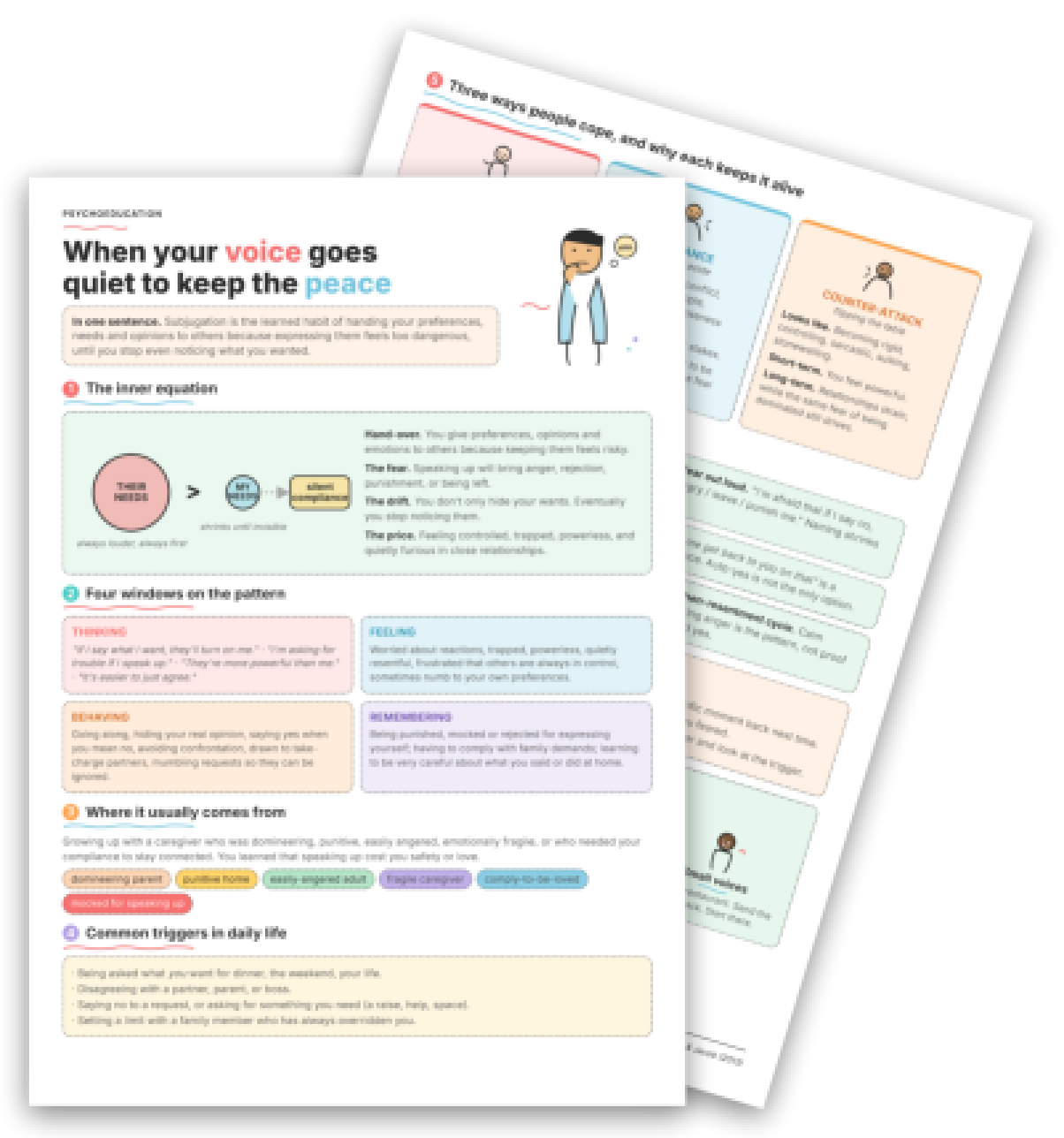
The fiche PDF is structured in six numbered panels that you can walk through with the patient during the session itself, not a questionnaire to fill in alone.
- Panel 1 (The inner equation) renders the schema's logic visually: the greater-than sign between THEIR NEEDS and MY NEEDS shows immediately what words take several exchanges to convey.
- Panel 2 (Four windows) maps the pattern across thinking, feeling, behaving, and remembering, the four-quadrant layout makes the cross-domain nature of schemas legible in a single glance. Sample cognitions include "If I say what I want, they'll turn on me" and "It's easier to just agree."
- Panel 3 covers origins (domineering, punitive, or fragile caregivers), connecting the schema to the mistrust and approval-seeking patterns that frequently co-occur.
- Panel 4 lists common present-day triggers: being asked for a preference, disagreeing with a boss, or setting a boundary with family. Patients reliably recognise themselves here.
- Panel 5 is the clinical core: surrender, avoidance, and counter-attack are each described with their short-term relief and long-term cost, using the same coping mode vocabulary as Young (2003) and Arntz & Jacob (2013).
- Panel 6 gives six graduated change steps and a "To discuss in session" block with three concrete prompts to carry into your next encounter.
> Key takeaway: the fiche is a visual support that facilitates the explanation of the subjugation schema during the session; it is not a self-administered assessment. You use it as a shared reference point, not a homework questionnaire.
Use it with your patients
Share this tool in the mobile app and follow the work between sessions.
When and How to Introduce It
The fiche fits naturally from the second or third session onward, once the formulation has sketched the schema's developmental origins. For patients presenting with self-sacrifice patterns, abandonment fear, or emotional inhibition, it can be introduced as a way to distinguish between schemas that overlap clinically.
A low-threshold opening: "I want to show you a model that maps something I think we've been circling around. You don't have to recognise everything in it, just tell me what does or doesn't fit." This framing sidesteps the risk of the patient complying with your interpretation, which would itself be a live enactment of the schema.
After reviewing the fiche together, debrief Panel 5 specifically: ask which coping mode the patient defaults to, and whether they recognise the relief-then-resentment sequence in the past week. The "To discuss in session" prompts at the bottom of the fiche can seed that conversation directly. Pairing this with assertiveness exercises or a structured assertiveness behavioral experiment gives the patient a concrete next step rather than leaving change at the level of insight.
The fiche does not replace the therapeutic relationship or the schema mode work that follows. It makes the explanation faster, clearer, and something the patient can hold in their hand when the old equation quietly reasserts itself at home.
Your session continues in your patients' pocket
Use with a patientYour resources, available everywhere
The handouts, exercises, programs and audios above: you choose which ones to make available to your patients, in the mobile app dedicated to them.
And far more than a library
The app goes well beyond resources, to support your patients every day:
Related categories
Explore other clinical resources by category.

Anxiety
Clinical hub for anxiety disorders: CBT and ACT worksheets, psychoeducation sheets, and exercises for assessment and treatment across the anxiety spectrum.

Mood
Evidence-based worksheets and clinical tools for mood disorders: CBT, ACT, and positive psychology resources for psychologists and therapists.

Identity
Clinical resources for self-identity work in therapy: CBT, ACT, schema tools for clinicians addressing self-concept, core beliefs, and identity disruption.
Relationships
Clinical worksheets and tools on relational functioning: attachment, schemas, assertiveness, and communication skills for therapists. Printable PDF resources.

Understand
Clinical hub for the therapeutic aim 'Understand': worksheets and tools to build patient insight across CBT, ACT, schema therapy and more.

Build awareness
Clinical worksheets and tools to build awareness in therapy: cognitive distortions, schemas, emotions, ACT and CBT resources for practitioners.