
Clinical picture. M., a woman in her mid-thirties, presents with persistent low mood and social withdrawal following the end of a long-term relationship. She describes a longstanding sense that she is fundamentally unlovable, though she frames this as a realistic appraisal rather than a belief. In session, the clinician introduces the schema maintenance cycle, mapping a recent episode in which M. declined a colleague's invitation to lunch, felt momentary relief, and then spent the afternoon ruminating that no one genuinely wanted her company. M. recognises, with some surprise, that the avoidance move had prevented any experience that could have challenged the belief, and that the relief it offered was brief while the confirming evidence it produced was lasting. She agrees to observe, without immediately changing, which protective move arises the next time the belief flares.
Schema Maintenance Vicious Cycles: PDF Worksheet, Tools and Exercises
A visual PDF worksheet, tools and exercises to map the self-confirming loops that keep early maladaptive schemas alive, and to identify exactly where the coping move can be shifted.
Clinical vignettes
Avoidance Sustaining an Unlovability Schema
Overcompensation Reinforcing Inadequacy Schema
Clinical picture. T., a man in his early forties referred for burnout, reports that he routinely rewrites subordinates' reports and struggles to delegate even minor tasks. He attributes this to professional standards, not distress. The clinician uses the vicious-cycle framework to trace the sequence: a core belief of fundamental inadequacy triggers fear of exposure, which activates a hypercompensatory drive to perform flawlessly and control outcomes. T. notes that the overcompensation does temporarily suppress the anxiety, yet the underlying need for realistic self-acceptance receives no new input, and the effort required escalates with each cycle. A shared goal is set to log one instance per week where the urge to take over arises, pausing to name the belief before acting on it.
Most patients can acknowledge, in the abstract, that their coping patterns are not serving them. What they cannot see is the precise mechanism by which those patterns feed the very belief they are trying to escape. This schema maintenance vicious cycles PDF worksheet gives that mechanism a visual form, so you can map it together in session rather than describe it in words that evaporate the moment the patient walks out.
Use this resource with your patients
Handout, exercises and materials ready to use, right inside SessionFuel.
Why Schema Maintenance Loops Are So Difficult to Convey Orally
The core problem is not insight, most patients in schema-informed work have plenty of it. The problem is that the self-reinforcing structure of the loop is genuinely invisible until it is drawn out. A patient who surrenders compulsively to a partner's demands usually describes this as "keeping the peace," not as evidence-suppression for an "I am unlovable" belief. The causal chain (belief flares → coping move fires → need stays unmet → belief returns stronger) only becomes legible when each step is named and spatially connected.
Verbal explanation alone leaves patients holding four discrete facts with no architecture between them. A clinician working with early maladaptive schemas or the three coping styles in schema therapy knows this gap well: the patient nods, the formulation seems solid, and the same pattern appears unchanged two weeks later.
What the Fiche Contains, and What the Visual Does That Words Cannot
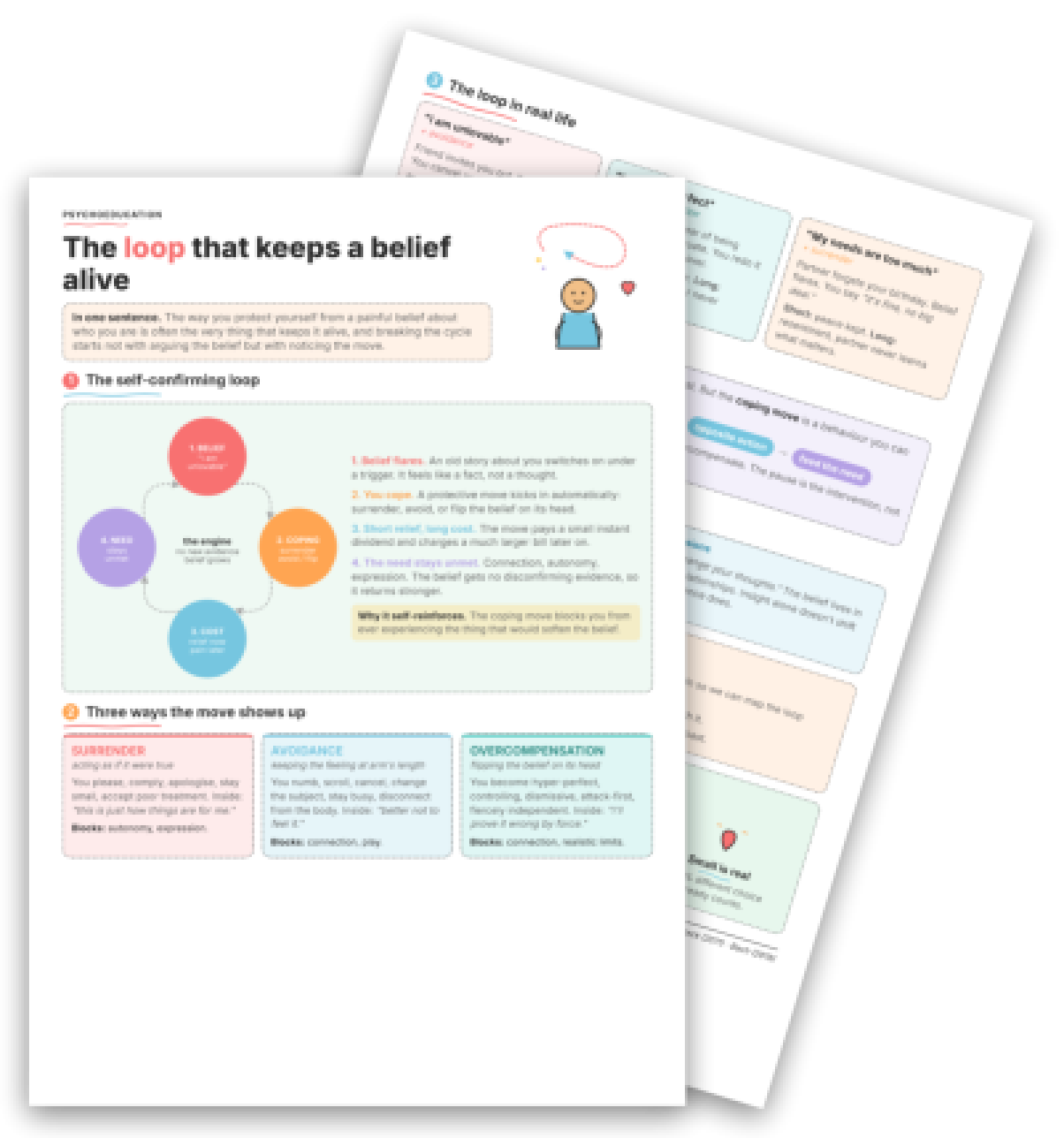
The fiche is built around five numbered panels that function as a single visual argument.
Panel 1 presents the self-confirming loop as a four-node diagram: Belief → Coping → Cost → Need (unmet). The node label "the engine / no new evidence / belief grows" sits at the base, making the maintenance logic explicit at a glance. Patients see, often for the first time, that relief and harm are sequential, not contradictory.
Panel 2 breaks down the three coping modes, each with a concrete inner monologue:
- Surrender ("this is just how things are for me"), blocks autonomy and expression
- Avoidance ("better not to feel it"), blocks connection and play
- Overcompensation ("I'll prove it wrong by force"), blocks connection and realistic limits
Naming the mode is the diagnostic move. Many patients who recognize approval-seeking patterns or defectiveness and shame schemas have never placed those behaviors inside the overarching surrender/avoid/flip taxonomy.
Panel 3 applies the loop to three clinical vignettes (the "I am unlovable" + avoidance cycle, the "I must be perfect" + overcompensation cycle, the "My needs are too much" + surrender cycle), each showing both the short-term dividend and the long-term cost. This panel does much of the psychoeducation work on its own, because patients tend to locate themselves in one of the three examples immediately.
Panel 4 offers the intervention sequence: notice body → name belief → name move → pause → opposite action → feed the need. The fiche is explicit that "the pause is the intervention, not the perfect choice", a reframe that matters for patients paralysed by perfectionism or the failure schema.
Panel 5 addresses common confusions directly: "This isn't just 'change your thoughts.' The belief lives in the body and in relationships. Insight alone doesn't shift it, only new experience does."
> Key point: The fiche is a visual support that facilitates your explanation in session, not a self-monitoring form the patient completes alone. Its architecture lets you walk through the loop step by step, finger on the diagram, and leave the patient with a concrete reference for between-session work.
750+ clinical tools
A library built with and for clinicians, ready to use in session and extend between appointments.
Access all the toolsWhen and How to Introduce the Fiche
This resource fits best once a working hypothesis about the dominant schema is established, typically from the third or fourth session onward, after an initial cognitive case formulation is in place. It is particularly useful when a recurring avoidance pattern or a belief that is damaging a key relationship has already been named but not yet mapped structurally.
A low-inference introduction: "I'd like to show you a diagram that maps out why certain patterns tend to repeat even when we understand them. Let's see if it fits what you've been describing."
When debriefing, use Panel 3's three-step structure (belief, short cost, long cost) as a template to co-construct the patient's own version of the loop. The three session prompts at the end of the fiche, on catching the coping move during the week, naming the belief beneath a recurring relational pattern, and slowing down when shame appears around the move, translate naturally into between-session intentions.
One limit worth holding: patients in acute crisis or with abandonment schema activation at high intensity may find Panel 1's architecture cognitively overwhelming. In those cases, starting with how the past shapes present behavior and returning to this fiche once the window of tolerance is wider is often the more productive sequence.
The fiche does not replace the therapeutic relationship or the gradual experiential work that schema cognitive restructuring requires. What it does is give both clinician and patient a shared map, drawn once, reusable across many sessions.
Use it with your patients
Share this tool in the mobile app and follow the work between sessions.
Sources
- Young, J. E., Klosko, J. S., & Weishaar, M. E. (2003). Schema Therapy: A Practitioner's Guide. Guilford Press.
- Rafaeli, E., Bernstein, D. P., & Young, J. E. (2011). Schema Therapy: Distinctive Features. Routledge.
- Basile, B., Tenore, K., Mancini, F., & Scarinci, A. (2024). Validation of the schema coping inventory for dysfunctional coping strategies. Frontiers in Psychology.
Your session continues in your patients' pocket
Use with a patientYour resources, available everywhere
The handouts, exercises, programs and audios above: you choose which ones to make available to your patients, in the mobile app dedicated to them.
And far more than a library
The app goes well beyond resources, to support your patients every day:
Related categories
Explore other clinical resources by category.

Trauma
Clinical hub on trauma and PTSD: assessment, differential diagnosis, treatment phases, and printable resources for practitioners. 155 chars.

Mood
Evidence-based worksheets and clinical tools for mood disorders: CBT, ACT, and positive psychology resources for psychologists and therapists.

Behaviours
Clinical hub for behaviors in therapy: worksheets and tools for coping, eating disorders, CBT formulation, and maladaptive behavioral patterns.

Build awareness
Clinical worksheets and tools to build awareness in therapy: cognitive distortions, schemas, emotions, ACT and CBT resources for practitioners.

Restructure
Clinical hub for cognitive restructuring worksheets: distortion identification, belief disputation, ABC model, and schema work for evidence-based practice.

CBT
CBT worksheets, cognitive restructuring exercises & behavioral tools for clinicians. Evidence-based resources for every phase of cognitive behavioral therapy.