
Clinical picture. P., a woman in her early thirties, presented with persistent occupational anxiety and recurrent burnout episodes; she described working until midnight most nights and experiencing intense shame whenever a task was left incomplete. During the third session, the clinician introduced the three-layer formulation, inviting P. to trace a recent hot thought, "I submitted the report late, my manager must think I'm incompetent," downward using the arrow technique. P. moved through "I can't get things right" to arrive, with visible discomfort, at "I am fundamentally defective." She acknowledged, almost reluctantly, that the overworking pattern had functioned as a coping strategy to keep that belief from being confirmed. This single mapping exercise shifted the focus of treatment from symptom management to schema-level work, which P. said felt "more honest" than anything tried previously.
Cognitive Case Formulation: PDF Worksheet, Tools and Exercises
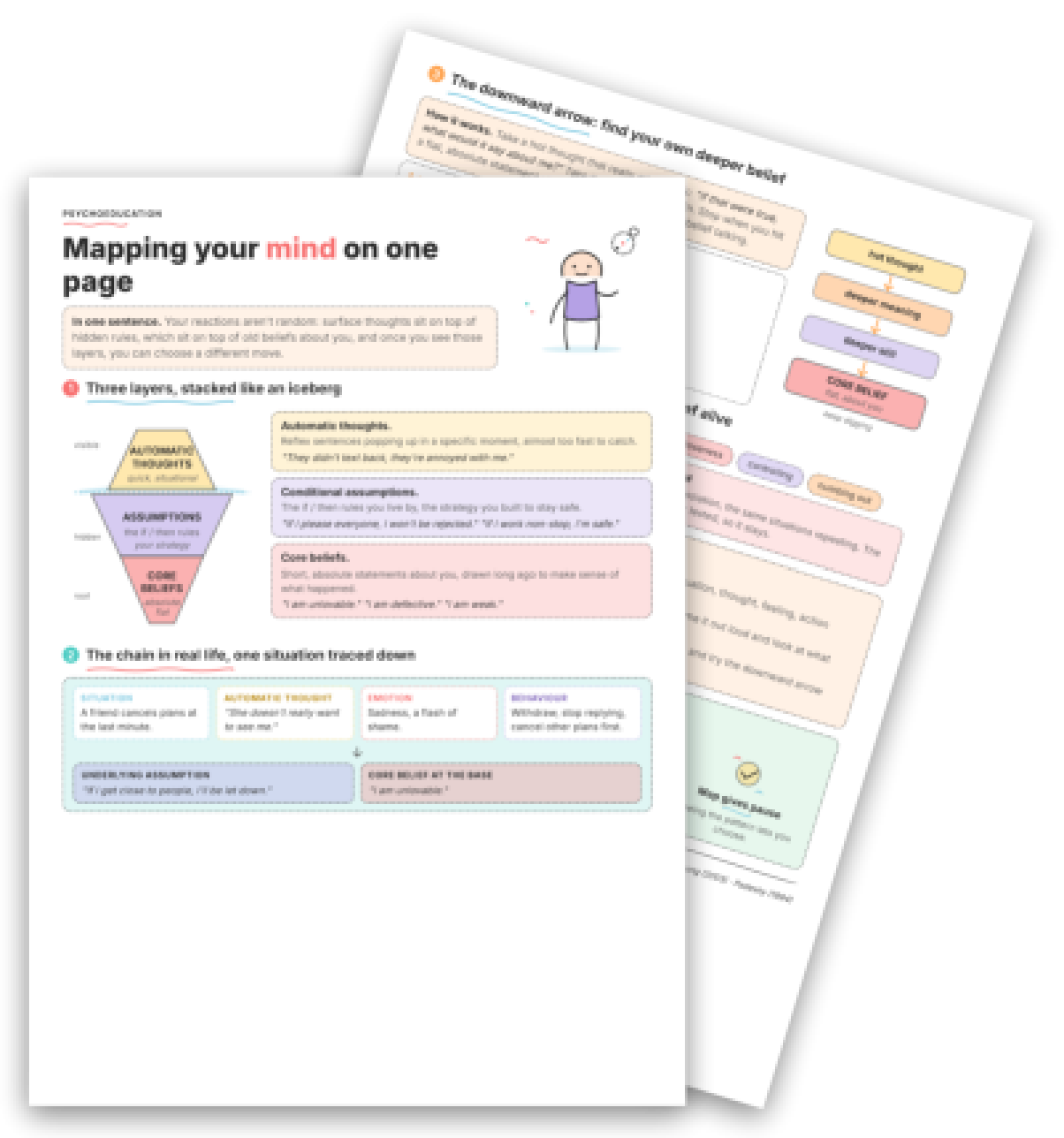
A visual psychoeducation sheet clinicians can use in session to map automatic thoughts, conditional assumptions, and core beliefs on a single page.
Clinical vignettes
Tracing Perfectionism to a Core Belief
Withdrawal Linked to an Unlovability Belief
Clinical picture. M., a man in his mid-forties referred for low mood following the end of a long relationship, reported a pattern of pulling back from friends whenever social plans fell through. The clinician used the formulation worksheet to map a recent episode: a colleague's last-minute cancellation had triggered the automatic thought "She never really wanted to spend time with me," followed by sadness and a week of unanswered messages. Working down the arrow together, M. identified the conditional assumption "If I let people close, I will be let down" and, one step further, the core belief "I am unlovable." Seeing the chain laid out on paper, he noted that withdrawing first had protected the belief rather than challenged it. The formulation became a shared reference point for subsequent sessions targeting avoidance behaviour.
Explaining the three-tier cognitive architecture verbally tends to produce polite nodding rather than genuine structural insight. Patients grasp that thoughts are "distorted," but rarely see how a reflex sentence in Tuesday's meeting is anchored to a rule formed at age twelve, which itself rests on a core belief consolidated much earlier. This fiche PDF gives you a single printed page to make that vertical architecture visible, traceable, and clinically actionable in real time.
Use this resource with your patients
Handout, exercises and materials ready to use, right inside SessionFuel.
Why the Cognitive Architecture Is Hard to Convey at the Oral Level
The gap between explaining Beck's cognitive model and a patient actually seeing the structure in their own experience is wider than most trainees expect. Verbally listing "automatic thoughts, assumptions, core beliefs" lands as taxonomy. What patients need is to feel the vertical pull between layers, the way a situational hot thought points downward toward something older and more absolute.
This is the moment where a structured automatic thoughts worksheet can support surface-level identification, but it doesn't, on its own, make the depth of the iceberg visible. Similarly, the CBT cognitive model explained as a diagram addresses maintenance cycles without necessarily illuminating the developmental stack. The cognitive case formulation fiche fills precisely that gap: it shows the layers together, with the root exposed.
Patients also routinely misread their coping behaviors as personality traits rather than as strategies built to protect a belief. Until the protection function is explicit, behavioral change feels arbitrary.
What the Fiche Contains: A Visual Map Built for In-Session Explanation
The printable is structured around four panels, each one building on the previous.
Panel 1 presents the iceberg diagram: automatic thoughts at the surface (described as "quick, situational"), conditional assumptions in the middle ("the if / then rules your strategy"), and core beliefs at the root ("absolute, flat"). The visual immediately communicates what a spoken list does not: the layers are stacked, not parallel. You can point to a level on paper, which lets the patient physically locate where they are working at any given moment.
Panel 2 traces one full situation chain: a friend cancels plans triggers the thought "She doesn't really want to see me," which produces sadness and withdrawal, grounded in the assumption "If I get close to people, I'll be let down," itself anchored to the core belief "I am unlovable." The chain is complete on one page. You don't need to reconstruct it from memory; the patient can follow the arrows themselves.
Panel 3 introduces the downward arrow technique with a fully worked descent: from "My boss didn't reply to my email" through successive "if true, what does it mean about me?" prompts down to "I am a failure." The fiche makes the mechanics of the technique explicit before you ask a patient to attempt it, which reduces resistance and confusion. Pair this with the guided downward-arrow homework exercise for between-session consolidation.
Panel 4 maps six coping strategies (people-pleasing, perfectionism, overworking, avoiding closeness, controlling, numbing out) against their short-term payoff and long-term cost, ending with "The belief is never tested, so it stays." This panel is particularly valuable for patients whose maladaptive coping patterns have become ego-syntonic; seeing the maintenance function printed plainly tends to shift the framing faster than a verbal explanation alone.
A closing "To bring into your next session" section gives the patient three concrete self-monitoring prompts, making the sheet a living reference rather than a one-off handout.
> Key point: the fiche is a visual support that facilitates the in-session explanation of the cognitive architecture; it is not a self-administered questionnaire. You use it with the patient to build a shared map, then leave it with them as a concrete reference between appointments.
750+ clinical tools
A library built with and for clinicians, ready to use in session and extend between appointments.
Access all the toolsWhen and How to Introduce the Fiche
Timing. The optimal window is typically the second or third session, once the initial anamnèse has surfaced at least one recurrent theme (rejection sensitivity, failure appraisals, abandonment fears). Earlier, the patient has no raw material to locate on the map; later, you may already have been explaining the model piecemeal and the visual retroactively organises what has been scattered.
Profiles. The fiche works well with patients who present with approval-seeking patterns, perfectionism, or chronic low self-esteem, all presentations where the protective function of coping is especially opaque to the patient. It integrates naturally with a schema therapy frame (Young, 2003) and with the longitudinal 5-P case formulation for more complex presentations.
Introduction. A neutral framing that avoids pathologising: "I'd like to show you a map we use in this kind of work. It doesn't tell you what's wrong with you; it just shows how thoughts at the surface are connected to rules and beliefs that formed earlier. Let's see if it matches what you've been describing." Then walk through panel 1 before touching anything from the patient's material.
Debrief. After working through the chain in panel 2 with the patient's own situation, ask which layer felt most immediately recognisable, and which felt most foreign or uncertain. The stuck layer is often the most clinically informative. Follow with the core beliefs self-reflection exercise and, once a belief is named, the exercise on clarifying a core belief as structured homework. For patients ready to challenge what they find, the reinforcing a new core belief exercise completes the arc.
One limit to keep in mind. For patients in acute crisis or early decompensation, the cognitive mapping work can feel cognitively demanding and should be deferred. In those contexts, stabilisation-focused tools take precedence.
The fiche does not replace the formulation de cas or the alliance; it makes the cognitive model legible at precisely the moment when legibility matters most.
Use it with your patients
Share this tool in the mobile app and follow the work between sessions.
Sources
- Beck, J. S. (2020). Cognitive Behavior Therapy: Basics and Beyond (3rd ed.). Guilford Press.
- Persons, J. B. (2008). The Case Formulation Approach to Cognitive-Behavior Therapy. Guilford Press.
- Kuyken, W., Padesky, C. A., Dudley, R. (2009). Collaborative Case Conceptualization: Working Effectively with Clients in Cognitive-Behavioral Therapy. Guilford Press.
- Neenan, M., Dryden, W. (1999). When Laddering and the Downward Arrow Can Be Used as Adjuncts to Inference Chaining in REBT Assessment. Journal of Rational-Emotive and Cognitive-Behavior Therapy.
Your session continues in your patients' pocket
Use with a patientYour resources, available everywhere
The handouts, exercises, programs and audios above: you choose which ones to make available to your patients, in the mobile app dedicated to them.
And far more than a library
The app goes well beyond resources, to support your patients every day:
Related categories
Explore other clinical resources by category.

Anxiety
Clinical hub for anxiety disorders: CBT and ACT worksheets, psychoeducation sheets, and exercises for assessment and treatment across the anxiety spectrum.

Trauma
Clinical hub on trauma and PTSD: assessment, differential diagnosis, treatment phases, and printable resources for practitioners. 155 chars.

Mood
Evidence-based worksheets and clinical tools for mood disorders: CBT, ACT, and positive psychology resources for psychologists and therapists.

Cognition
Printable cognitive therapy worksheets and clinical tools for therapists: CBT, ACT, schema work, defusion, distortions, and belief restructuring.

Build awareness
Clinical worksheets and tools to build awareness in therapy: cognitive distortions, schemas, emotions, ACT and CBT resources for practitioners.

Restructure
Clinical hub for cognitive restructuring worksheets: distortion identification, belief disputation, ABC model, and schema work for evidence-based practice.