
Clinical picture. M., a doctoral student in her late twenties, was referred after reporting persistent exhaustion and low mood that worsened around submission deadlines. She described submitting work as providing only a few hours of relief before attention shifted entirely to the next task's shortcomings. The clinician introduced the psychoeducation worksheet as a shared reading exercise, inviting M. to mark her responses aloud. She endorsed items 5, 7, and 13 without hesitation, pausing on item 13 to say she had never considered that her self-worth might be the mechanism rather than her workload. This reframe opened a useful discussion about the distinction between high standards as preferences and high standards as a measure of personal adequacy, which M. agreed to keep in mind before the next session.
Perfectionism: PDF Worksheet, Tools and Exercises for Clinical Practice
A structured PDF worksheet, psychoeducation tools, and clinical exercises to help patients identify perfectionism and work with it in session.
Clinical vignettes
Worth Tied to Output in a Graduate Student
Avoidance Misread as Procrastination
Clinical picture. T., a man in his mid-forties presenting with occupational stress, reported that he repeatedly delayed starting reports at work and attributed this to poor motivation. He had tried time-management strategies with little effect. The clinician offered the worksheet as a brief self-check, noting that it carries no score and is not an assessment. T. endorsed items 9 and 10 alongside items 3 and 11, and recognized that he began drafts only when certain he could complete them without visible errors. Naming the avoidance as fear-driven rather than motivational shifted his account of the problem, and a modest behavioral experiment was agreed upon: beginning one low-stakes report without reviewing it until the following day.
Patients referred for perfectionism rarely arrive naming it as the problem. They frame it as conscientiousness, high standards, or simply "how I am." Getting them to examine the gap between healthy striving and a self-worth-contingent pattern takes more than a verbal explanation, and in session, that distinction collapses quickly under rationalisation. This PDF worksheet was built to hold that distinction visually, so the psychoeducation lands rather than dissolves.
Use this resource with your patients
Handout, exercises and materials ready to use, right inside SessionFuel.
Why Perfectionism Is Hard to Explain in Session
The clinical difficulty is not that patients fail to understand perfectionism conceptually. Most do, on an intellectual level. The resistance is more specific: they cannot locate where their own pattern sits on the spectrum, and they do not experience worth-contingency as a feature. They experience it as motivation. When you describe the mechanism verbally, the patient hears a general category and rarely applies it spontaneously to their own internal economy of success and failure.
Two further obstacles are common. First, perfectionism frequently co-presents with burnout, avoidance-driven procrastination, or low self-esteem, and the patient attributes their difficulties to those downstream phenomena rather than to the maintaining pattern beneath them. Second, perfectionism-adjacent cognitive content such as all-or-nothing thinking or chronic negative self-labeling requires a shared vocabulary before the patient can observe their own processing accurately. The worksheet builds that vocabulary in session, progressively.
Inside the Perfectionism Worksheet: A Visual Tool for Session
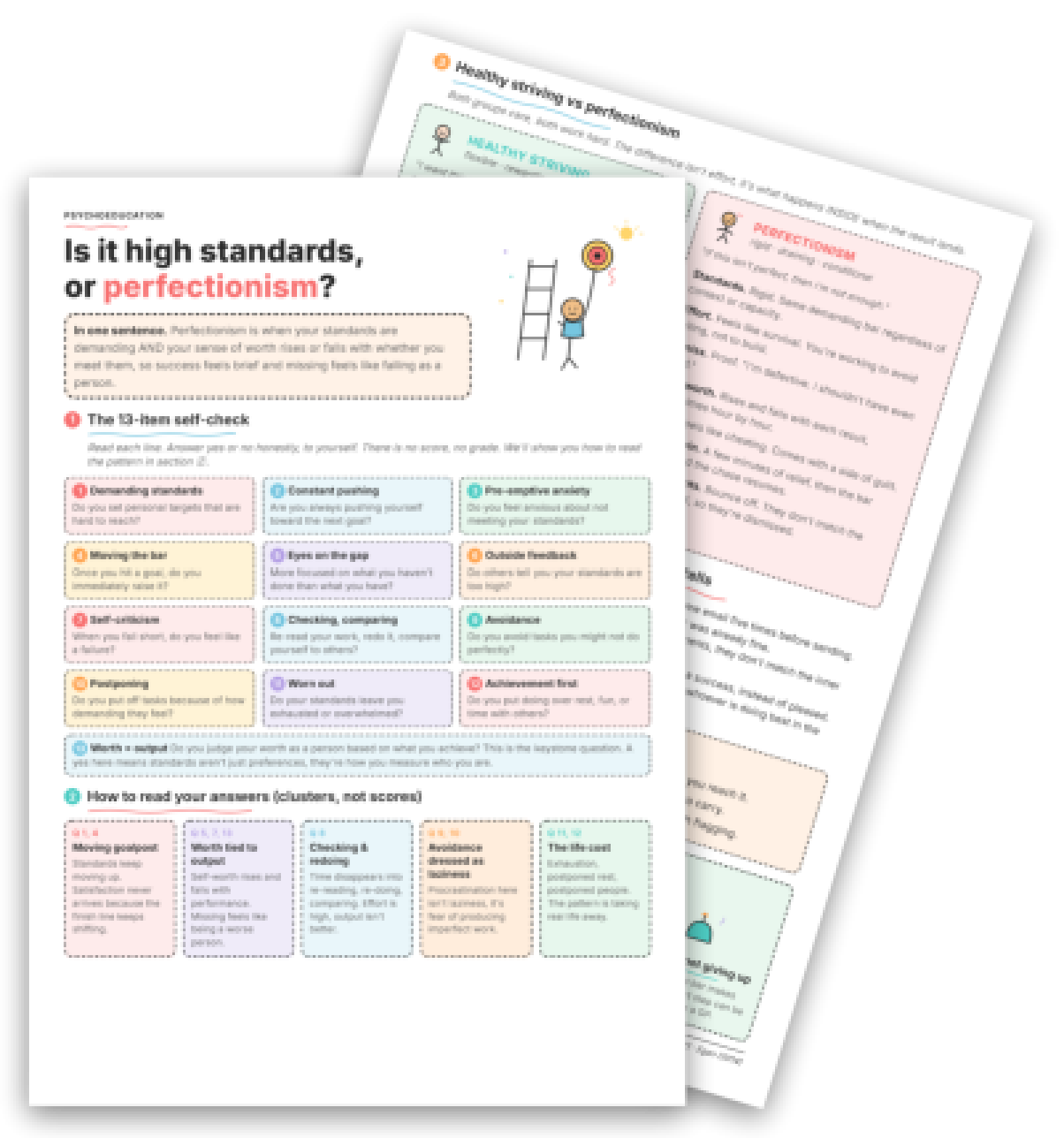
The fiche opens with a single-sentence clinical anchor: "Perfectionism is when your standards are demanding AND your sense of worth rises or falls with whether you meet them." The conjunction is the hinge. Having it printed means you can point to it, and the patient can see what distinguishes their pattern from simply caring about quality.
The first panel is a 13-item self-check, structured as honest yes/no questions with no total score. Item 13 is explicitly flagged as the "keystone question": whether the patient judges their worth as a person based on what they achieve. This is the pivot the entire psychoeducation turns on, and printing it prevents the patient from sliding past it without registering its weight.
Section two teaches the patient to read their answers by cluster, not by count. Five named clusters make the visual layout do work that oral explanation alone cannot:
- Moving goalpost (items 1, 4): standards that shift the moment a goal is reached
- Worth tied to output (items 5, 7, 13): self-esteem that fluctuates with each result
- Checking and redoing (item 8): high effort, no better output, time lost
- Avoidance dressed as laziness (items 9, 10): procrastination driven by fear of imperfect work
- The life cost (items 11, 12): exhaustion, postponed rest, postponed relationships
Section three is a side-by-side comparison of healthy striving and perfectionism, covering standards, effort quality, response to a miss, self-worth stability, rest, response to a win, and the fate of compliments. This is where the visual format earns its place: the patient sees both columns simultaneously and locates themselves, without you having to hold the comparison in the air. Section four maps hidden costs (chronic anxiety, low mood, burnout, rumination, strained closeness), and section five offers concrete daily-life behavioural tells, followed by explicit prompts for what to bring back into session.
> Key point: this PDF worksheet is a visual support that facilitates the explanation of perfectionism in session; you work through it together. The patient takes it home as a named reference, not a task to complete alone.
750+ clinical tools
A library built with and for clinicians, ready to use in session and extend between appointments.
Access all the toolsHow and When to Introduce the Worksheet
This set of tools works best from the second or third session onward, once the anamnesis has surfaced secondary presentations: overwork, difficulty accepting compliments, impostor syndrome dynamics, or constant self-critical comparison. A formal perfectionism presentation is not required as an entry condition.
A useful framing: "I'd like to look at something with you that might name a few patterns we've been noticing. There's no score, no grade, just some questions to read through together." This positions the exercise as collaborative inquiry, not evaluation, which matters with patients whose self-worth is already performance-contingent.
Item 13 typically generates the most productive clinical moment. When a patient answers yes and pauses, that pause opens the work on worth-contingency directly. You can extend it with a structured perfectionism exercise or connect it to values clarification using a personal values exercise. For patients where avoidance is prominent, the cluster framing reframes procrastination as fear rather than character failure, which reduces self-blame and opens the door to self-compassion work around mistakes. Where the growth edge is attentional rigidity, the healthy striving column can pair naturally with growth mindset exercises.
One contraindication worth noting: for patients in acute decompensation or with severe self-critical processing, the item-by-item format can amplify self-attack rather than support observation. In those cases, hold the worksheet until the patient has sufficient metacognitive distance.
The worksheet does not replace the therapeutic frame; it anchors the explanation and leaves the patient with a concrete vocabulary to bring back into subsequent sessions.
Use it with your patients
Share this tool in the mobile app and follow the work between sessions.
Sources
- Frost, R. O., Marten, P., Lahart, C., & Rosenblate, R. (1990). The dimensions of perfectionism. Cognitive Therapy and Research, 14(5), 449-468.
- Shafran, R., Egan, S., & Wade, T. (2010). Overcoming Perfectionism. Constable and Robinson.
- Egan, S. J., Wade, T. D., Shafran, R., & Antony, M. M. (2014). Cognitive-Behavioral Treatment of Perfectionism. Guilford Press.
Your session continues in your patients' pocket
Use with a patientYour resources, available everywhere
The handouts, exercises, programs and audios above: you choose which ones to make available to your patients, in the mobile app dedicated to them.
And far more than a library
The app goes well beyond resources, to support your patients every day:
Related categories
Explore other clinical resources by category.

Anxiety
Clinical hub for anxiety disorders: CBT and ACT worksheets, psychoeducation sheets, and exercises for assessment and treatment across the anxiety spectrum.

Mood
Evidence-based worksheets and clinical tools for mood disorders: CBT, ACT, and positive psychology resources for psychologists and therapists.

Identity
Clinical resources for self-identity work in therapy: CBT, ACT, schema tools for clinicians addressing self-concept, core beliefs, and identity disruption.

Behaviours
Clinical hub for behaviors in therapy: worksheets and tools for coping, eating disorders, CBT formulation, and maladaptive behavioral patterns.

Cognition
Printable cognitive therapy worksheets and clinical tools for therapists: CBT, ACT, schema work, defusion, distortions, and belief restructuring.

Build awareness
Clinical worksheets and tools to build awareness in therapy: cognitive distortions, schemas, emotions, ACT and CBT resources for practitioners.