
Clinical picture. M., a woman in her late thirties, presented with generalized anxiety and a longstanding pattern of seeking reassurance from her partner following any social interaction, asking repeatedly whether she had seemed rude or odd. The clinician introduced the informational sheet on safety crutches during a mid-treatment session, inviting M. to trace her own maintenance loop from the previous week. She identified the trigger (a brief silence at a dinner), the spike, the reassurance request, and the momentary relief, then paused when she reached the "lesson" step and said, quietly, that she had never considered the relief itself as the mechanism sustaining the fear. Over the following two weeks she monitored three reassurance urges without acting on them; her self-reported anxiety did not escalate as anticipated, which opened a productive discussion about what the crutch had been preventing her from learning.
Psychological Safety Crutches: PDF Worksheet, Tools and Exercises
A visual PDF fiche for explaining safety behaviors in session: tools and exercises to help patients recognise the maintenance loop keeping their fear alive.
Clinical vignettes
Reassurance Loop in Generalized Anxiety
Over-Preparation Maintaining Performance Anxiety
Clinical picture. T., a man in his mid-forties referred for occupational burnout, described spending four to five hours revising each client report well beyond any reasonable standard, experiencing marked distress if asked to submit before what he called a final pass. When the clinician shared the crutch typology from the worksheet, T. recognized his pattern immediately under "perfectionism" and noted, with some irritation, that the extra hours had never once prevented criticism. The worksheet framing helped distinguish his behaviour from conscientiousness: the question was not whether the behaviour looked reasonable from the outside, but whether it was workable in terms of cost and learning. T. agreed to submit one report after two drafts as a behavioural experiment; the absence of negative feedback did not eliminate the urge to check, but it provided concrete data to work with in the following session.
Patients arrive already convinced their safety behaviors are working. Naming the concept of psychological safety crutches verbally rarely dislodges that conviction, the relief they feel after the crutch is its own evidence. This PDF fiche gives you a visual support to explain the maintenance mechanism clearly in session, before the patient leaves and reaches for the reassurance call you haven't finished discussing.
Use this resource with your patients
Handout, exercises and materials ready to use, right inside SessionFuel.
Why Safety Behaviors Resist Oral Explanation
The clinical difficulty isn't theoretical. Most practitioners can sketch Salkovskis's safety behavior model in two minutes. The difficulty is that patients experience their crutches as solutions, not as problems. Suggesting that the mental checking, the over-prepared email, or the "safe person" arrangement is maintaining fear can feel, from the patient's side, like you're asking them to remove the only thing that actually helps.
Without a shared visual reference, that friction is hard to move past. The reinforcing mechanism is invisible mid-spike: the patient feels better after the crutch, logs the relief as proof the threat was real, and has often already left the room before the irony registers. The avoidance cycle follows the same logic, but safety behaviors are clinically trickier precisely because the patient is present and functional, just heavily armored. CBT maintaining processes models this well theoretically; the fiche makes it legible to the patient in under five minutes.
What the Fiche Contains
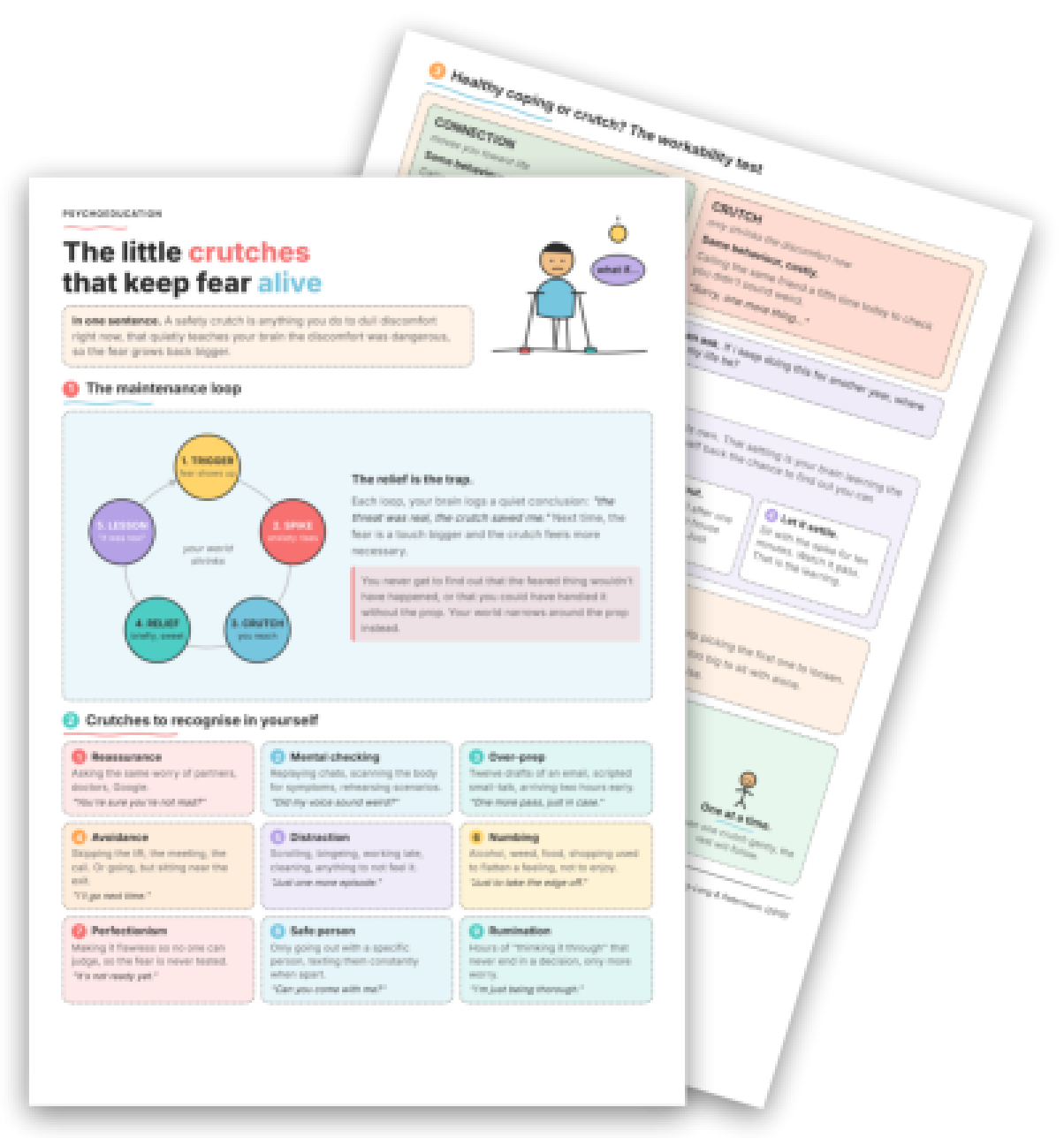
The fiche opens with a single defining sentence: "A safety crutch is anything you do to dull discomfort right now, that quietly teaches your brain the discomfort was dangerous, so the fear grows back bigger." Direct enough to read aloud without paraphrasing.
Four visual panels follow:
- The maintenance loop: a five-step diagram (Trigger → Spike → Crutch → Relief → Lesson) anchored by the line "The relief is the trap." A patient who sees this layout grasps the paradox in a way that a spoken explanation rarely delivers: the crutch doesn't resolve the threat, it files a false report about it.
- Nine crutches to recognise: Reassurance, Mental checking, Over-prep, Avoidance, Distraction, Numbing, Perfectionism, Safe person, and Rumination, each illustrated with a brief inner monologue ("One more pass, just in case" for over-prep; "Sorry, one more thing..." for repeated reassurance calls). The panel normalises without minimising, which protects the alliance at the point of recognition.
- The workability test: a side-by-side comparison between connection (behavior moving toward valued life) and crutch (behavior only shrinking discomfort now), with two self-inquiry questions the patient can carry between sessions.
- From awareness to gentle change: four concrete steps (pick one, notice it, try without, let it settle), grounded in the habituation principle and closing with a clear "To discuss in session" prompt list.
> Key point: this fiche is a visual support for in-session explanation, not a self-monitoring form to complete alone. You work through it together; the patient leaves with it as a reference. It builds a shared vocabulary before graded exposure work begins, and it distinguishes adaptive from maladaptive coping at a level patients can actually use.
750+ clinical tools
A library built with and for clinicians, ready to use in session and extend between appointments.
Access all the toolsWhen and How to Introduce It
The natural entry point is any session where a patient describes a behavior they're uncertain about: "I just like to double-check," or "I always text my partner when I feel off." Rather than labelling it immediately, you can say: "There's a distinction worth looking at together, let me show you this." The workability test ("Does this move me toward the life I want, or only shrink the discomfort right now?") frames the question without triggering defensiveness.
In terms of sequencing, the fiche fits after a first psychoeducation pass on the anxiety maintenance cycle and before starting a formal exposure programme. It is equally well-placed when reassurance-seeking is the primary target, alongside work on checking and certainty behaviors, or when perfectionism is operating as avoidance in disguise. For patients with prominent social anxiety, pairing it with the Clark and Wells model clarifies why in-situation safety behaviors (the scripted small talk, the practiced entrance) actually intensify self-focused attention. In younger populations, coping tools adapted for children and adolescents offer age-calibrated alternatives to introduce alongside this fiche.
For debriefing, asking which of the nine crutches the patient recognised in themselves is a low-stakes entry that keeps the alliance intact while naming the target precisely. The "To discuss in session" prompts on the fiche give the patient a clear set of criteria for when to bring the work back to you, rather than trying to manage it alone.
One limit worth noting: with patients in acute destabilisation, hold panel four (the change steps) until there is sufficient regulatory capacity. Panels one and two remain useful even then. The fiche does not replace formulation or the clinical rationale for automatic behavior change work; it makes the explanation faster, sharper, and leaves the patient with something concrete to hold on to between appointments.
Use it with your patients
Share this tool in the mobile app and follow the work between sessions.
Sources
- Salkovskis, P. M. (1991). The Importance of Behaviour in the Maintenance of Anxiety and Panic: A Cognitive Account. Behavioural and Cognitive Psychotherapy.
Your session continues in your patients' pocket
Use with a patientYour resources, available everywhere
The handouts, exercises, programs and audios above: you choose which ones to make available to your patients, in the mobile app dedicated to them.
And far more than a library
The app goes well beyond resources, to support your patients every day:
Related categories
Explore other clinical resources by category.

Anxiety
Clinical hub for anxiety disorders: CBT and ACT worksheets, psychoeducation sheets, and exercises for assessment and treatment across the anxiety spectrum.

Mood
Evidence-based worksheets and clinical tools for mood disorders: CBT, ACT, and positive psychology resources for psychologists and therapists.

Behaviours
Clinical hub for behaviors in therapy: worksheets and tools for coping, eating disorders, CBT formulation, and maladaptive behavioral patterns.

Cognition
Printable cognitive therapy worksheets and clinical tools for therapists: CBT, ACT, schema work, defusion, distortions, and belief restructuring.

Understand
Clinical hub for the therapeutic aim 'Understand': worksheets and tools to build patient insight across CBT, ACT, schema therapy and more.

Build awareness
Clinical worksheets and tools to build awareness in therapy: cognitive distortions, schemas, emotions, ACT and CBT resources for practitioners.