
Clinical picture. T., a 34-year-old teacher, presents with longstanding social anxiety centred on staff meetings; she describes leaving each one convinced she had embarrassed herself, despite colleagues' neutral reactions. During the second session, the clinician introduces the Clark and Wells informational sheet and walks through the loop diagram together, inviting T. to map her own experience onto each node. T. quickly identifies that during meetings her attention shifts entirely inward, that she grips her pen and rehearses sentences before speaking, and that she replays the meeting for most of the evening. Naming the self-as-social-object process visibly shifted T.'s framing: she noted, unprompted, that she had never actually watched the room, only herself. This shared formulation became the reference point for subsequent work on attentional retraining and safety behaviour reduction.
Clark & Wells Model of Social Anxiety: PDF Worksheet, Tools and Exercises
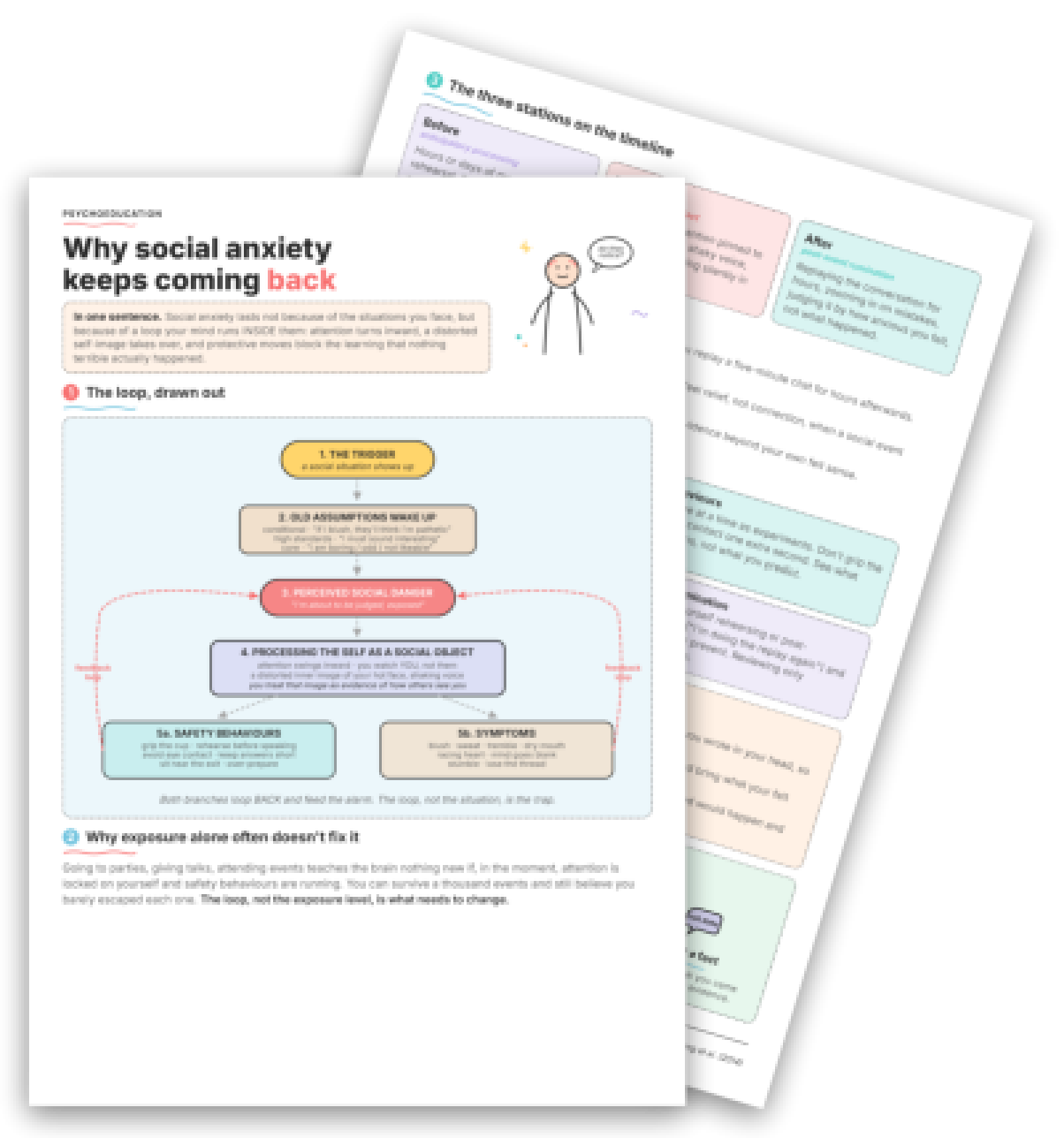
A visual PDF worksheet to explain the Clark & Wells maintenance loop in session, giving patients a concrete map of why social anxiety persists and where to intervene.
Clinical vignettes
Naming the Loop in a First Session
Post-Event Rumination Recognised Late
Clinical picture. M., a 28-year-old postgraduate student, had completed a previous course of CBT focused on exposure; anxiety at seminars had decreased only modestly, and he could not account for why. Reviewing the Clark and Wells sheet together, the clinician drew attention to the timeline section covering anticipatory processing and post-event rumination, both of which M. had not previously identified as part of his difficulty. He described spending Sunday evenings rehearsing Monday presentations in near-perfect detail, and two to three hours each Monday night replaying what he judged to be failures. The sheet clarified why repeated attendance at seminars had not updated his threat beliefs: the loop had been running before and after each event, not only during it. Subsequent sessions targeted the rumination phase directly, which M. found more tractable than the in-session exposure work had been.
Patients with social anxiety rarely struggle to name their fear. What they almost universally miss is the internal loop sustaining it, and explaining that loop verbally, mid-session, rarely lands as cleanly as the model deserves. This PDF worksheet on the Clark & Wells model gives you a visual anchor for that explanation, one you can place in front of the patient and work through together in real time.
Use this resource with your patients
Handout, exercises and materials ready to use, right inside SessionFuel.
Why the Clark & Wells Loop Is So Difficult to Convey at the Whiteboard
The core mechanism Clark & Wells identified in 1995 is deceptively counterintuitive: the problem is not the social situation but what the mind does inside it. Most patients arrive believing that more exposure will eventually fix things. They have attended dozens of parties, given multiple presentations, forced themselves through countless interactions, and still feel they barely survived each one. That paradox is hard to articulate verbally without the patient concluding, wrongly, that they are simply beyond help.
Two specific elements generate the most confusion in oral psychoeducation. First, self-focused attention is invisible by definition; patients process themselves as a social object without realising that this shift in attentional direction is the mechanism, not a symptom. Second, safety behaviours feel rational and even socially skilled (rehearsing answers, keeping responses short, gripping the cup for steadiness), so framing them as maintenance factors meets significant resistance. Without a clear visual, patients tend to hear the explanation as abstract theory and walk out of the session unconvinced.
What the Worksheet Contains: A Visual Map of the Loop
The fiche PDF structures the Clark & Wells model across five named sections, each grounded in a distinct clinical target.
- The loop, drawn out: a numbered five-step diagram tracing the full cycle from trigger through conditional and core assumptions, perceived social danger, processing the self as a social object, and the twin feedback branches of safety behaviours and somatic symptoms. Seeing the two feedback arrows return to the alarm gives patients an immediate visual grasp of why the situation is not the trap but the loop is.
- Why exposure alone often doesn't fix it: a short explanatory panel directly addressing the "I've tried exposure and nothing changed" impasse. This section is particularly useful for patients who have already completed a basic graded exposure hierarchy without meaningful belief change.
- The three stations on the timeline: anticipatory processing, the live self-as-social-object loop, and post-event rumination, each with a concrete clinical descriptor. The temporal map is something a spoken explanation rarely conveys; patients suddenly recognise that their anxiety is not confined to the event itself.
- Signs your loop is running: five behavioural indicators, including "You leave a conversation more aware of what your face was doing than of what the other person said" and "You feel relief, not connection, when a social event ends." These function as recognition prompts, not a checklist the patient fills in alone.
- What breaks each link: targeted strategies for each maintenance factor, outward attention practice for self-focused monitoring, behavioural experiments for safety behaviour reduction, video feedback or honest peer feedback for the distorted self-image, and redirection techniques for ruminative post-event processing.
- To discuss in session: three explicit homework bridges ("When you try dropping ONE safety behaviour as an experiment, bring what you predicted would happen and what actually did"), making the debrief structure for your next appointment built in.
> Key point: the worksheet is a visual support that facilitates the explanation in session, not a self-help handout. Its value is that the clinician works through it with the patient, pointing to the loop diagram and the three-timeline row in real time, then leaves the patient with a concrete reference to take home.
750+ clinical tools
A library built with and for clinicians, ready to use in session and extend between appointments.
Access all the toolsWhen and How to Introduce It
The worksheet fits most naturally after the initial symptom mapping and before the behavioural experiment phase. Session two or three is typically the right window, once alliance is established and the patient has identified at least one recurrent social situation that triggers the loop.
A low-resistance introduction: "I want to show you a diagram that explains why what you've been doing, which makes complete sense, keeps the anxiety going rather than reducing it. Have a look at this with me." That framing externalises the problem, positions safety behaviours as learned strategies rather than character deficits, and immediately reduces shame.
For patients who have already tried graded exposure exercises without success, the "Why exposure alone often doesn't fix it" panel is particularly disarming. It validates their experience and reorients the clinical work toward attention training and challenging the distorted self-image rather than simply increasing exposure dosage. Pair it with the Social Anxiety Psychoeducation program for patients who benefit from structured between-session reading.
One contraindication to flag: for patients with high shame sensitivity or a strong approval-seeking schema, introducing the safety behaviour section too early can feel like criticism of their coping. Normalise explicitly before pointing to that panel.
The worksheet does not replace case formulation or alliance work. It makes one specific, often elusive explanation clear, and hands the patient a map they can return to between sessions.
Use it with your patients
Share this tool in the mobile app and follow the work between sessions.
Sources
- Clark, D. M., & Wells, A. (1995). A cognitive model of social phobia. Guilford Press.
- Clark, D. M. (2001). A cognitive perspective on social phobia. John Wiley & Sons.
- Wells, A. (1997). Cognitive Therapy of Anxiety Disorders: A Practice Manual and Conceptual Guide. John Wiley & Sons.
- Leigh, E., & Clark, D. M. (2018). Understanding Social Anxiety Disorder in Adolescents and Improving Treatment Outcomes: Applying the Cognitive Model of Clark and Wells (1995).
- National Institute for Health and Care Excellence (NICE) (2013). Social anxiety disorder: recognition, assessment and treatment (CG159).
Your session continues in your patients' pocket
Use with a patientYour resources, available everywhere
The handouts, exercises, programs and audios above: you choose which ones to make available to your patients, in the mobile app dedicated to them.
And far more than a library
The app goes well beyond resources, to support your patients every day:
Related categories
Explore other clinical resources by category.

Anxiety
Clinical hub for anxiety disorders: CBT and ACT worksheets, psychoeducation sheets, and exercises for assessment and treatment across the anxiety spectrum.

Understand
Clinical hub for the therapeutic aim 'Understand': worksheets and tools to build patient insight across CBT, ACT, schema therapy and more.

Build awareness
Clinical worksheets and tools to build awareness in therapy: cognitive distortions, schemas, emotions, ACT and CBT resources for practitioners.

CBT
CBT worksheets, cognitive restructuring exercises & behavioral tools for clinicians. Evidence-based resources for every phase of cognitive behavioral therapy.

Trauma
Clinical hub on trauma and PTSD: assessment, differential diagnosis, treatment phases, and printable resources for practitioners. 155 chars.

Mood
Evidence-based worksheets and clinical tools for mood disorders: CBT, ACT, and positive psychology resources for psychologists and therapists.