
Clinical picture. T., a woman in her late thirties, presented with persistent low mood and a pattern of overworking that left her exhausted and resentful. She described herself as someone who simply had high standards, and initially found the idea of a "bottom line" abstract. The clinician introduced Fennell's psychoeducation sheet in session, walking through the cycle from early experience to maintaining behaviour. When T. reached the rules column and read the prompt aloud, she paused and said, "I'm only okay if I'm useful to everyone" before adding, quietly, that she had never put it quite that way before. The session ended with T. agreeing to note occasions during the week when that rule felt most active, without any pressure to challenge it yet.
Fennell's CBT Model of Low Self-Esteem: PDF Worksheet, Tools and Exercises
A visual psychoeducation fiche to explain the Fennell cycle of low self-esteem in session, with tools and exercises for clinical practice.
Clinical vignettes
Naming the Verdict in Session
Distinguishing Trigger from Verdict
Clinical picture. M., a man in his mid-forties referred after a period of signed-off work, presented with shame following a critical performance review. He described the review as proof that he had always been incompetent, a reading that had remained unchallenged across several previous contacts. The clinician used the informational sheet to map the incident onto Fennell's cycle, placing the review at step four as a critical incident rather than as evidence of a global truth. M. recognised, with some surprise, that the feeling of being defective had a longer history than the review itself. This distinction did not resolve the belief, but it created enough space to begin exploring the early experiences that had made "I'm defective" feel so factual.
Explaining Fennell's model verbally rarely lands on the first try. Patients understand the words, nod, and then leave the session still treating their bottom line as biographical truth rather than a learned cognitive structure. This fiche PDF gives you a visual scaffold to walk through the full maintenance cycle in session, so the patient can see the architecture of their self-esteem problem rather than just hear about it.
Use this resource with your patients
Handout, exercises and materials ready to use, right inside SessionFuel.
Why Low Self-Esteem Resists Verbal Explanation
The clinical difficulty is not the concept itself. Most practitioners who work within CBT or schema therapy know Fennell's 1999 model well. The difficulty is that the patient is inside the cycle: the bottom line ("I'm not good enough," "I'm defective") feels like unmediated reality, not a learned conclusion. When you describe the loop at the whiteboard or in words, two things work against you.
First, the patient's confirmatory processing is active in real time: compliments get discounted, evidence of competence gets attributed to luck, and your own warm regard can be dismissed as professional obligation. Second, the concept has several moving parts, namely early experiences, the bottom line, rules for living, a critical incident, four simultaneous activation channels, and the confirmation loop, and holding all of them in working memory while also tracking their own emotional response is simply too much to ask.
A visual layout solves both problems. It anchors the model outside the patient's head, makes the loop's self-referential logic visible as a diagram, and gives them something to look at when the bottom line is pulling their attention downward.
750+ clinical tools
A library built with and for clinicians, ready to use in session and extend between appointments.
Access all the toolsWhat the Fiche Contains
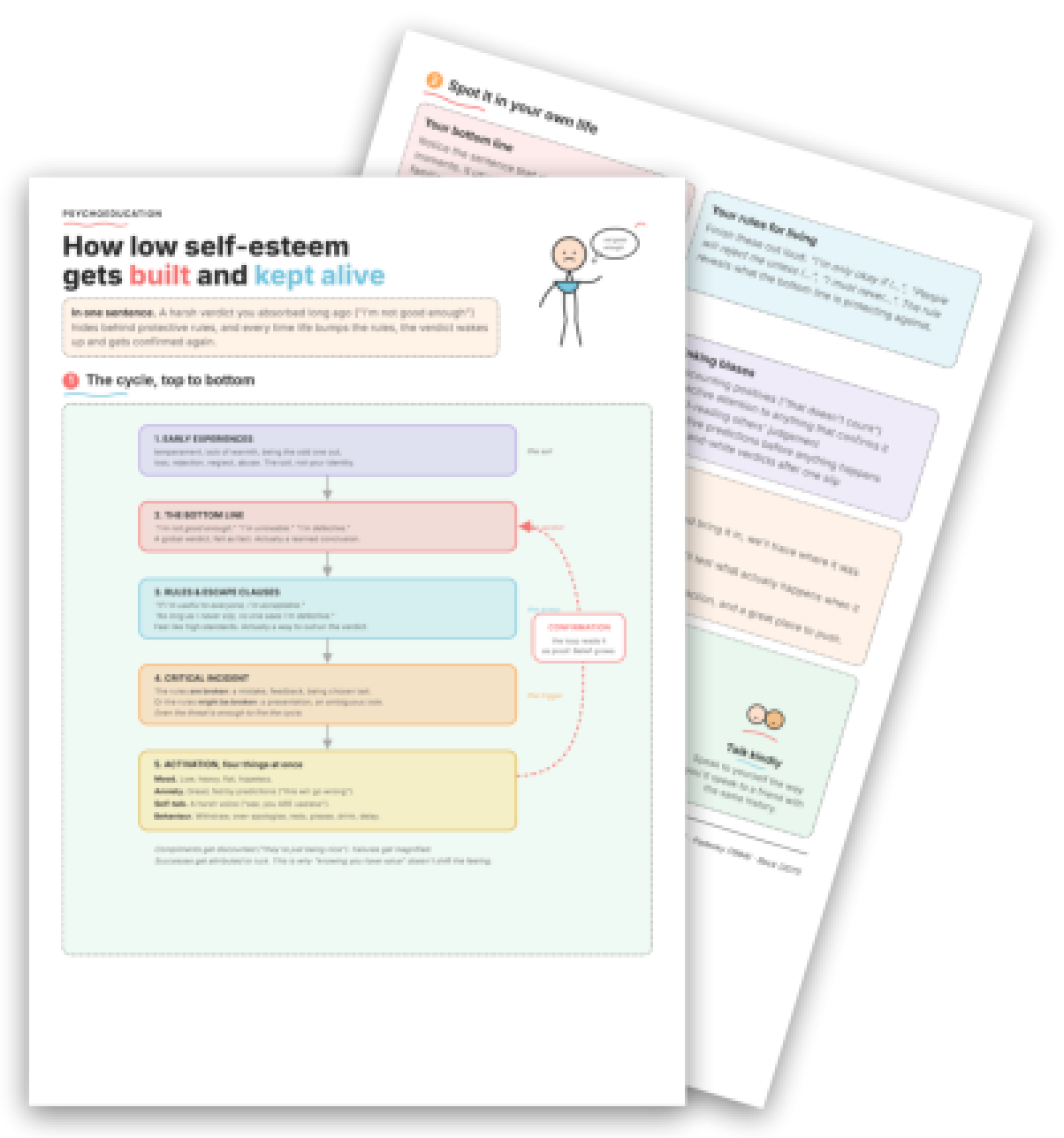
The fiche PDF is structured across three panels, all derived from Fennell (1999), Padesky (1994), and Beck (2011).
Panel 1 walks the full cycle from top to bottom: Early Experiences (framed explicitly as "the soil, not your identity"), the bottom line as a global verdict felt as fact, rules and escape clauses (the armour), a critical incident that fires the cycle, and activation across four simultaneous channels: mood, anxiety, self-talk, and behaviour. The confirmation loop closes the diagram with the key clinical note that "this is why 'knowing you have value' doesn't shift the feeling", which is often the sentence that makes patients stop and re-read.
Panel 2 offers two reflective prompts for in-session use: identifying the patient's own bottom line ("the sentence that shows up in your worst moments") and surfacing their rules for living through sentence-completion starters ("I'm only okay if I...", "I must never..."). These are not take-home self-report items. Use them as conversation openers while the patient looks at the fiche.
Panel 3 maps what keeps the cycle alive: a list of maintaining behaviours (perfectionism, people-pleasing, hiding opinions, avoiding evaluation) alongside the thinking biases that feed confirmation (discounting positives, selective attention to negative information, mind-reading, negative prediction, black-and-white verdicts). Three specific "To discuss in session" prompts at the bottom give the patient a precise brief for between-session observation: write down any "I am..." sentence on a heavy day, name any "If...then..." rule that bends, note any discounted compliment.
> Key point: the fiche is a visual support that facilitates your explanation of the Fennell cycle in session. It is not a questionnaire the patient completes alone at home. The diagram does the conceptual heavy lifting so you can spend the session on the patient's specific material, not on re-explaining the architecture.
Use it with your patients
Share this tool in the mobile app and follow the work between sessions.
When and How to Introduce It
The fiche fits most naturally in early psychoeducation phase, once the anamnèse has surfaced a pattern of low self-esteem or a defectiveness or shame schema. It is also useful mid-treatment when a patient is stuck, particularly if they report that compliments feel hollow or that they cannot hold positive evidence.
A straightforward introduction: "I'd like to show you a map of how low self-esteem tends to maintain itself. As I talk through it, see if any part resonates with your own experience." This framing positions the fiche as a shared object of curiosity, not a diagnostic label being applied to the patient.
Debrief by going directly to Panel 1 and asking: "Where does your cycle tend to start?" For patients with perfectionism features, the rules-and-escape-clauses layer usually generates the most recognition. For those with strong approval-seeking patterns, the activation column (especially the behaviour channel) is often the entry point. The downward arrow technique pairs well as a follow-up tool once the bottom line has been named.
One practical limit: for patients in acute crisis or with severely fragile alliance, seeing the full cycle visually can feel overwhelming. In those cases, introduce only Panel 1 and defer the maintaining-behaviours panel to a later session when the formulation feels more collaborative than exposing.
The fiche does not replace the cognitive case formulation or the self-image and self-esteem psychoeducation work that follows. It gives the patient a durable reference they can return to between sessions when the confirmation loop fires, which is precisely when they need it most.
Your session continues in your patients' pocket
Use with a patientYour resources, available everywhere
The handouts, exercises, programs and audios above: you choose which ones to make available to your patients, in the mobile app dedicated to them.
And far more than a library
The app goes well beyond resources, to support your patients every day:
Related categories
Explore other clinical resources by category.

Anxiety
Clinical hub for anxiety disorders: CBT and ACT worksheets, psychoeducation sheets, and exercises for assessment and treatment across the anxiety spectrum.

Mood
Evidence-based worksheets and clinical tools for mood disorders: CBT, ACT, and positive psychology resources for psychologists and therapists.

Identity
Clinical resources for self-identity work in therapy: CBT, ACT, schema tools for clinicians addressing self-concept, core beliefs, and identity disruption.

Understand
Clinical hub for the therapeutic aim 'Understand': worksheets and tools to build patient insight across CBT, ACT, schema therapy and more.

Build awareness
Clinical worksheets and tools to build awareness in therapy: cognitive distortions, schemas, emotions, ACT and CBT resources for practitioners.

CBT
CBT worksheets, cognitive restructuring exercises & behavioral tools for clinicians. Evidence-based resources for every phase of cognitive behavioral therapy.