
Clinical picture. A, a man in his late thirties, presented with low mood and mounting occupational difficulties after several months of calling in sick on days when a difficult line manager was scheduled to be present. In session, the clinician used the five-step avoidance loop from the worksheet to trace one specific episode: a Friday afternoon email that A had left unopened for eleven days. Walking through the sequence together, A recognized for the first time that the relief he felt after closing his inbox was reinforcing the behavior, not a sign that he was managing well. He left with one agreed behavioral experiment: to open the next work email within two hours of receipt, without acting on it, simply to break the trigger-to-avoidance reflex. At the following appointment he reported completing this on three occasions, noting that anticipated dread had peaked and subsided faster than expected.
Changing Avoidance: PDF Worksheet, Tools and Exercises for Clinical Practice
A structured visual PDF worksheet with tools and exercises to map avoidance loops, explain experiential avoidance, and introduce behavioral activation directly in session.
Clinical vignettes
Mapping the Loop in a First Session
Recognizing Soothing Creep Over Time
Clinical picture. T, a woman in her mid-fifties referred following a bereavement, described her evenings as consumed by television and snacking, with activities she had previously valued, including a weekly choir and visits to a close friend, gradually dropped over eight months. The clinician introduced the asymmetry concept from the worksheet, noting that short-term relief from solitary soothing is loud and immediate, while the cumulative cost of a shrinking world is quiet and only visible in retrospect. T identified the choir as the smallest, most concrete re-engagement step, chosen because attendance required no conversation and ended at a fixed time. She attended once before the next session and described the experience as effortful but not overwhelming, which opened a productive discussion about graded reactivation rather than an all-or-nothing return.
Explaining experiential avoidance in session is deceptively difficult: patients nod, agree the pattern sounds familiar, then leave without the conceptual grip needed to actually notice it in the moment. This PDF worksheet on changing avoidance gives you a structured visual support to bridge that gap, turning an abstract maintenance mechanism into something the patient can see, map, and work with between sessions.
Use this resource with your patients
Handout, exercises and materials ready to use, right inside SessionFuel.
Why Avoidance Resists Explanation in Session
The clinical sticking point is not the concept itself. It is the asymmetry. Avoidance works. The relief is immediate, somatic, and subjectively rewarding, which is exactly why the behavior consolidates. Patients do not frame their withdrawal as avoidance; they experience it as a rational response to an aversive state. When you describe the negative reinforcement loop verbally, many patients understand it abstractly but cannot feel the asymmetry. They hear "it comes at a cost" and agree in the moment. Three weeks later, the loop is intact.
This is where a visual layout earns its place. The contrast between short-term relief and long-term cost is not a matter of logic for most patients; it is a matter of salience. A diagram that renders the two sides simultaneously, with their different timescales and intensities, shows what a verbal explanation only states. The fiche is particularly useful with patients presenting with depression and situational withdrawal, chronic procrastination, or anxiety-driven social restriction, where the avoidance loop is dense and ego-syntonic.
What the Fiche Contains: A Visual Map of the Loop
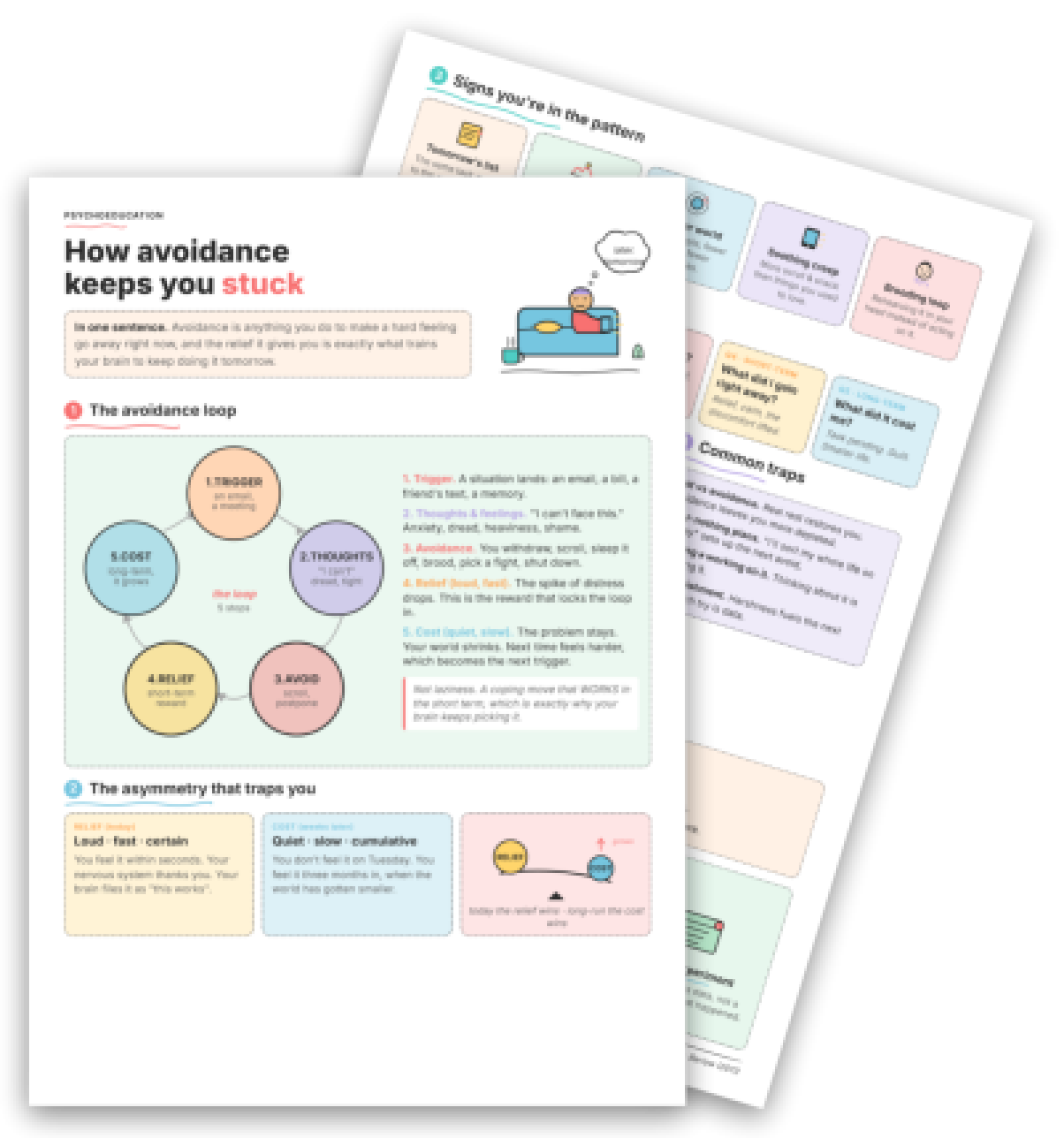
The worksheet is built around six thematic panels, each designed to be read and discussed in session rather than completed independently.
The first panel opens with a one-sentence anchor: "Avoidance is anything you do to make a hard feeling go away right now, and the relief it gives you is exactly what trains your brain to keep doing it tomorrow." This framing is deliberately non-pathologising, which helps sustain alliance when introducing the concept.
- The avoidance loop traces five sequential stops: Trigger, Thoughts and feelings, Avoidance behavior, Relief (fast, loud, certain), and Cost (quiet, slow, cumulative). The visual layout places cost explicitly downstream, making the temporal gap between reward and consequence concrete.
- The asymmetry panel juxtaposes relief and cost side by side, naming them: "today the relief wins, long-run the cost wins." This is the diagram to point to when a patient insists avoidance "helps."
- Signs you're in the pattern lists five behavioral markers, including "the same task moves to the next day, again" and "fewer people, fewer places, fewer activities." These serve as tracking anchors between sessions.
- Map one episode offers five structured questions (situation, internal experience, avoidance behavior, short-term gain, long-term cost), directly usable as a behavioral self-monitoring exercise after psychoeducation.
- Trade it for a small approach move reframes action through value-anchoring and an experimental stance, with concrete micro-examples (send the 1-line reply, open the doc for 5 minutes). This connects naturally with Activity Menu and behavioral activation planning tools.
- Common traps addresses the rest-versus-avoidance confusion, all-or-nothing planning, and the brooding-as-work error, three miscalibrations that frequently derail adaptive coping work mid-treatment.
> Key takeaway: The fiche is a visual support for explaining avoidance in session, not a self-guided questionnaire. Its value lies in what the clinician does with it alongside the patient: pointing, naming, and building shared vocabulary around a loop the patient has never seen from the outside.
750+ clinical tools
A library built with and for clinicians, ready to use in session and extend between appointments.
Access all the toolsWhen and How to Introduce It in Session
The fiche fits best in early-to-mid psychoeducation, once the chief complaint is clear and before graduated exposure or behavioral activation work begins. It is not a first-session tool; it lands better once the patient has described at least one concrete avoidance episode you can use to walk through the loop together.
A low-threshold introduction: "I have a one-page diagram that maps exactly what you described. Let's look at it together and see where your situation fits." This avoids labelling while using the visual to do the conceptual work.
For patients with social anxiety, the "smaller world" framing in panel three can be especially activating. For those with generalised anxiety and high intolerance of uncertainty, the experimental stance in panel five ("you're collecting data, not chasing a mood") dovetails with psychological flexibility work and the Choice Point. Debrief the five-question mapping in the following session, using any completed examples as case material for building an exposure hierarchy or a weekly activity plan.
The fiche does not replace a full formulation of avoidance within the care plan. What it does is give the patient a durable visual reference, one they can return to between sessions when the pull to withdraw is strongest.
Use it with your patients
Share this tool in the mobile app and follow the work between sessions.
Sources
- Martell, C. R., Dimidjian, S., & Herman-Dunn, R. (2022). Behavioral Activation for Depression: A Clinician's Guide (2nd ed.). Guilford Press.
- Martell, C. R., Addis, M. E., & Jacobson, N. S. (2001). Depression in Context: Strategies for Guided Action. W. W. Norton.
- Hayes, S. C., Strosahl, K. D., & Wilson, K. G. (1999). Acceptance and Commitment Therapy: An Experiential Approach to Behavior Change. Guilford Press.
Your session continues in your patients' pocket
Use with a patientYour resources, available everywhere
The handouts, exercises, programs and audios above: you choose which ones to make available to your patients, in the mobile app dedicated to them.
And far more than a library
The app goes well beyond resources, to support your patients every day:
Related categories
Explore other clinical resources by category.
Anxiety
Clinical hub for anxiety disorders: CBT and ACT worksheets, psychoeducation sheets, and exercises for assessment and treatment across the anxiety spectrum.

Trauma
Clinical hub on trauma and PTSD: assessment, differential diagnosis, treatment phases, and printable resources for practitioners. 155 chars.

Mood
Evidence-based worksheets and clinical tools for mood disorders: CBT, ACT, and positive psychology resources for psychologists and therapists.

Behaviours
Clinical hub for behaviors in therapy: worksheets and tools for coping, eating disorders, CBT formulation, and maladaptive behavioral patterns.

Build awareness
Clinical worksheets and tools to build awareness in therapy: cognitive distortions, schemas, emotions, ACT and CBT resources for practitioners.

Engage & motivate
Clinical hub: printable worksheets and exercises to build therapeutic engagement and motivation across ACT, CBT, and integrative practice. For clinicians.