
Clinical picture. M., a 34-year-old with recurrent mild depression, presented reporting persistent rumination about a conflict with a colleague; she could describe the situation in exhaustive detail yet felt paralysed when asked what she might do next. The clinician introduced the solution-focused worksheet, inviting her to name the problem in one concrete sentence rather than as a general grievance, then to list her prior attempts. On paper, M. noticed she had tried five variations of the same strategy: avoiding the colleague entirely. Working through the brainstorm step surfaced one option she had not considered, sending a brief written message instead of waiting for a face-to-face opportunity. By the end of the session she had identified a specific action with a date, which reduced her reported dread without requiring any commitment to a particular outcome.
Focusing on Solutions: PDF Worksheet, Tools and Exercises for Clinical Practice
A visual PDF worksheet with structured tools and exercises to help patients move from ruminative problem-mode to one concrete, scheduled next step in session.
Clinical vignettes
Breaking a Rumination Loop at Work
From Rehearsal to One Scheduled Step
Clinical picture. T., a 47-year-old presenting with generalised anxiety, described lengthy nightly rehearsals about an unresolved family matter; he reported exhaustion without having taken any concrete action in several weeks. The clinician used the worksheet's problem-mode versus action-mode contrast to name what was happening, normalising the function of rumination as a way of keeping the problem at a safe distance. T. completed the five steps in session, and the weighing phase revealed that his preferred options all required a single conversation he had been postponing, whereas one lower-stakes step, drafting a short message to clarify a practical point, was reachable within two days. He left with that specific task noted in his calendar; at the following session he reported that completing it had not resolved the broader situation but had interrupted the Sunday-night dread cycle.
Patients caught in what the literature on perseverative cognition describes as problem-mode can articulate a difficulty with remarkable precision and still freeze completely on "what next." Verbal explanation alone rarely breaks that loop. This fiche PDF on focusing on solutions functions as an in-session visual that makes the problem-to-action shift legible, not just audible, and leaves the patient with a concrete reference to take home.
Use this resource with your patients
Handout, exercises and materials ready to use, right inside SessionFuel.
Why Problem-Mode Thinking Resists Oral Explanation
The core clinical difficulty is that ruminative analysis feels productive. Patients replay, weigh, and what-if. They produce what the fiche describes as "a very detailed map of what's wrong" while their body stays "tired, tense, no movement." When you name this dynamic verbally, patients often agree, nod, and continue ruminating. The asymmetry between apparent cognitive effort and zero behavioral output stays invisible to them because thinking and acting share a convincingly similar surface structure.
This dynamic overlaps with the ruminative loops explored in the Constructive vs Harmful Rumination worksheet and the rumination psychoeducation program. The key distinction here is directional: where rumination-focused work targets the thinking pattern itself, this fiche pivots immediately toward behavioral output. It complements, rather than duplicates, that work.
Patients presenting with procrastination, depression-linked avoidance, or motivation loss are especially likely to recognise themselves in the signs-you're-stuck panel: "same worry loops at 3am," "exhausted without having moved anything," or the defensive "I've already tried everything." Naming those signs visually, rather than clinically, short-circuits the patient's reflex to argue with the framing.
What the Fiche Contains: A Visual Support for the Session
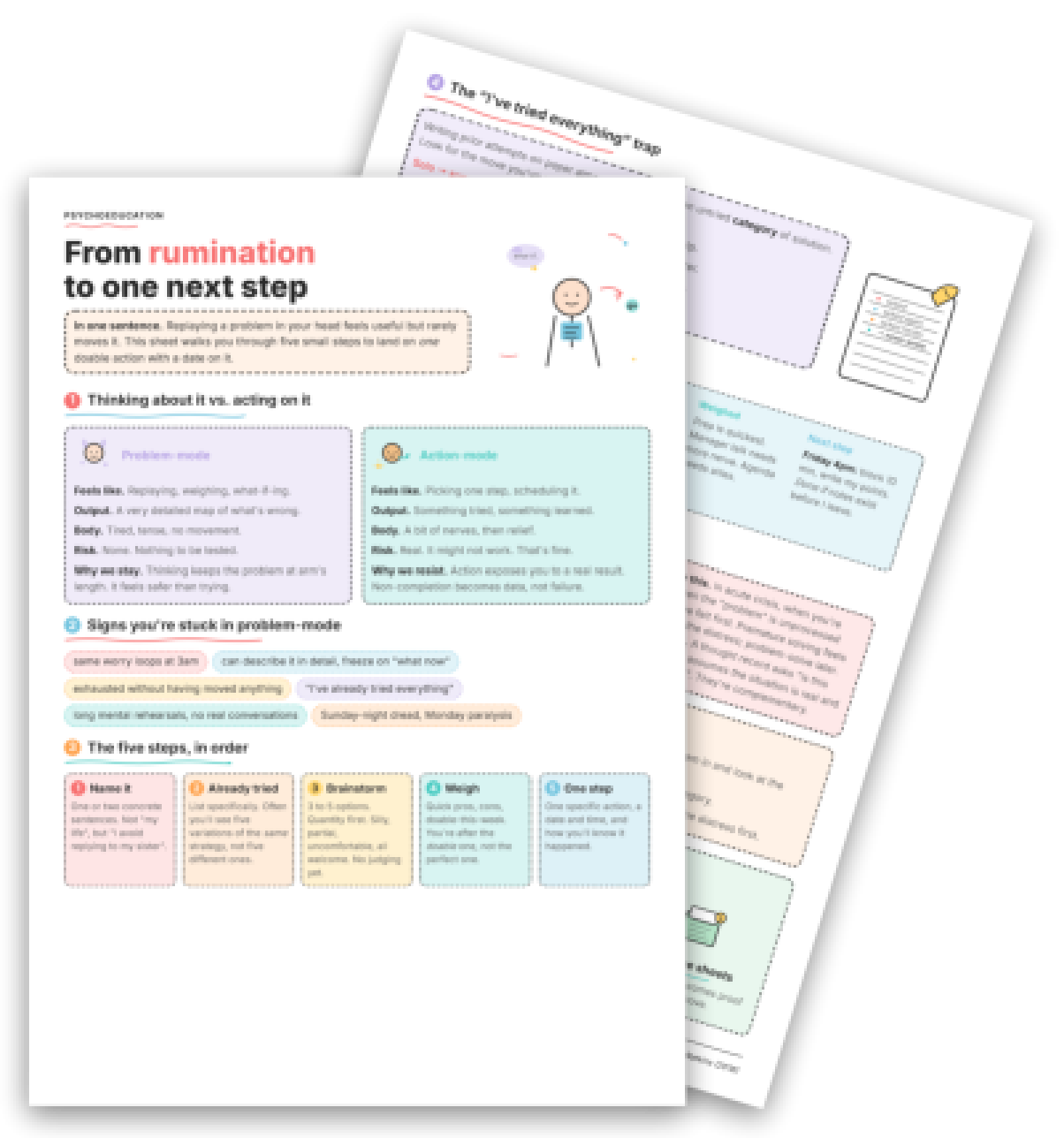
The fiche is organised into six panels on a single printable page. Its value as a visual support is that it externalises the comparison the clinician would otherwise have to rebuild verbally in every session.
Panel 1 places problem-mode and action-mode side by side across five dimensions: subjective feel, output, somatic state, risk level, and the reason each mode gets maintained. Seen in a table rather than heard in succession, the contrast lands immediately. Patients who have been describing their situation for weeks often pause at this panel.
Panel 2 lists six behavioural signs of being stuck, giving patients a recognition checklist without pathologising language.
Panel 3 is the structural spine of the fiche: a five-step sequence (Name it, Already tried, Brainstorm, Weigh, One step). The final step requires "one specific action, a date and time, and how you'll know it happened", a level of precision that pairs naturally with the structured goal-setting exercise and weekly behavioral activation planning. The fiche explicitly separates divergent generation (brainstorming) from convergent evaluation (weighing), a distinction that is easy to state but hard for patients to apply without a visual prompt.
Panel 4 addresses the "I've tried everything" trap by mapping four untried solution categories: Solo→support, Talk→write, Fix→accept, Push→pause. Writing prior attempts on paper almost always reveals five variations of the same strategy, not five genuinely different ones. The worked example in Panel 5 (dreading Monday meetings, taken through all five steps) makes the sequence concrete for patients who struggle to abstract from instructions alone.
Panel 6 closes with key distinctions, including an explicit "when NOT to use this" note covering acute crisis, dissociation, and unprocessed pain where premature problem-solving risks feeling invalidating. That note is worth reading aloud with the patient when you introduce the sheet.
> Key point: This fiche is a visual support for psychoeducation in session, not a self-report questionnaire. The clinician walks through the panels with the patient; the sheet goes home as a reference, not an autonomous assignment to complete alone.
750+ clinical tools
A library built with and for clinicians, ready to use in session and extend between appointments.
Access all the toolsWhen and How to Introduce It in Session
The fiche fits naturally after the initial case formulation (see the CBT problem exploration model), once the maintenance cycle is mapped and the patient has spent several sessions describing a situation without movement. It slots well into behavioral activation protocols in depression, and into mid-therapy moments where avoidance is named but action planning keeps stalling.
A low-resistance introduction: "You've described this clearly. I'd like to look at something together that maps out why the 'what next' part gets stuck, and then run through a short sequence with you." This positions the fiche as shared clinical work, not a patient directive.
The built-in debrief prompts at the end of the fiche are useful clinical leverage: if the patient has completed three sheets and the chosen step keeps not happening, that pattern becomes the clinical material. Bring it into session and look at what gets in the way, whether the step was too large, the timing wrong, or avoidance showed up in a new form. For patients whose non-completion signals something more, the rumination self-monitoring exercise and the adaptive vs maladaptive coping framework are natural companions.
One firm contraindication: do not introduce this fiche when the primary need is affect validation. The fiche assumes the situation is real and asks "what will you do?" That stance reads as dismissive when acute distress is still uncontained. Pair it with distress tolerance tools or emotional regulation work first, then return to solution-focused planning once the window is open. The fiche does not replace the therapeutic frame; it makes one specific clinical move faster, cleaner, and easier to revisit between sessions.
Use it with your patients
Share this tool in the mobile app and follow the work between sessions.
Sources
- de Shazer, S., Dolan, Y., Korman, H., Trepper, T., McCollum, E., Berg, I. K. (2007). More Than Miracles: The State of the Art of Solution-Focused Brief Therapy. Routledge.
- Martell, C. R., Dimidjian, S., Herman-Dunn, R. (2022). Behavioral Activation for Depression: A Clinician's Guide (2nd ed.). Guilford Press.
Your session continues in your patients' pocket
Use with a patientYour resources, available everywhere
The handouts, exercises, programs and audios above: you choose which ones to make available to your patients, in the mobile app dedicated to them.
And far more than a library
The app goes well beyond resources, to support your patients every day:
Related categories
Explore other clinical resources by category.

Emotions
Clinical resources on emotion regulation: worksheets, coping tools, CBT, REBT, and ACT exercises for therapists working across diagnoses and age groups.

Transitions
Clinical hub for life transitions: tools, worksheets and exercises to support psychosocial adjustment, role change and identity work in practice.

Cognition
Printable cognitive therapy worksheets and clinical tools for therapists: CBT, ACT, schema work, defusion, distortions, and belief restructuring.

Build awareness
Clinical worksheets and tools to build awareness in therapy: cognitive distortions, schemas, emotions, ACT and CBT resources for practitioners.

Build skills
Skill-building resources for clinicians: printable worksheets and exercises for coping, assertiveness, and communication skills training in therapy.

Engage & motivate
Clinical hub: printable worksheets and exercises to build therapeutic engagement and motivation across ACT, CBT, and integrative practice. For clinicians.