
Clinical picture. A., a 41-year-old project manager, presented with persistent low mood and a sense of going through the motions after returning from sick leave for occupational burnout. He described filling his schedule with tasks that felt obligatory rather than meaningful, and could not articulate what he wanted beyond "not feeling like this anymore." The clinician introduced the eleven life-areas framework, inviting A. to rate each domain by current attention and by personal importance. The exercise revealed a clear mismatch: Work and Body were consuming most of his energy, while Learning and Friendship, areas he rated as highly important, had been quietly abandoned for years. Over the following two sessions, A. identified one concrete, time-limited goal per neglected area, which he found considerably more actionable than the broad aspiration to "get his life back."
Personal Meaning and Direction: PDF Worksheet, Tools and Exercises
A visual psychoeducation fiche PDF to help clinicians clarify values, identify life-area gaps, and translate meaning into committed action during session.
Clinical vignettes
Reclaiming Direction After Burnout
Distinguishing Values From Borrowed Goals
Clinical picture. M., a 29-year-old graduate student, sought consultation for chronic anxiety and recurrent self-doubt about her career trajectory. She reported working long hours toward a research position she described as "the obvious next step," though she struggled to explain why it mattered to her personally. The clinician used the values-versus-goals distinction from the worksheet to invite reflection: was the academic path a direction she actually chose, or a goal inherited from family expectations? M. spent time with the rewrite exercise, noting that her genuine direction, which she labelled as Growth and Learning, could be pursued through several routes, not only the one she had assumed was mandatory. She left the session without a resolved career plan, but with a clearer sense of what to evaluate her options against, which reduced the paralysis she had brought into the room.
In ACT-informed practice, the values-versus-goals distinction trips patients up reliably: they nod at the oral explanation, then leave session still treating values like an unfinished to-do list. This fiche PDF on personal meaning and direction gives clinicians a concrete visual support to make that distinction land, map the patient's eleven life areas, and surface the gap between stated importance and actual energy invested, all within a single session.
Use this resource with your patients
Handout, exercises and materials ready to use, right inside SessionFuel.
Why Values Clarification Resists Verbal Explanation
When clinicians explain values at the whiteboard or in plain speech, patients often conflate them with goals or, worse, absorb a borrowed list of things they should care about. The fiche names this directly under the heading "Borrowed shoulds": goals inherited from parents, social comparison, or past partners that were never consciously chosen. That framing gives a patient permission to question their own hierarchy, something a verbal nudge rarely achieves on its own.
A second clinical obstacle is prioritisation paralysis. Patients presenting with burnout, depression, or chronic avoidance often report that "everything matters equally." Without a visual structure, that statement is hard to challenge. The fiche's two-step rating exercise, built on a 1-5 importance scale across eleven distinct life domains, makes the flattening visible and creates the friction needed for honest reflection. The ACT Hexaflex situates values-clarification within the broader hexaflex model; this fiche operationalises the values and committed action vertices specifically, with concrete exercises clinicians can anchor to in session.
What the Fiche Contains: A Visual Map for Meaning and Direction
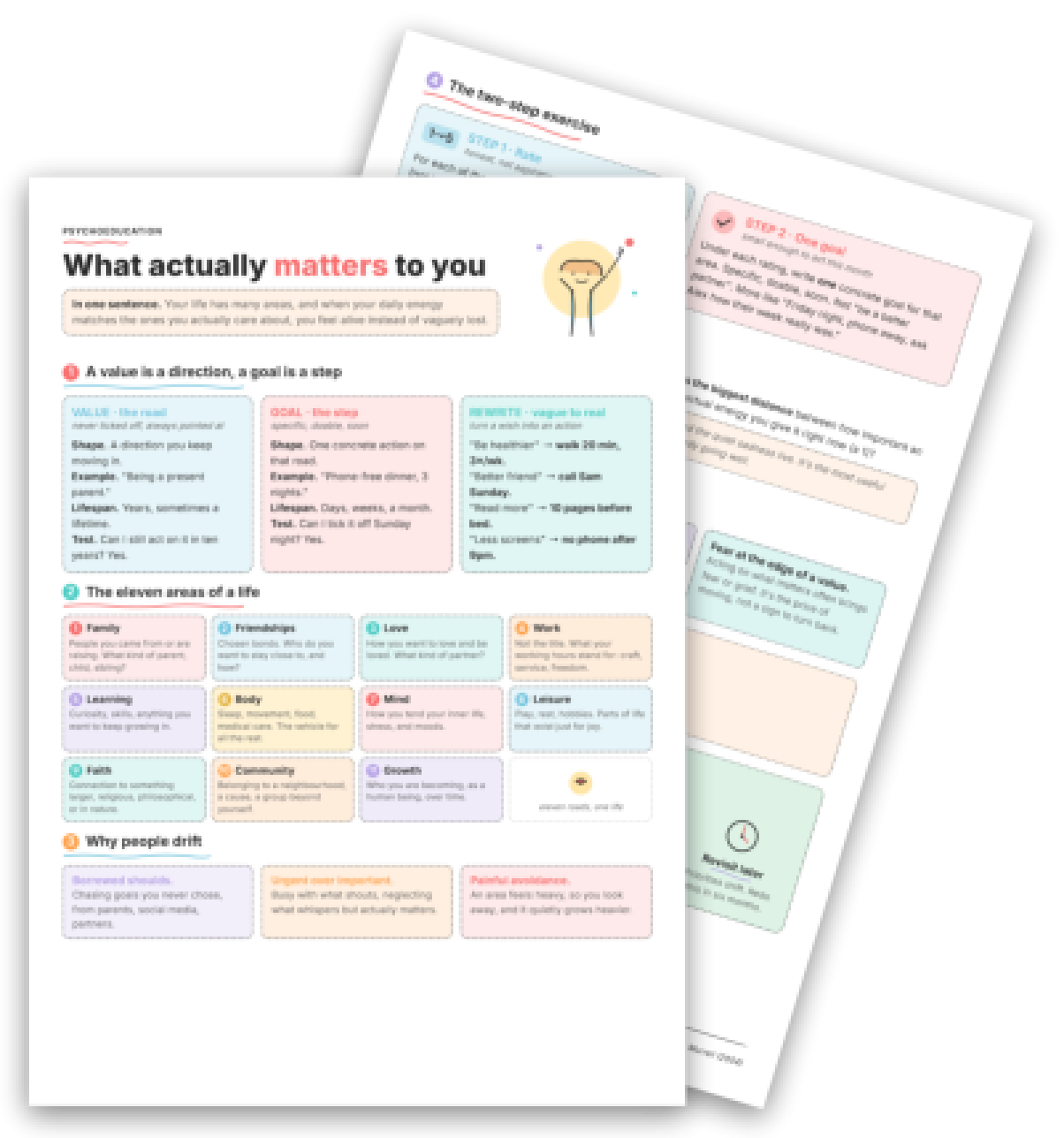
The fiche is structured across six numbered panels, each carrying a distinct clinical function.
Panel 1 presents the values-versus-goals distinction as a side-by-side visual: "VALUE · the road, never ticked off, always pointed at" versus "GOAL · the step, specific, doable, soon." A rewrite column converts vague wishes into concrete actions ("Be healthier" → walk 20 min, 3×/wk), which is the kind of behavioural specificity that links directly to goal-setting work and committed action exercises.
Panel 2 lists all eleven life areas, Family, Friendships, Love, Work, Learning, Body, Mind, Leisure, Faith, Community, Growth, each with a one-line orienting question. This layout lets patients see their whole life on one page, a perspective that verbal enumeration rarely produces.
Panels 3 and 4 address drift mechanisms (urgent over important, painful avoidance) and introduce the two-step exercise: rate each area 1-5 for importance, then write one concrete goal under each rating.
Panel 5 is the clinical centrepiece: a visual gap diagram showing the distance between a "5, matters" rating and a "1, energy" reality. The fiche states plainly, "That gap is usually where the drift and the quiet sadness live." Displayed as a diagram rather than described in words, this gap becomes immediately self-evident to the patient. It connects naturally to motivational interviewing's discrepancy-building work and complements the Current Activity Inventory as a behavioural activation entry point.
Panel 6 addresses three common patterns worth noticing in session: rating everything a 5, low ratings accompanied by guilt, and fear at the edge of a value, each with a brief interpretive note to guide the debrief.
> Key takeaway: the fiche is a visual support that facilitates the explanation of values and meaning in session; it is not a questionnaire patients complete alone, but a shared map the clinician and patient read together, then take forward into concrete committed action.
750+ clinical tools
A library built with and for clinicians, ready to use in session and extend between appointments.
Access all the toolsHow and When to Introduce the Fiche in Session
Timing. The fiche fits best after an initial anamnèse, once the working alliance is established and the patient has articulated a sense of being stuck, drifting, or living on autopilot. It works particularly well at the formulation stage, alongside tools such as the Choice Point or Exploring Values, and pairs usefully with longer horizon exercises like Setting 6 and 12 Month Goals or the 10-Year Goal Projection.
Profiles. The fiche is especially indicated for patients presenting with anhedonia, chronic indecision, or identity diffusion, and for those whose avoidance is organised around an entire life domain rather than a discrete situation. In ACT for depression, values work is a precondition for behavioural activation; this fiche maps the terrain before the My Values exercise goes deeper.
Introduction. A low-resistance framing: "Before we talk about what to change, let's use this to map what actually matters to you, not what should matter, what does." Invite the patient to rate the eleven areas during the session, rather than as homework, so you can observe where they hesitate or over-rate.
Debrief. Focus on the largest gap, not the highest-rated area. Watch for guilt accompanying a low rating, Panel 6 names this pattern explicitly and gives you a ready interpretive lever. The "To discuss in session" checklist on the fiche flags the three situations that warrant direct clinical exploration: a frightening gap area, universal 5 ratings, and goals that sound like someone else's voice.
Limit. With patients in acute crisis or with significant dissociation, the breadth of the eleven-area map can amplify overwhelm. In those contexts, narrow the exercise to one or two domains and return to the full map once stability is consolidated. The fiche does not replace case formulation; it enriches it.
Use it with your patients
Share this tool in the mobile app and follow the work between sessions.
Sources
- Harris, R. (2021). The Happiness Trap: Stop Struggling, Start Living (2nd ed.). Exisle Publishing.
- Hayes, S. C., Strosahl, K. D., & Wilson, K. G. (2011). Acceptance and Commitment Therapy: The Process and Practice of Mindful Change (2nd ed.). Guilford Press.
- Wilson, K. G., Sandoz, E. K., Kitchens, J., & Roberts, M. E. (2010). The Valued Living Questionnaire: Defining and Measuring Valued Action within a Behavioral Framework. The Psychological Record, 60, 249-272.
- Wilson, K. G., & Murrell, A. R. (2004). Values Work in Acceptance and Commitment Therapy: Setting a Course for Behavioral Treatment. In S. C. Hayes, V. M. Follette, & M. M. Linehan (Eds.), Mindfulness and Acceptance: Expanding the Cognitive-Behavioral Tradition (pp. 120-151). Guilford Press.
- Harris, R. (2019). ACT Made Simple: An Easy-to-Read Primer on Acceptance and Commitment Therapy (2nd ed.). New Harbinger Publications.
Your session continues in your patients' pocket
Use with a patientYour resources, available everywhere
The handouts, exercises, programs and audios above: you choose which ones to make available to your patients, in the mobile app dedicated to them.
And far more than a library
The app goes well beyond resources, to support your patients every day:
Related categories
Explore other clinical resources by category.

Mood
Evidence-based worksheets and clinical tools for mood disorders: CBT, ACT, and positive psychology resources for psychologists and therapists.

Identity
Clinical resources for self-identity work in therapy: CBT, ACT, schema tools for clinicians addressing self-concept, core beliefs, and identity disruption.

Transitions
Clinical hub for life transitions: tools, worksheets and exercises to support psychosocial adjustment, role change and identity work in practice.

Build awareness
Clinical worksheets and tools to build awareness in therapy: cognitive distortions, schemas, emotions, ACT and CBT resources for practitioners.

Engage & motivate
Clinical hub: printable worksheets and exercises to build therapeutic engagement and motivation across ACT, CBT, and integrative practice. For clinicians.

ACT
Clinical hub for Acceptance and Commitment Therapy (ACT): worksheets, exercises, programs and audio resources for practitioners using the ACT model.