
Clinical picture. T., a 34-year-old solicitor, presented with persistent low mood and occupational exhaustion despite what he described as an objectively successful career. He reported feeling "hollow" after a recent promotion and struggled to articulate what he actually wanted. The clinician introduced the Circles of Influence worksheet, asking T. to list the five values most prized by each circle before the next session. At review, T. noted that "recognition" and "security" appeared in his Family and Society columns but were absent from his Myself column, where he had written "curiosity" and "creativity" with some hesitation. This mapping gave the therapeutic dyad a shared vocabulary for exploring how much of his career trajectory had been built on a borrowed list, and opened space to examine what a personally authored direction might look like.
Personal Values: PDF Worksheet, Tools and Exercises for Clinical Practice
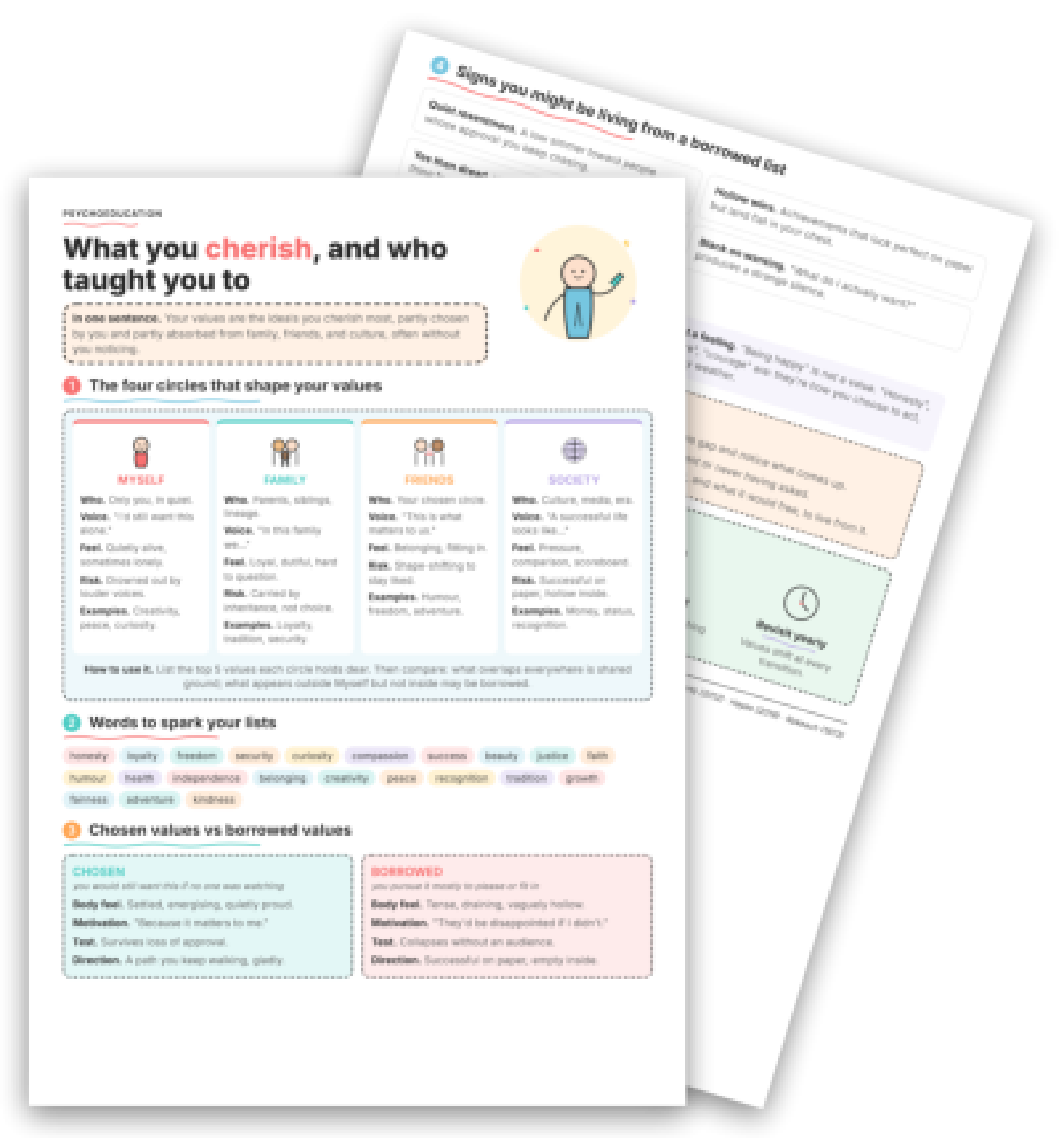
A visual PDF fiche clinicians can use in session to map the four sources of personal values, distinguish chosen from borrowed beliefs, and give patients a concrete anchor for values-guided work.
Clinical vignettes
Inherited Ambition, Absent Satisfaction
Peer Belonging vs. Personal Compass
Clinical picture. M., a 27-year-old woman referred following a second episode of anxiety, described a pattern of agreeing to social commitments she resented and then feeling depleted and resentful. She was uncertain whether her discomfort reflected social anxiety or something else. The clinician used the Circles of Influence framework as a psychoeducational entry point, framing it as a way to map rather than judge her values. M. completed the four-circle exercise between sessions and returned noting that "belonging" and "humour" dominated her Friends column, while her Myself column held "peace" and "independence." Recognising the structural tension between these two sets reduced her self-criticism and shifted the clinical focus toward practicing value-congruent choices in low-stakes social situations.
Values clarification is one of the most frequently underestimated clinical tasks. Patients agree the concept matters, then struggle to name a single value that feels genuinely theirs rather than inherited. Explaining the difference verbally rarely resolves that confusion. This fiche PDF gives you a structured visual to bring into session, so the distinction lands rather than floats.
Use this resource with your patients
Handout, exercises and materials ready to use, right inside SessionFuel.
Why Values Are So Hard to Clarify Verbally
The core difficulty is not that patients lack values. It is that most values arrive pre-installed, absorbed from family scripts, peer groups, and cultural benchmarks, without the patient having explicitly chosen them. When you ask "what matters most to you?", many patients answer with goals ("getting promoted"), feelings ("being happy"), or socially desirable abstractions. The fiche addresses these directly: it includes a short section called Two confusions to avoid, distinguishing values from goals (a goal is ticked off; a value is "a direction you keep walking in") and from feelings.
A second problem is that patients rarely have language for the experience of living from someone else's value system. The quiet resentment, the hollow wins, the reflexive yes followed by days of dread: these are recognizable clinical presentations, but patients rarely connect them to misaligned values. Without a shared vocabulary and a visual that makes the structure explicit, this link stays implicit and hard to work with.
This is the gap the fiche PDF closes.
What the Fiche Contains: A Visual Map of Four Value Sources
The fiche is built around a four-circle model presenting the distinct sources from which values originate: MYSELF, FAMILY, FRIENDS, and SOCIETY. Each circle carries the same five dimensions (who speaks, what it sounds like, how it feels, what the risk is, and concrete examples), so patients can compare across circles on identical axes. This parallel structure is precisely what a spoken explanation cannot replicate: it lets the patient see, at a glance, that "In this family we..." (Family) and "A successful life looks like..." (Society) are both external voices, distinct from "I'd still want this alone" (Myself).
A curated word list of 22 values (honesty, curiosity, freedom, belonging, adventure, tradition, and others) prompts patients who go blank when asked to generate their own. The instruction embedded in the fiche is clinically usable as-is: "List the top 5 values each circle holds dear. Then compare: what overlaps everywhere is shared ground; what appears outside Myself but not inside may be borrowed."
The chosen vs. borrowed values panel maps each category across four dimensions: body feel, motivation, test (does it survive loss of approval?), and direction. This is the section that most patients photograph or take home.
> Key takeaway: the fiche is a visual psychoeducation support that facilitates the explanation in session, not a self-administered questionnaire. The clinician uses it to anchor the conversation, name the distinction, and hand the patient a concrete reference they can return to between appointments.
Finally, a To discuss in session block offers three ready-made clinical prompts: what to explore when a value sits in Family or Society but not in Myself, how to read a patient whose four lists are nearly identical, and how to open the cost-benefit conversation when a value appears in Myself alone.
750+ clinical tools
A library built with and for clinicians, ready to use in session and extend between appointments.
Access all the toolsWhen and How to Introduce It in Session
The fiche is most useful after an initial anamnèse and once a working alliance is established, typically from session two or three onward. It fits naturally into ACT-oriented work (especially alongside values-guided committed action exercises and the ACT Hexaflex), but it also complements schema therapy case formulations where enmeshment or undeveloped-self dynamics are central. It pairs well with motivational interviewing when building discrepancy around lifestyle choices.
For patients presenting with approval-seeking patterns, the borrowed-vs-chosen distinction can reframe compliance as a survival strategy rather than a character flaw. For those working on life goals across multiple domains, the circles model provides the values layer that goal-setting tools alone skip.
A low-threshold introduction: "Before we decide what direction to work toward, it can help to map where your current values actually come from. This sheet makes that structure visible in about ten minutes." Debrief by asking the patient to identify one value that lives only in the Myself circle and one that appears everywhere except there.
For between-session follow-up, the My Values guided exercise and the My Future Inventory extend the conversation autonomously. The fiche does not replace the clinical framework; it makes the explanation precise and leaves the patient with a map they can actually use.
Use it with your patients
Share this tool in the mobile app and follow the work between sessions.
Sources
- Hayes, S. C., Strosahl, K. D., Wilson, K. G. (2012). Acceptance and Commitment Therapy: The Process and Practice of Mindful Change (2nd ed.). Guilford Press.
- Wilson, K. G., Sandoz, E. K., Kitchens, J., Roberts, M. E. (2010). The Valued Living Questionnaire: Defining and Measuring Valued Action within a Behavioral Framework. The Psychological Record, 60, 249-272.
Your session continues in your patients' pocket
Use with a patientYour resources, available everywhere
The handouts, exercises, programs and audios above: you choose which ones to make available to your patients, in the mobile app dedicated to them.
And far more than a library
The app goes well beyond resources, to support your patients every day:
Related categories
Explore other clinical resources by category.

Identity
Clinical resources for self-identity work in therapy: CBT, ACT, schema tools for clinicians addressing self-concept, core beliefs, and identity disruption.

Transitions
Clinical hub for life transitions: tools, worksheets and exercises to support psychosocial adjustment, role change and identity work in practice.

Build awareness
Clinical worksheets and tools to build awareness in therapy: cognitive distortions, schemas, emotions, ACT and CBT resources for practitioners.

Engage & motivate
Clinical hub: printable worksheets and exercises to build therapeutic engagement and motivation across ACT, CBT, and integrative practice. For clinicians.

ACT
Clinical hub for Acceptance and Commitment Therapy (ACT): worksheets, exercises, programs and audio resources for practitioners using the ACT model.

Humanistic
Printable clinical resources for humanistic therapy: worksheets, exercises, and psychoeducation programs for practitioners using person-centered and experiential approaches.