
Clinical picture. T., a man in his mid-forties, presented with persistent low mood and a vague sense that life had become mechanical despite objective professional success. He met criteria for mild persistent depressive disorder and reported no leisure activity or meaningful contact with his children outside weekends. During a session structured around the six-list exercise from the values worksheet, he listed "connection" and "family" under values he would like to live, then paused visibly when his actually live by column filled with "work," "pleasing," and "comfort." The clinician reflected the gap back without interpretation, asking only what he noticed. T. said quietly that he had been living his father's list for twenty years without realising it had never quite been his own. This observation became a workable focus for subsequent sessions, shifting the frame from symptom reduction alone to deliberate value-congruent behaviour change.
Exploring Values: PDF Worksheet, Tools and Exercises for ACT Practice
A structured PDF worksheet with a six-list exercise, gap analysis, and committed action prompt to help patients clarify what genuinely guides their life.
Clinical vignettes
Values-Action Gap in Chronic Overwork
Disentangling Inherited and Chosen Values
Clinical picture. M., a woman in her early thirties, sought therapy following a prolonged period of anxiety centred on career decisions she described as feeling "wrong in a way I cannot explain." She had trained in law partly at her parents' encouragement and reported chronic guilt when considering a change of direction. The clinician introduced the informational sheet on exploring values as preparatory homework, asking M. to complete the six lists before the next appointment. She returned having noted that "achievement" and "status" appeared under both her parents' columns and under the society column, yet were absent from her would like to live list, where she had written "creativity," "learning," and "service." Reviewing the lists together, the clinician normalised the process of inheriting values without conscious endorsement and helped M. distinguish reactions against parental expectations from her own emerging preferences. No career decision was made in session; the goal was legibility, not resolution.
Values clarification is one of those concepts patients agree with verbally and promptly misapply. They conflate values with goals, or recite a list that turns out to belong to their parents. This fiche PDF gives you a visual structure to hold that distinction in session, name the inheritance dynamic explicitly, and leave the patient with a concrete diagnostic they can use between appointments.
Use this resource with your patients
Handout, exercises and materials ready to use, right inside SessionFuel.
Why values clarification slips through verbal explanation
The standard oral explanation ("values are directions, not destinations") lands cleanly for about thirty seconds, then dissolves. What actually derails the work is subtler: most patients have never distinguished between values they have absorbed and values they have chosen. When you ask "What matters to you?" in session, the honest answer is frequently a collage of parental injunctions, cultural messaging, and genuine preference, all of which feel equally "theirs."
This is not a comprehension failure. It is a psychological flexibility problem. Without a structured prompt, patients cannot perceive the collage as a collage. They need a side-by-side visual to see the seams. The fiche provides exactly that, which is why showing it in session is more effective than describing the same idea at length.
The same blind spot appears in values-action gaps: patients who deeply value connection but schedule no relational time rarely name this as a discrepancy. They experience it as low-grade dissatisfaction, often mislabeled as depression or loss of meaning. A visual gap between two columns makes the mechanism visible in a way that narrative alone does not.
What the fiche contains: a visual support for values work in session
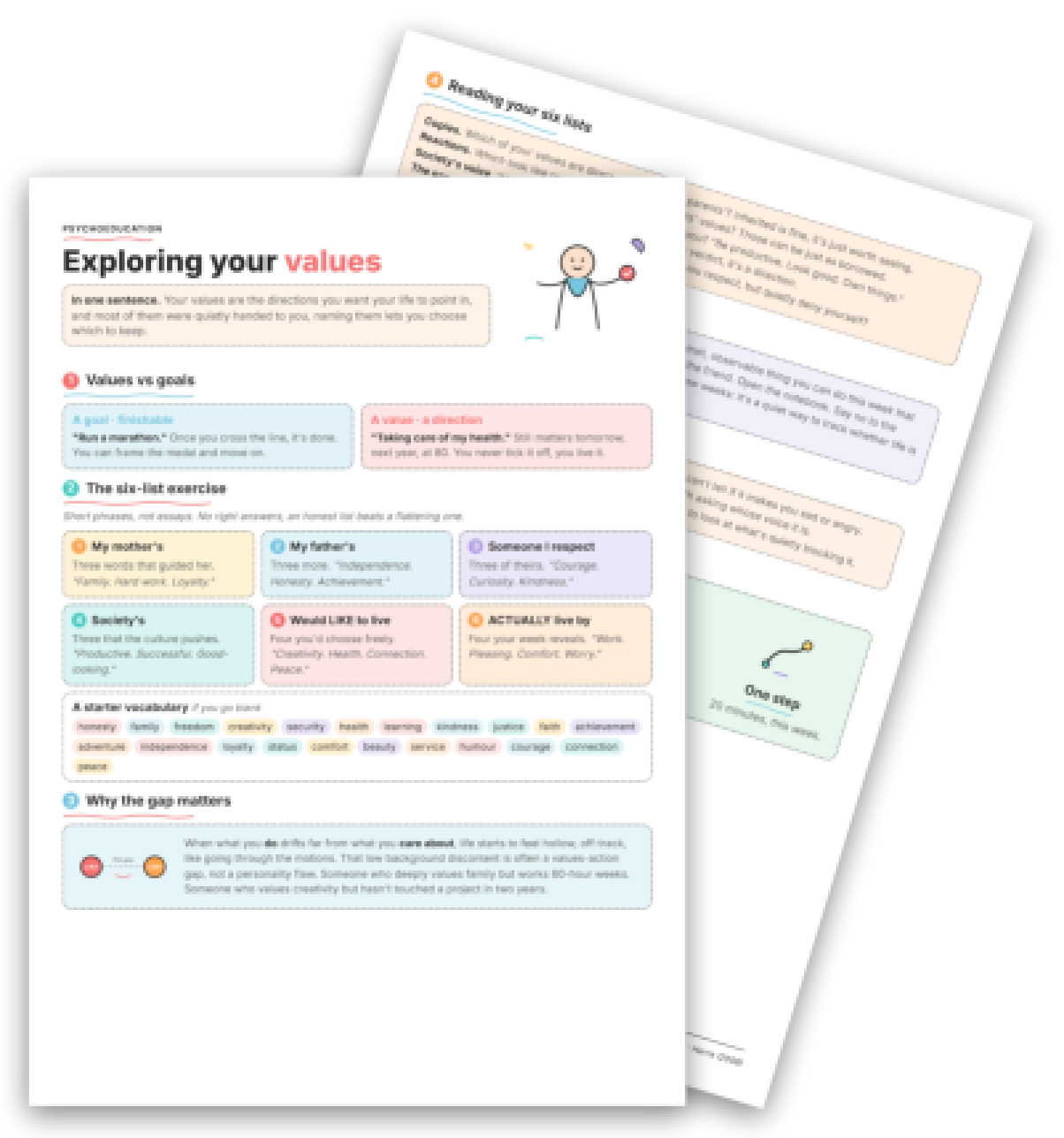
The fiche is built around a six-list exercise, reproduced as a single printable grid. Each column carries a short prompt: the patient lists three words that guided their mother, three for their father, three for someone they respect, three they perceive as society's expectations, four they would like to live by, and four their current week actually reveals. The layout puts all six columns side by side on the page, making the comparison immediate and undeniable.
A starter vocabulary (twenty-two single words: honesty, family, freedom, creativity, security, health, and so on) is printed on the fiche for patients who go blank mid-exercise. It removes the performance anxiety of having to generate values from scratch.
A gap diagram labeled "the gap" sits between the "would like" and "actually live" columns, with a brief framing note: "when what you do drifts far from what you care about, life starts to feel hollow, off-track, like going through the motions." This is the phrasing patients often recognise as their own experience, stated before they have found the words for it.
The fiche closes with a one small committed action prompt (a direct bridge to committed action work) and a structured "to discuss in session" section flagging three specific clinical moments: when the gap between columns five and six produces ambivalent affect, when a listed value feels like a duty rather than something alive, and when the patient's chosen "tiny action" keeps slipping week after week.
> Key point: the fiche is a visual support for the clinician to use during explanation, not a self-administered questionnaire. Walking through the six lists together in session, with the grid visible between you, is what generates the clinical material. The patient takes it home as a reference, not as homework to complete alone.
750+ clinical tools
A library built with and for clinicians, ready to use in session and extend between appointments.
Access all the toolsWhen and how to introduce it
The fiche fits naturally in early-to-mid treatment, once the alliance is established and the patient has begun to notice behavioral patterns. In an ACT-oriented formulation, it serves the values clarification pillar directly. In schema therapy or longer-term work, it surfaces early maladaptive schemas that are value-shaped (enmeshment, subjugation) without requiring that vocabulary upfront.
It is particularly useful with patients who present with diffuse dissatisfaction, avoidance-driven lifestyle patterns, or a stated inability to make decisions, the profile that benefits most from the Choice Point approach. It also works well alongside motivational interviewing tools that build discrepancy, since the six-list exercise operationalizes exactly the values-behavior gap MI targets.
To introduce it without pathologising: "I'd like to try something that helps us see what's actually guiding your choices right now, and compare it to what you'd prefer to be guided by. It takes about ten minutes and it tells us more than an hour of talking often does." Once completed together, debrief the gap column first: which divergence generates the strongest affect? That is your clinical priority.
Pair the fiche with the values clarification exercise for between-session consolidation, and with the 10-year goal projection when the patient needs to translate identified values into a longer time horizon. The fiche does not replace the conceptual work of an ACT program for depression or a future inventory exercise; it gives the patient a portable diagnostic to revisit as life slowly turns toward, or away from, what they care about.
Use it with your patients
Share this tool in the mobile app and follow the work between sessions.
Sources
- Hayes, S. C., Strosahl, K. D., Wilson, K. G. (2012). Acceptance and Commitment Therapy: The Process and Practice of Mindful Change. Guilford Press.
- Harris, R. (2019). ACT Made Simple: An Easy-to-Read Primer on Acceptance and Commitment Therapy. New Harbinger Publications.
- Wilson, K. G., Sandoz, E. K., Kitchens, J., Roberts, M. E. (2010). The Valued Living Questionnaire: Defining and Measuring Valued Action within a Behavioral Framework. The Psychological Record.
Your session continues in your patients' pocket
Use with a patientYour resources, available everywhere
The handouts, exercises, programs and audios above: you choose which ones to make available to your patients, in the mobile app dedicated to them.
And far more than a library
The app goes well beyond resources, to support your patients every day:
Related categories
Explore other clinical resources by category.

Identity
Clinical resources for self-identity work in therapy: CBT, ACT, schema tools for clinicians addressing self-concept, core beliefs, and identity disruption.

Transitions
Clinical hub for life transitions: tools, worksheets and exercises to support psychosocial adjustment, role change and identity work in practice.

Build awareness
Clinical worksheets and tools to build awareness in therapy: cognitive distortions, schemas, emotions, ACT and CBT resources for practitioners.

Engage & motivate
Clinical hub: printable worksheets and exercises to build therapeutic engagement and motivation across ACT, CBT, and integrative practice. For clinicians.

ACT
Clinical hub for Acceptance and Commitment Therapy (ACT): worksheets, exercises, programs and audio resources for practitioners using the ACT model.

Humanistic
Printable clinical resources for humanistic therapy: worksheets, exercises, and psychoeducation programs for practitioners using person-centered and experiential approaches.