
Clinical picture. M., a 41-year-old secondary school teacher, presented after six months of sick leave following occupational burnout, reporting a pervasive sense of emptiness and difficulty imagining any future beyond work. In session four, the clinician introduced the eight-domain worksheet as a structured way to map life areas that had been quietly neglected. M. worked through the three horizons and was visibly surprised to find that the leisure and social domains had been blank for years, noting that he had "forgotten he used to paint." For the one-month step in leisure, he committed to blocking two hours on Saturday mornings; he returned the following week having done so once, describing it as "oddly calming." The exercise did not resolve the burnout, but it shifted the therapeutic conversation from deficit to direction.
Life Goals Across Eight Domains: PDF Worksheet, Tools and Exercises
A visual PDF worksheet that maps goals across eight life areas and three time horizons, giving clinicians a structured in-session tool for values-based goal work.
Clinical vignettes
Restoring Direction After Burnout
Clarifying Values in Prolonged Grief
Clinical picture. A., a 57-year-old woman, was seen in the context of complicated grief following the death of her husband two years prior; she described her days as "flat" and reported withdrawing from friends and her adult children. The clinician presented the eight-domain worksheet as an informational sheet and invited A. to complete the family and social columns between sessions, framing it as curiosity rather than goal-setting. A. returned having filled in only the five-year column for family, writing that she wanted "to be someone my grandchildren remember as warm." That single sentence became a recurring reference point in subsequent sessions when avoidance behaviour was discussed. Progress remained slow, consistent with the clinical picture, but the worksheet provided a shared, concrete language for values that had previously stayed implicit.
In session, patients who say "I want to change my life" rarely arrive with a map. The conversation stays vague: work is unsatisfying, relationships feel flat, nothing brings energy. This fiche PDF gives the clinician a shared visual structure to move that diffuse dissatisfaction toward a concrete, domain-by-domain goal inventory the patient can carry out of the room.
Use this resource with your patients
Handout, exercises and materials ready to use, right inside SessionFuel.
Why Life Goal Mapping Resists Verbal Exploration
When patients try to project into the future without scaffolding, the conversation typically collapses onto one or two salient pain points. The remaining life areas simply don't come up. From a values clarification standpoint, which is central to both ACT and schema therapy, this narrowing is clinically significant: it usually reflects longstanding patterns of overinvestment and neglect, not a conscious allocation of resources. The patient hasn't chosen to starve their friendships or leisure life. They just haven't looked.
A second difficulty is temporal. Without structure, most patients oscillate between grandiose, poorly-anchored long-term fantasies and paralysing short-term urgency. Neither produces committed action. The three-horizon architecture of this tool, 5 years, 1 year, 1 month, bypasses both traps by separating aspiration from planning and planning from first steps. That distinction is hard to hold verbally. Shown visually, it becomes obvious.
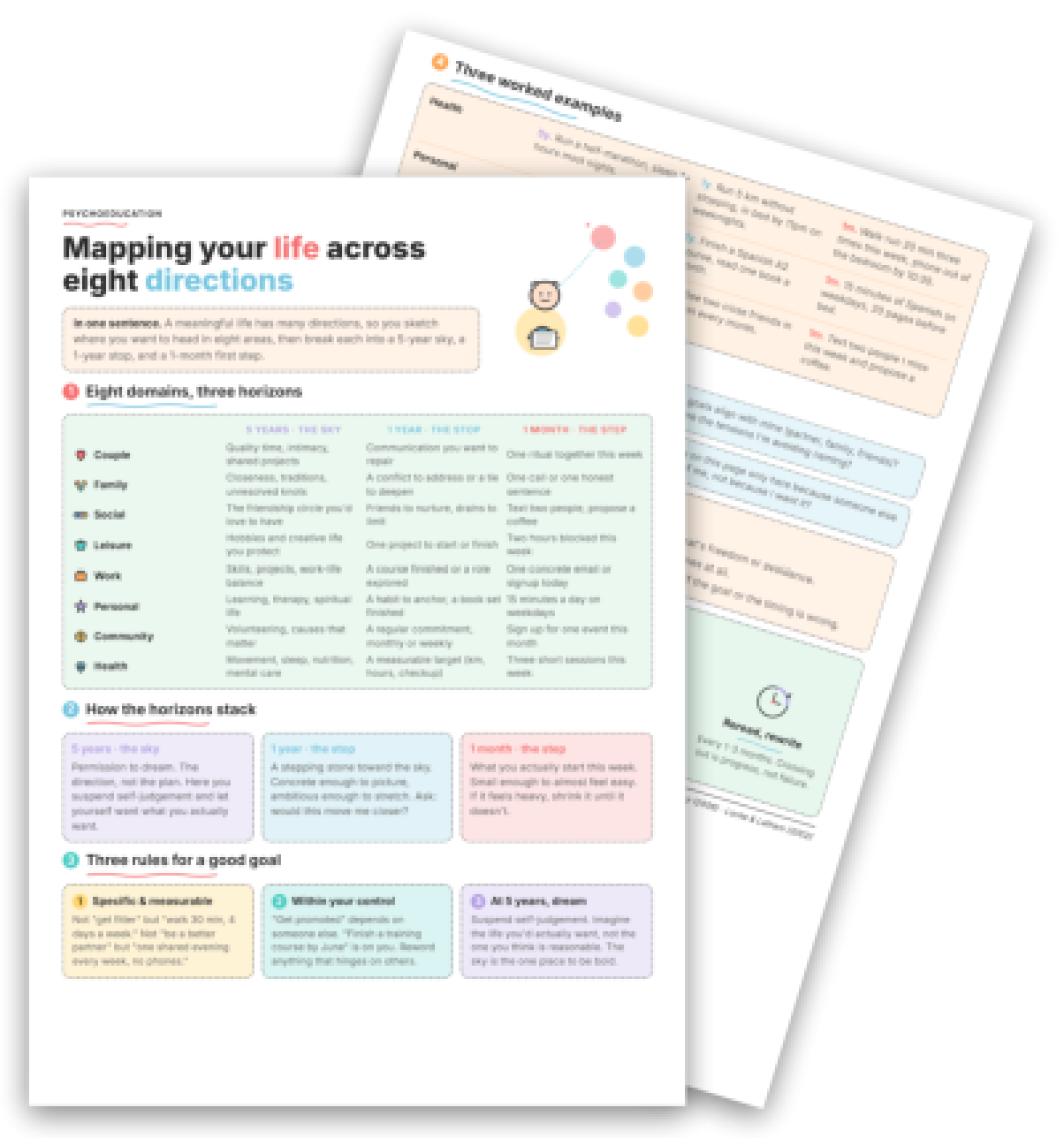
What the Fiche Contains: A Visual Frame for Eight Directions
The fiche organises the work around eight life domains (Couple, Family, Social, Leisure, Work, Personal, Community, Health) crossed with three time horizons. Each cell contains concrete contextual cues. The Couple row, for instance, prompts the patient toward "communication you want to repair" at the 1-year horizon and "one ritual together this week" at the 1-month level, moving within a single visual row from broad aspiration to a behaviourally specific weekly action.
A dedicated section explains the logic of each horizon. The 5-year level is framed explicitly as "permission to dream. The direction, not the plan", language the clinician can use in real time to suspend the patient's self-editing. The 1-month step follows the principle labeled "smaller, almost easy": if the goal feels heavy, shrink it. Naming this in session, with the grid in front of the patient, is far more efficient than explaining the concept discursively.
The fiche also includes three worked examples (Health, Personal, Social), a set of three goal-writing rules (specific and measurable, within your control, bold at 5 years), and a post-completion reflection block with questions such as "Which domains did I fill, which did I leave almost empty?" Finally, a curated "To discuss in session" panel flags the clinical moments worth returning to: a domain that is consistently empty, a 5-year goal that feels embarrassing to write, or repeated failures to hit 1-month steps.
> Key takeaway: This fiche PDF is a visual psychoeducation support that structures the goal-mapping conversation in session. The clinician uses it as a shared reference to guide exploration, domain by domain and horizon by horizon. It is not a questionnaire the patient fills alone and brings back.
750+ clinical tools
A library built with and for clinicians, ready to use in session and extend between appointments.
Access all the toolsWhen and How to Introduce It in Session
The fiche fits naturally once the initial case formulation is in place and the patient is ready to orient toward change rather than symptom description alone. It works especially well when the presentation includes low-grade anhedonia, motivational drift, or a diffuse sense that nothing is working without a clear hierarchy of concerns. For patients arriving with a work-life balance concern or a values clarification need, it provides an immediate structure the clinician can anchor the session to.
A practical introduction: "I'd like us to look at your life across several areas at once, not just the one we've been focusing on. This grid will help us map where you want to head and what a first step might actually look like." That framing prevents the patient from reading it as an evaluation or homework assignment.
When debriefing, the empty domains are usually the most clinically productive: a patient who leaves Community and Leisure entirely blank while writing three lines under Work has told you something central to their schémas précoces and current maintenance cycles. You can identify growth axes across multiple domains and follow up with more targeted tools, a 10-year projection exercise, a 6 and 12 month goal structure, or a values mapping exercise for patients whose 5-year goals feel blocked by identity ambiguity rather than planning skill.
For patients who struggle to write any 5-year goal at all, complement the fiche with a future inventory exercise or a committed action exercise to restore contact with what genuinely matters before returning to the grid. For those whose 1-month steps consistently fall apart, a behavioral goal-setting exercise or a building new habits tool targets the implementation layer directly.
One contraindication worth naming: in acute depressive episodes with marked anhedonia and severe goal-blocking, the eight-domain grid can amplify the patient's sense of failure. Defer it until some behavioral activation is underway, and return to it once the patient can engage with future orientation without the grid becoming a list of everything they feel incapable of.
The fiche does not replace the therapeutic frame. It makes the explanation clearer and leaves the patient with a concrete visual reference they can revisit, revise, and bring back.
Use it with your patients
Share this tool in the mobile app and follow the work between sessions.
Sources
- Wilson, K. G., Sandoz, E. K., Kitchens, J., Roberts, M. E. (2010). The Valued Living Questionnaire: Defining and Measuring Valued Action within a Behavioral Framework. The Psychological Record.
- Hayes, S. C., Strosahl, K. D., Wilson, K. G. (1999). Acceptance and Commitment Therapy: An Experiential Approach to Behavior Change. Guilford Press.
- Buus, N., Rasmussen, P., Michail, M., Gill, K., Schweitzer, R. D. (2022). Goal Planning in Mental Health Service Delivery: A Systematic Integrative Review. Frontiers in Psychiatry.
Your session continues in your patients' pocket
Use with a patientYour resources, available everywhere
The handouts, exercises, programs and audios above: you choose which ones to make available to your patients, in the mobile app dedicated to them.
And far more than a library
The app goes well beyond resources, to support your patients every day:
Related categories
Explore other clinical resources by category.

Identity
Clinical resources for self-identity work in therapy: CBT, ACT, schema tools for clinicians addressing self-concept, core beliefs, and identity disruption.

Relationships
Clinical worksheets and tools on relational functioning: attachment, schemas, assertiveness, and communication skills for therapists. Printable PDF resources.

Transitions
Clinical hub for life transitions: tools, worksheets and exercises to support psychosocial adjustment, role change and identity work in practice.

Build awareness
Clinical worksheets and tools to build awareness in therapy: cognitive distortions, schemas, emotions, ACT and CBT resources for practitioners.

Engage & motivate
Clinical hub: printable worksheets and exercises to build therapeutic engagement and motivation across ACT, CBT, and integrative practice. For clinicians.

ACT
Clinical hub for Acceptance and Commitment Therapy (ACT): worksheets, exercises, programs and audio resources for practitioners using the ACT model.