
Clinical picture. R., a man in his mid-forties, presented with low-grade dysthymia and a vague sense that life had narrowed. He described his days as efficient but joyless, and attributed this to work pressure. During a session focused on the nine-domain worksheet, the clinician invited him to rate each area for importance and then for current time investment. R. scored leisure a four out of five for importance, then paused visibly before marking effort as one. Naming the quality he wanted to bring to that domain, he wrote "curious" without hesitation, then noted aloud that he could not recall the last time curiosity had guided an afternoon. The gap between stated value and lived behaviour became a concrete, non-blaming focus for the following two sessions.
Values Exploration Across Nine Life Domains: PDF Worksheet, Tools and Exercises
A visual PDF worksheet helping clinicians make values clarification concrete in session, with nine life domains, four structured questions, and a gap-analysis tool grounded in ACT.
Clinical vignettes
Leisure Domain Reveals Chronic Neglect
Couple Domain Reframes Conflict Complaints
Clinical picture. T., a woman in her late thirties, had been describing recurring arguments with her partner primarily in terms of unmet needs and her partner's shortcomings. The clinician introduced the values worksheet as a structured way to shift perspective, walking through the couple domain question by question. When asked what qualities she wanted to bring to the relationship, T. listed "attentive" and "warm," then was asked how often her behaviour in recent weeks reflected those qualities. She sat with the question rather than deflecting, and identified that her own withdrawal had preceded the most recent conflict. The session did not resolve the relational difficulties, but it moved the clinical conversation from complaint inventory toward her own directional choices.
Asking a patient "what matters to you?" in session rarely produces the clarity either of you needs. The answer is usually circular, socially groomed, or stuck at the level of goals rather than directions. This PDF worksheet was built precisely for that impasse: a structured visual support that lets you work through values clarification across nine life domains together, in session, without the conversation collapsing into vague aspiration.
Use this resource with your patients
Handout, exercises and materials ready to use, right inside SessionFuel.
Why Values Clarification Is Hard to Explain Verbally
The core conceptual snag is the value-vs-goal confusion. Patients consistently conflate the two, and oral explanation seldom resolves it. Saying "a value is a direction, not a destination" lands better with a concrete contrast in front of them than as a sentence they hear and forget.
A second obstacle is what the fiche names directly: borrowed values. Many patients articulate what parents, culture, or a partner expect rather than what genuinely guides them. Without a structured prompt to slow that down, the session stays at the surface. And a third trap, particularly relevant in avoidant or depressive presentations, is what the fiche calls avoidance disguised: rating a domain as irrelevant when actually the patient stopped letting themselves want anything from it. That distinction is almost impossible to surface through free conversation alone. You need a scaffold.
What the Fiche Contains: A Visual Tool for In-Session Explanation
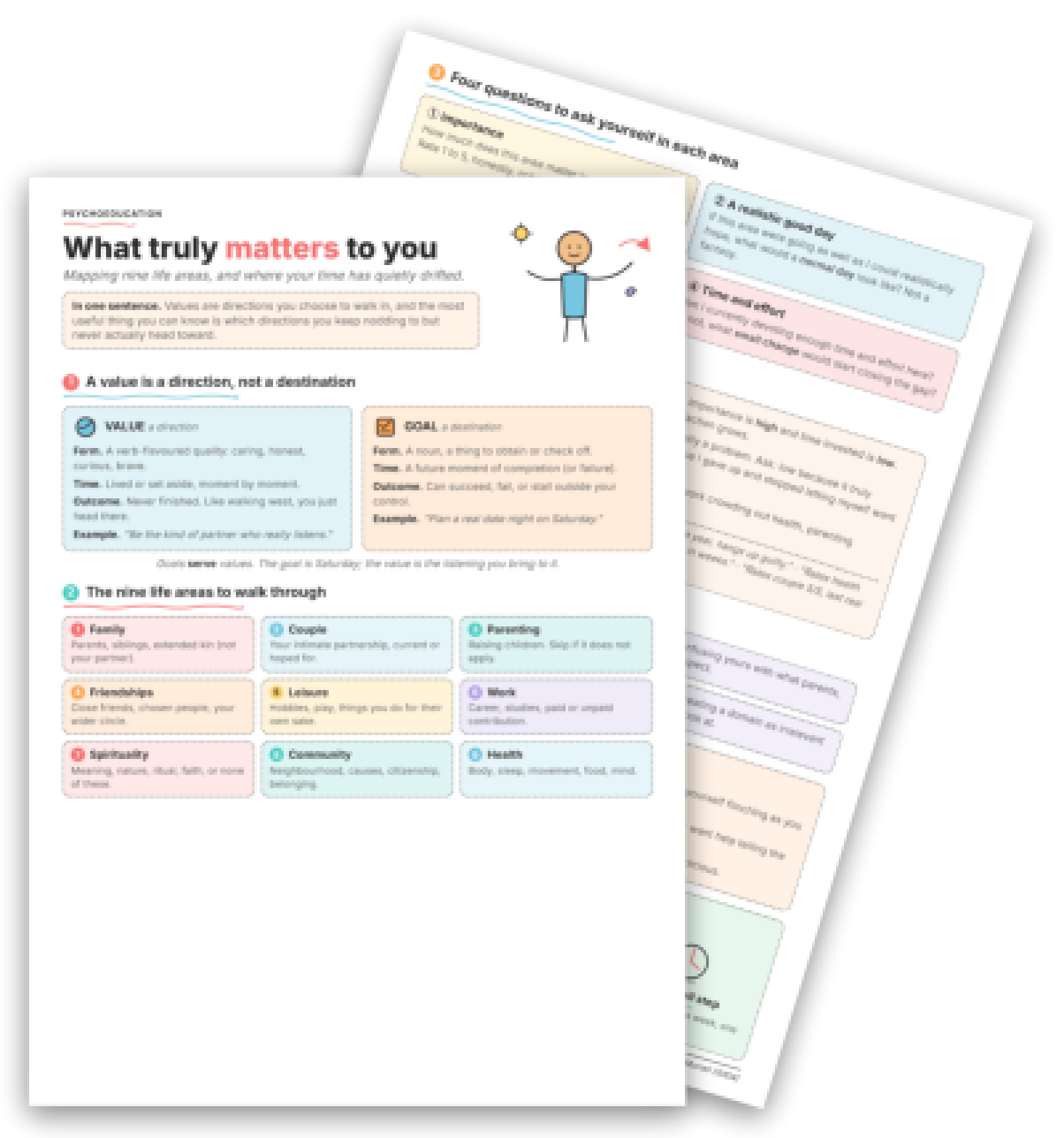
The sheet is organised across five clearly separated panels, each serving a specific clinical function.
Panel 1 draws an explicit side-by-side contrast between a value (a verb-flavoured direction, never completed) and a goal (a noun, a future moment of success or failure). The example given: "Be the kind of partner who really listens" as a value, versus "Plan a real date night on Saturday" as the goal it serves. That single visual contrast does more work than most explanations.
Panel 2 lists the nine life domains: Family, Couple, Parenting, Friendships, Leisure, Work, Spirituality, Community, and Health, with a one-line description of each scope.
Panel 3 gives four structured questions to apply to each domain: importance rated 1-5 ("not how important it should be"), a realistic-good-day picture, the personal qualities to bring, and a time-and-effort audit. These are questions the clinician walks through with the patient, not a questionnaire left as homework before any psychoeducation has occurred.
Panel 4 is the clinical centrepiece: a gap diagram mapping importance against time invested. The fiche states plainly: "The juicy info lives where importance is high and time invested is low." That visual contrast, rendered as a chart, makes misalignment immediately legible for patients who would otherwise describe their dissatisfaction as diffuse or shameful.
Panel 5 names the five common traps (sounding good, borrowed values, feelings mistaken for values, avoidance disguised, and goals mislabelled as values), followed by three "to discuss in session" prompts tied to the moments where clinical dialogue is most productive.
> Key point: This fiche is a visual support that facilitates in-session explanation, not an autonomous questionnaire. The clinician uses it as a shared map, pointing to panels as the conversation unfolds, and leaves the patient with a concrete reference to carry forward.
750+ clinical tools
A library built with and for clinicians, ready to use in session and extend between appointments.
Access all the toolsWhen and How to Introduce It
This worksheet fits naturally from session two or three onward, once an initial case formulation is in place but before committing to a behavioural direction. It is especially well-suited to patients presenting with chronic dissatisfaction, depression with anhedonia, burnout, or existential drift, where the problem is not symptom severity but disconnection from meaningful action. It integrates easily into ACT-informed practice and pairs directly with the Choice Point for clarifying committed action.
A workable introduction: "I'd like us to look at this together. It maps nine areas of life and asks a simple question for each: how much does this matter to you, and how much of your time is actually going there? There are no right answers, and nobody else will grade this."
From there, you walk through the domains in session, note where the gap diagram lights up, and use the "to discuss in session" prompts to anchor the exchange. For patients who tend to seek approval or write what sounds acceptable, the trap panel is worth naming explicitly before you begin. The values cultivation exercise and the personal values clarification exercise make natural follow-ups for between-session work once the map is drawn. You can also articulate findings with life goals across eight domains or explore personal meaning and direction for patients who need a forward-looking frame.
For adolescents or patients with significant cognitive rigidity, the nine domains may be too many to cover in one session. Work through three or four areas with the most pronounced gaps, and return to the others. For patients where psychological flexibility is the central therapeutic target, the fiche bridges directly into defusion and acceptance work by making the valued direction explicit first.
The fiche does not replace the formulation. It sharpens it, giving both of you a shared vocabulary and a visual record of what the patient actually cares about.
Use it with your patients
Share this tool in the mobile app and follow the work between sessions.
Sources
- Wilson, K. G., Sandoz, E. K., Kitchens, J., & Roberts, M. E. (2010). The Valued Living Questionnaire: Defining and Measuring Valued Action within a Behavioral Framework. The Psychological Record.
- Harris, R. (2019). ACT Made Simple: An Easy-To-Read Primer on Acceptance and Commitment Therapy (2nd ed.). New Harbinger Publications.
- Hayes, S. C., Strosahl, K. D., & Wilson, K. G. (1999). Acceptance and Commitment Therapy: An Experiential Approach to Behavior Change. Guilford Press.
- Barrett, K., O'Connor, M., & McHugh, L. A. (2019). Systematic Review of Values-Based Psychometric Tools Within Acceptance and Commitment Therapy (ACT). The Psychological Record.
Your session continues in your patients' pocket
Use with a patientYour resources, available everywhere
The handouts, exercises, programs and audios above: you choose which ones to make available to your patients, in the mobile app dedicated to them.
And far more than a library
The app goes well beyond resources, to support your patients every day:
Related categories
Explore other clinical resources by category.

Identity
Clinical resources for self-identity work in therapy: CBT, ACT, schema tools for clinicians addressing self-concept, core beliefs, and identity disruption.

Behaviours
Clinical hub for behaviors in therapy: worksheets and tools for coping, eating disorders, CBT formulation, and maladaptive behavioral patterns.

Transitions
Clinical hub for life transitions: tools, worksheets and exercises to support psychosocial adjustment, role change and identity work in practice.

Build awareness
Clinical worksheets and tools to build awareness in therapy: cognitive distortions, schemas, emotions, ACT and CBT resources for practitioners.

Engage & motivate
Clinical hub: printable worksheets and exercises to build therapeutic engagement and motivation across ACT, CBT, and integrative practice. For clinicians.

ACT
Clinical hub for Acceptance and Commitment Therapy (ACT): worksheets, exercises, programs and audio resources for practitioners using the ACT model.