
Clinical picture. A, a man in his late forties, presented with a three-year history of chronic lower back pain and a secondary depressive episode, reporting that anticipatory thoughts about pain had led him to cancel most social and professional commitments. During a session focused on the informational sheet on psychological flexibility, the clinician introduced the defusion exercise: A was invited to prefix each catastrophic prediction with "I am having the thought that..." rather than treating it as a statement of fact. A initially found the technique awkward, yet by the following week he reported noticing a small but perceptible gap between the thought and his behavioural response. He attended a family dinner he would previously have declined, describing the discomfort as present but no longer fully directive.
Psychological Flexibility: PDF Worksheet, Tools and Exercises for ACT Practice
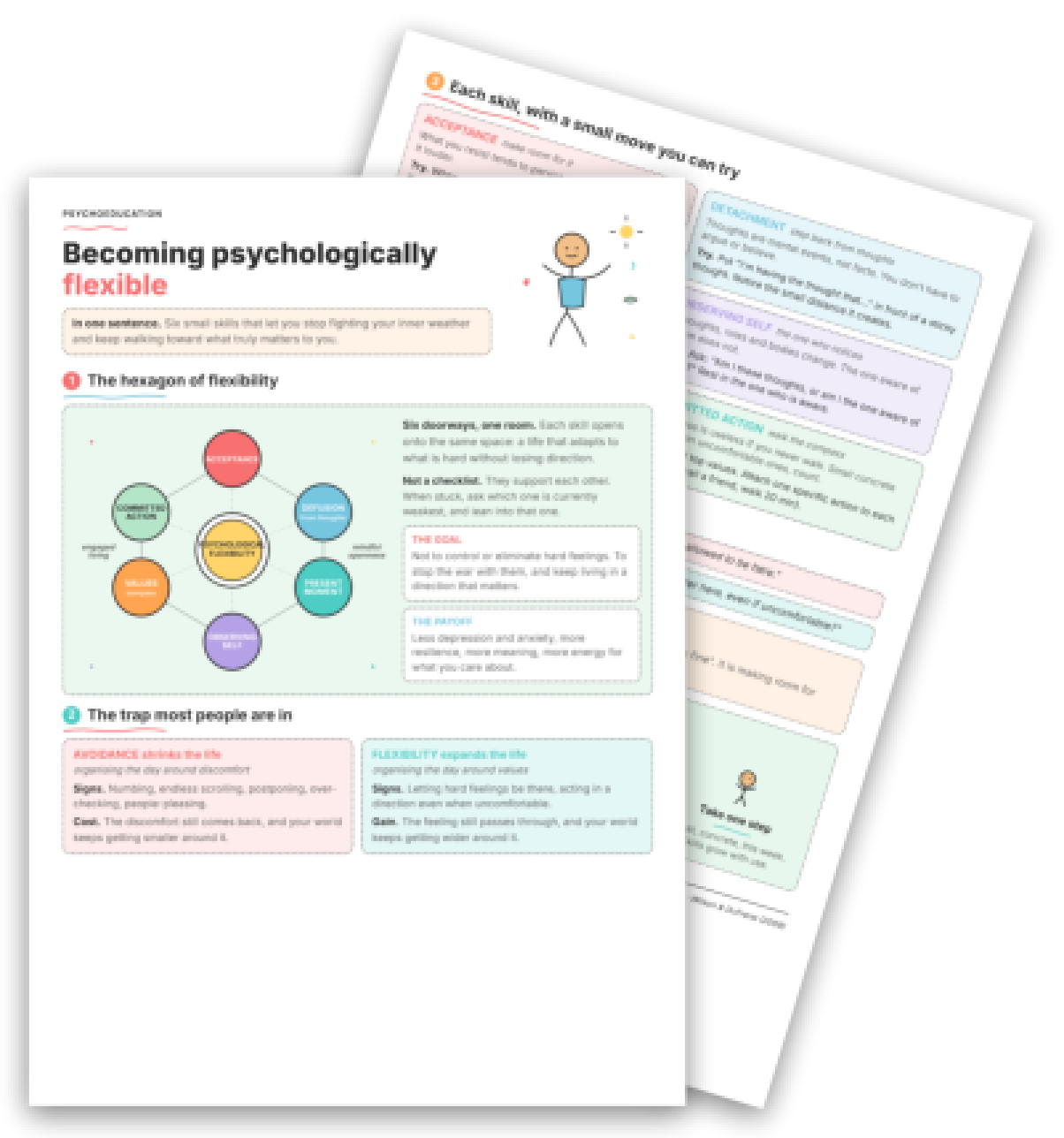
A visual PDF worksheet presenting the ACT hexaflex in four panels, with tools and exercises clinicians can use to explain psychological flexibility clearly in session.
Clinical vignettes
Defusion in Chronic Pain Management
Acceptance Skill in Generalised Anxiety
Clinical picture. R, a woman in her early thirties, sought treatment for generalised anxiety disorder characterised by high somatic reactivity and a longstanding pattern of avoidance, including reduced work hours and withdrawal from friendships. The clinician used the psychoeducation sheet to map R's avoidance behaviours onto the "shrinking life" column, then introduced the acceptance micro-practice: locating anxiety in the body, observing its qualities, and breathing around it for sixty seconds rather than leaving the situation. R practised this during a subsequent meeting with her line manager, a context she had been postponing for two months. She described the anxiety as intense but time-limited, and noted that the conversation ended without the feared outcome she had long rehearsed.
Explaining psychological flexibility verbally often means juggling six interdependent processes simultaneously while holding the therapeutic alliance. Without a visual anchor, the hexaflex becomes a list the patient hears once and forgets. This PDF fiche gives you a concrete in-session scaffold to make each ACT process legible, one panel at a time.
Use this resource with your patients
Handout, exercises and materials ready to use, right inside SessionFuel.
Why Psychological Flexibility Resists Verbal Explanation
The core difficulty is structural: the six processes of the ACT hexaflex (acceptance, cognitive defusion, present-moment contact, self-as-context, values, committed action) are not sequential steps but mutually reinforcing doorways. When you describe them linearly, the patient constructs a mental checklist. The system character of the model, its whole point, disappears.
Two specific misreadings recur regardless of how carefully you frame it orally. Patients routinely hear acceptance as resignation, or passive approval of something painful. And they hear defusion as the instruction to stop thinking. Without something to point at, each correction requires a new verbal detour. The conversation loops. Meanwhile, the patient's own experiential avoidance is often active in the room, making sustained abstract listening harder still. A grounding support is not a pedagogical convenience here; it is a clinical necessity.
What the Fiche Contains: Four Panels That Show What Speech Alone Cannot
The fiche structures the concept across four panels, each serving a distinct explanatory function.
Panel 1 renders the hexaflex as a literal hexagon: six labeled nodes around the central phrase "psychological flexibility," grouped under the three broader stances of openness, mindful awareness, and engaged living. Pointing to this diagram while narrating each node lets the patient see the system, not just hear its parts. The ACT Hexaflex worksheet goes deeper into the model itself; this fiche uses the hexagon as an entry point into a broader psychoeducation sequence.
Panel 2 makes the clinical stakes explicit with a direct contrast: "AVOIDANCE shrinks the life / FLEXIBILITY expands the life." The panel maps the behavioral signs and the cost of each pattern. This is where you can anchor the formulation of the patient's presenting avoidance without using jargon. For patients already working with adaptive versus maladaptive coping strategies, this panel makes the ACT framing of the same phenomena immediately recognizable.
Panel 3 is the practical core. Each of the six processes gets a two-sentence description and a micro-exercise the patient can try between sessions: placing "I'm having the thought that..." before a sticky cognition, naming two sensory anchors per modality to return to the present moment, or writing one value-anchored action for each of three priority domains. These are not homework assignments to complete alone; they are moves you can rehearse together in session using the panel as your shared reference. For patients needing more targeted work on defusion specifically, ACT Cognitive Defusion and the ACT Schemas and Modes worksheet extend this work considerably.
Panel 4 collects ready-made phrases the patient can internalize: "This feeling is allowed to be here," "I am the one noticing this," "What would matter here, even if uncomfortable?" These function as defusion and acceptance prompts the patient can apply without recalling theoretical content.
A brief clarification block addresses the acceptance-versus-resignation confusion directly, which saves you from handling it reactively in every session.
> Key takeaway: This fiche is a visual support that facilitates the explanation of psychological flexibility in session. It is not a self-administered questionnaire; it is a psychoeducation tool the clinician uses to make a complex, multi-process model clear in real time, then leaves the patient as a concrete reference point.
750+ clinical tools
A library built with and for clinicians, ready to use in session and extend between appointments.
Access all the toolsWhen and How to Introduce It in Session
The fiche fits naturally after the initial assessment, once you have identified experiential avoidance as a maintaining factor. For patients who arrive with generalized anxiety structured around worry and suppression, or with depression sustained by behavioral withdrawal, Panel 2 alone can open a productive formulation conversation in under five minutes.
You can introduce it with: "I'd like to show you a map of the skills we'll be building together. Nothing to fill in right now, just something to look at while I explain." That framing positions it as a shared visual, not an evaluation instrument, which preserves the alliance in early-phase work.
After walking through the hexagon and the avoidance-versus-flexibility contrast, Panel 3's micro-exercises provide a natural bridge to between-session work. The Choice Point worksheet pairs particularly well as a next step, operationalizing the values-to-committed-action pathway the fiche introduces. For patients already working on values clarification, My Values and Cultivating Personal Values extend that strand directly.
One limit worth noting: for patients with active psychosis or severe cognitive disorganization, the hexagon's density warrants working with one panel at a time across separate sessions rather than presenting the whole fiche at once. For most other presentations, including those engaged in an ACT for Depression program, the fiche serves as a reliable orientation map the patient can return to independently whenever the framework feels abstract again.
Use it with your patients
Share this tool in the mobile app and follow the work between sessions.
Sources
- Hayes, S. C., Strosahl, K. D., & Wilson, K. G. (2012). Acceptance and Commitment Therapy: The Process and Practice of Mindful Change (2nd ed.). Guilford Press.
- Harris, R. (2007). The Happiness Trap: Stop Struggling, Start Living. Exisle Publishing.
- Association for Contextual Behavioral Science (ACBS). Psychological Flexibility and Inflexibility Measures: The ACT Hexaflex Model.
Your session continues in your patients' pocket
Use with a patientYour resources, available everywhere
The handouts, exercises, programs and audios above: you choose which ones to make available to your patients, in the mobile app dedicated to them.
And far more than a library
The app goes well beyond resources, to support your patients every day:
Related categories
Explore other clinical resources by category.

Anxiety
Clinical hub for anxiety disorders: CBT and ACT worksheets, psychoeducation sheets, and exercises for assessment and treatment across the anxiety spectrum.

Mood
Evidence-based worksheets and clinical tools for mood disorders: CBT, ACT, and positive psychology resources for psychologists and therapists.

Identity
Clinical resources for self-identity work in therapy: CBT, ACT, schema tools for clinicians addressing self-concept, core beliefs, and identity disruption.

Emotions
Clinical resources on emotion regulation: worksheets, coping tools, CBT, REBT, and ACT exercises for therapists working across diagnoses and age groups.

Cognition
Printable cognitive therapy worksheets and clinical tools for therapists: CBT, ACT, schema work, defusion, distortions, and belief restructuring.

Understand
Clinical hub for the therapeutic aim 'Understand': worksheets and tools to build patient insight across CBT, ACT, schema therapy and more.