
Clinical picture. M., a man in his late thirties, presented with alcohol use disorder in sustained remission and a longstanding pattern of self-critical rumination that intensified during high-risk periods such as work deadlines. He described feeling entirely alone during urge states and noted that no coping card had ever felt credible in those moments. The clinician introduced the future-self letter as a session task, asking M. to picture himself at 11 p.m. on a Thursday after a difficult week and to write to that specific version of himself using the tone he would naturally adopt with a close friend in distress. M. spent approximately fifteen minutes on the letter, naming the chest tightness and the urge directly rather than offering reassurances, and closed with a single sentence he chose himself. At the following session he reported having read the letter once during a high-risk evening; he described it as "like hearing someone who already knew" and did not drink that night.
Speaking to Your Future Self: PDF Worksheet, Tools and Exercises
A printable PDF worksheet, clinical tools and guided exercises helping patients prepare compassionate self-talk for their most predictable hard moments, before the crisis arrives.
Clinical vignettes
Anticipating the Urge to Relapse
Preparing for a Feared Medical Scan
Clinical picture. T., a woman in her mid-fifties undergoing surveillance imaging following treatment for breast cancer, met criteria for health anxiety with prominent anticipatory distress in the days before each scan appointment. Standard cognitive restructuring had limited traction because she recognised the thoughts as irrational yet found the emotional intensity unchanged. During a session three weeks before her next scan, the clinician used the future-self worksheet to guide T. in writing a letter addressed to herself on the morning of the appointment, beginning with a precise sensory description of the waiting room she had described as most difficult. T. named the fear directly in the letter, validated it without minimising it, and included two short sentences about what had helped her wait before. She kept the letter on her phone and read it in the radiology department; she later noted that the pre-written compassion felt less effortful to receive than anything she tried to generate in the moment.
Most patients can describe, in session, exactly what they would say to a close friend in distress: slow, warm, generous. The moment they are the one in pain, that voice vanishes entirely. This PDF worksheet on speaking to your future self addresses that gap directly, giving patients a concrete psychoeducation tool they prepare in a regulated state and leave where their distressed future self can actually find it.
Use this resource with your patients
Handout, exercises and materials ready to use, right inside SessionFuel.
Why the Compassion Gap Resists Oral Explanation
The compassion gap between self-directed and other-directed care is well-documented in Kristin Neff's self-compassion framework and Paul Gilbert's compassion-focused therapy model. Naming it verbally in session tends to produce recognition without transfer: the patient understands the concept, but cannot access the kinder register when their nervous system is in a threat state.
What patients typically miss when you explain this at the oral level is the temporal problem. It is not just that they are unkind to themselves in a crisis; it is that the regulated, warm voice they have right now, in your office, is simply unavailable to them later. No amount of instruction changes the fact that cognitive flexibility narrows under acute distress. The only reliable solution is to prepare the warmer voice in advance, in writing, addressed to the specific moment when it will be needed.
This is precisely the clinical gap the fiche fills.
What the Fiche Contains: A Visual Support for the Explanation
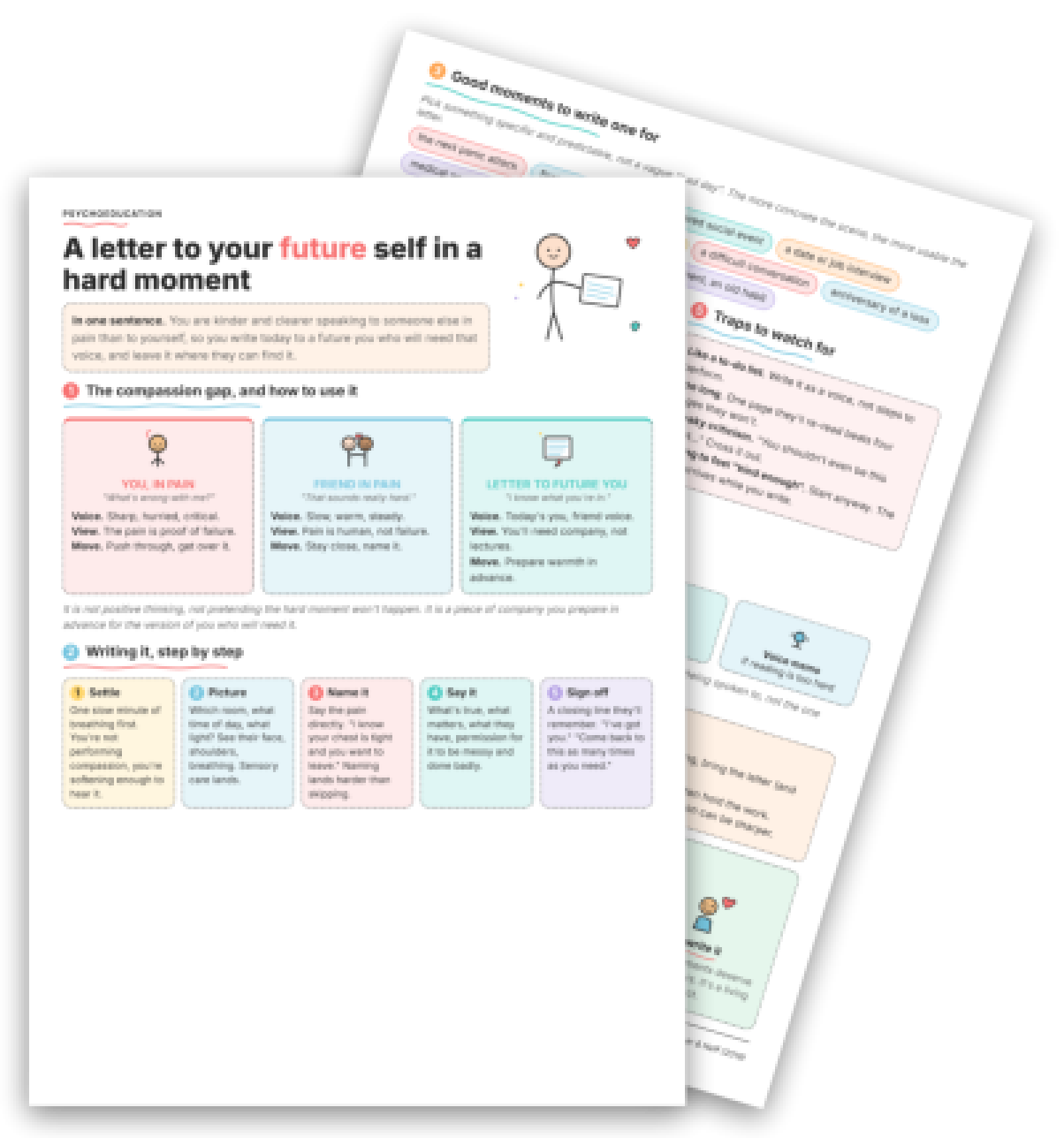
The fiche opens with a three-column comparison table that makes the compassion gap visible at a glance. The columns read YOU IN PAIN, FRIEND IN PAIN, and LETTER TO FUTURE YOU, each with identical sub-rows: voice, view, and move. The visual contrast is the argument. Where your patient's pain column reads "What's wrong with me?" and "Pain is proof of failure," the friend column reads "That sounds really hard" and "Pain is human, not failure." Showing patients this layout side by side, in session, lands faster than any verbal analogy.
From there, the fiche walks through six concrete writing steps (settle, picture, name it, say it, sign off), a list of specific predictable moments to write for (the next panic attack, a feared medical appointment, a date that hurts, Sunday evenings), a bank of sentence starters for when words stall, a short list of traps to watch for (letters that drift into to-do lists, or where "sneaky criticism" slips in), and practical storage formats (pinned phone note, photo in favourites, voice memo). A closing "To discuss in session" panel gives you explicit debriefing hooks.
> Key point: this fiche is a visual support that facilitates the explanation in session. It is not a questionnaire patients complete alone; it is something you work through together to establish a shared vocabulary, then send home as a living reference they will rewrite over time.
The fiche references Neff (2011), Gilbert (2009), and Germer & Neff (2019), which grounds it cleanly in the self-compassion and CFT literature you are already using when you pair it with tools like structured self-compassion practice or the self-compassion bandage guided audio.
750+ clinical tools
A library built with and for clinicians, ready to use in session and extend between appointments.
Access all the toolsWhen and How to Introduce the Fiche
Timing. Propose it once the patient can articulate at least one predictable high-distress scenario. It fits naturally in the middle phase of work, after initial psychoeducation on the anxiety or depression maintenance cycle, and before the patient faces a known upcoming stressor. For patients working on coping with crisis moments or building anticipatory fear tolerance, it slots in as a proactive complement.
Profiles. Particularly useful with patients who show strong évitement expérientiel, who dismiss distress with "I just need to push through," or who already score high on self-compassion deficits visible in structured exercises. Also well-suited to patients reviewing progress against anxiety or depression, where the letter becomes part of relapse prevention planning.
Introduction. A clean framing: "You have a warmer voice than you give yourself credit for. We're going to prepare it now, when you have access to it, for the moment when you won't." Avoid framing it as homework to perfect; the fiche itself flags that "the voice arrives while you write" and that "different moments deserve different letters."
Debrief. The three "To discuss in session" prompts on the fiche structure the debrief for you: what felt too big to picture without flooding, which lines the inner critic slipped into, and what actually helped when the patient used the letter.
The fiche does not replace the therapeutic relationship. It extends the regulated, compassionate voice you help the patient access in session into the moments you cannot be present for, and leaves them something concrete to return to. For patients also working with RAIN mindfulness practice or maintaining hope under pressure, it reinforces the same underlying stance: meeting distress with presence rather than avoidance.
Use it with your patients
Share this tool in the mobile app and follow the work between sessions.
Sources
- Neff, K. (2011). Self-Compassion: The Proven Power of Being Kind to Yourself. William Morrow.
- Neff, K.. Exercise 3: Exploring Self-Compassion Through Writing. Self-Compassion.org.
- Greater Good Science Center, UC Berkeley. Self-Compassionate Letter. Greater Good in Action.
- (2024) Dear John: Letter Writing as a Narrative Therapy Intervention. Trends in Psychology (Springer Nature).
Your session continues in your patients' pocket
Use with a patientYour resources, available everywhere
The handouts, exercises, programs and audios above: you choose which ones to make available to your patients, in the mobile app dedicated to them.
And far more than a library
The app goes well beyond resources, to support your patients every day:
Related categories
Explore other clinical resources by category.
Anxiety
Clinical hub for anxiety disorders: CBT and ACT worksheets, psychoeducation sheets, and exercises for assessment and treatment across the anxiety spectrum.
Trauma
Clinical hub on trauma and PTSD: assessment, differential diagnosis, treatment phases, and printable resources for practitioners. 155 chars.

Mood
Evidence-based worksheets and clinical tools for mood disorders: CBT, ACT, and positive psychology resources for psychologists and therapists.

Identity
Clinical resources for self-identity work in therapy: CBT, ACT, schema tools for clinicians addressing self-concept, core beliefs, and identity disruption.

Emotions
Clinical resources on emotion regulation: worksheets, coping tools, CBT, REBT, and ACT exercises for therapists working across diagnoses and age groups.

Build awareness
Clinical worksheets and tools to build awareness in therapy: cognitive distortions, schemas, emotions, ACT and CBT resources for practitioners.