
Explaining self-compassion verbally often misfires: patients hear "be nicer to yourself" and respond with skepticism, minimisation, or a polite nod that signals nothing has actually landed. This fiche PDF on practicing self-compassion gives you a structured visual support to make the concept concrete during the session itself, replacing a vague injunction with a shared map the patient can take away and return to.
HandoutSelf & identityMood & depressionAnxietyEmotions & stressUnderstandRepair & sootheACTCompassion-focusedMindfulness (MBSR/MBCT)Humanistic
Practicing Self-Compassion: PDF Worksheet, Tools and Exercises
A printable PDF fiche and concrete exercises to help clinicians explain self-compassion clearly in session and give patients a lasting visual reference.
Use this resource with your patients
Handout, exercises and materials ready to use, right inside SessionFuel.
Why Self-Compassion Is Hard to Explain at the Oral Level
The core obstacle is not conceptual ignorance; it is the inner critic's grip. When a patient is embedded in chronic self-attack, asking them to imagine speaking to themselves "like a close friend" sounds either naive or, worse, like a threat to their sense of moral seriousness. The three-component model developed by Neff (self-kindness, common humanity, mindfulness) is clinically robust, but delivered verbally it becomes abstract. Patients often conflate self-compassion with self-pity, with permissiveness, or with bypassing accountability, confusions that stall the work before it begins.
The same dynamic appears with patients presenting perfectionism, low self-esteem, or burnout: they may intellectually accept the model while their inner monologue continues unchanged. A visual support externalises the two-voice structure and gives the clinician something to point to, which shifts the conversation from argument to observation.
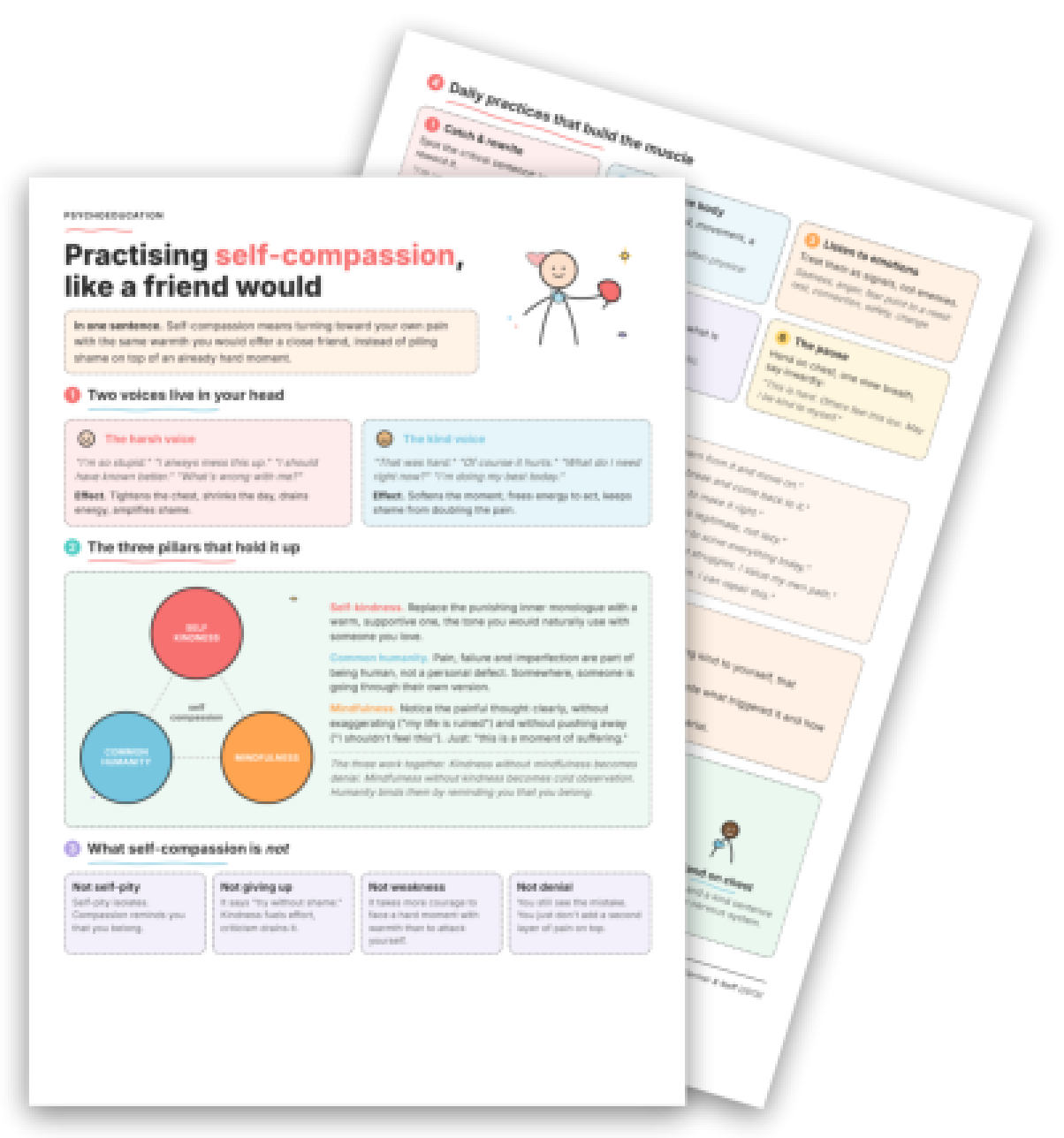
What the Fiche Contains: A Visual Map for the Session
The fiche is organised into five numbered panels plus a "To discuss in session" block, making it a ready-made psychoeducation arc rather than a loose handout.
- Panel 1 ("Two voices live in your head") places the harsh voice and the kind voice side by side, each with concrete self-talk examples ("I'm so stupid" / "That was hard") and their physiological effects. This side-by-side layout does what the oral explanation rarely achieves: it makes the contrast visible and immediate.
- Panel 2 maps the three pillars (self-kindness, common humanity, mindfulness) in a diagram and explains how they interlock. The note that "kindness without mindfulness becomes denial" is particularly useful for patients who fear self-compassion will make them complacent.
- Panel 3 addresses misconceptions head-on: not self-pity, not giving up, not weakness, not denial. Work through this panel with patients who resist self-acceptance or who need the distinction between compassion and avoidance made explicit.
- Panel 4 lists six daily practices (Catch and rewrite, The pause, Reach out, and others) with brief instructions. These translate directly into between-session homework without requiring a separate prescription.
- Panel 5 is a trigger-response table with seven scenarios (mistake at work, feeling overwhelmed, snapping at someone) alongside a modelled kind-voice reply. For patients working on inner self-talk, this column structure is far easier to internalise than an oral list.
- The "To discuss in session" block closes the fiche with three clinical prompts, including the mention of backdraft (emotional flooding when kindness first arrives), a phenomenon worth naming explicitly before the patient encounters it.
> Key takeaway: the fiche is a visual support that facilitates the explanation of self-compassion in session; the clinician uses it to walk through the concept panel by panel, not as homework the patient completes alone.
Clinical library
750+ clinical tools
A library built with and for clinicians, ready to use in session and extend between appointments.
Access all the toolsSeveral resource types
Psychoeducation handouts
Understand at a glance
Interactive exercises
To do and fill in
Interactive programs
A structured path
Audios
Meditation and relaxation
Psychometric tests
Automatic scoring
When and How to Introduce the Fiche
The fiche fits naturally from the second or third session onward, once the formulation is established and self-critical patterns have been named. It is particularly indicated when you are working with perfectionism and self-reflection, shame, constant social comparison, or feelings of inadequacy.
Introduce it without labelling the patient: "I want to show you a model that might reframe what we've been noticing about how you talk to yourself." Walk through Panels 1 and 2 together in session, then ask the patient which panel matches their current experience most closely. Panel 5's trigger table works well as a debrief anchor: "Which of these seven situations felt most recognisable this week?"
One limit worth naming: patients with significant emotional dysregulation or active trauma may experience backdraft (the fiche itself names this) when they first attempt the kind-voice practice. In those cases, pair the fiche with a somatic regulation resource such as the Self-Compassion Bandage guided audio or the Emotional Self-Compassion meditation before assigning the daily practices. For between-session consolidation, Accepting Mistakes extends Panel 1 directly into structured written work.
The fiche does not replace the relational and experiential dimensions of this work; it makes the explanation precise, saves time on concept-building, and leaves the patient with a concrete reference they can consult between sessions.
Use it with your patients
Share this tool in the mobile app and follow the work between sessions.
Sources
- Neff, K. D. (2011). Self-Compassion: The Proven Power of Being Kind to Yourself. William Morrow.
- Neff, K. D., Germer, C. K. (2018). The Mindful Self-Compassion Workbook: A Proven Way to Accept Yourself, Build Inner Strength, and Thrive. Guilford Press.
- Neff, K. D. (2023). Self-Compassion: Theory, Method, Research, and Intervention. Annual Review of Psychology, 74, 193-218.
Patient mobile app
Your session continues in your patients' pocket
Use with a patientYour resources, available everywhere
The handouts, exercises, programs and audios above: you choose which ones to make available to your patients, in the mobile app dedicated to them.
Psychoeducation handoutsInteractive exercisesInteractive programsAudiosPsychometric tests
And far more than a library
The app goes well beyond resources, to support your patients every day:
Standardized tests
Therapy journal
Gamification
Wellbeing challenges
Introspection prompts
Therapist homework
Related categories
Explore other clinical resources by category.

Anxiety
Clinical hub for anxiety disorders: CBT and ACT worksheets, psychoeducation sheets, and exercises for assessment and treatment across the anxiety spectrum.

Mood
Evidence-based worksheets and clinical tools for mood disorders: CBT, ACT, and positive psychology resources for psychologists and therapists.

Identity
Clinical resources for self-identity work in therapy: CBT, ACT, schema tools for clinicians addressing self-concept, core beliefs, and identity disruption.

Emotions
Clinical resources on emotion regulation: worksheets, coping tools, CBT, REBT, and ACT exercises for therapists working across diagnoses and age groups.

Understand
Clinical hub for the therapeutic aim 'Understand': worksheets and tools to build patient insight across CBT, ACT, schema therapy and more.
Repair & soothe
Clinical resources for the repair and soothe therapeutic aim: worksheets, exercises and tools to build self-compassion, reduce shame and restore emotional safety.