
A. is a 34-year-old professional referred for generalised anxiety disorder who reported a persistent pattern of avoidance before high-stakes work presentations. During session, the clinician introduced the RAIN worksheet and walked A. through each step using a recent episode: A. named the sensation as "dread sitting in my sternum," paused with Allow rather than immediately problem-solving, and located a fear of humiliation during Investigate. At Nurture, A. placed a hand on the chest and silently repeated a phrase borrowed from a trusted mentor, since self-directed kindness felt hollow at first. By the following week A. reported having used the sequence independently before one meeting; the anxiety did not resolve entirely, but A. described being less pulled toward cancellation.
RAIN Mindfulness Technique: PDF Worksheet, Tools and Exercises
A printable PDF worksheet, clinical tools, and exercises to explain the RAIN mindfulness technique in session and give patients a durable self-compassion map.
Clinical vignettes
RAIN With Pre-Session Anxiety Spike
RAIN After a Relapse Slip
M. is a 41-year-old in recovery from alcohol use disorder who disclosed a brief lapse following a family conflict and arrived at the next session flooded with self-recrimination. The clinician offered the RAIN framework as a structured way to stay with shame without either suppressing it or amplifying the self-attack. M. moved slowly through Recognize and Allow, noting that simply naming "this is shame, not proof I am hopeless" produced a small but perceptible shift in arousal. Investigate surfaced a younger, frightened sense of self beneath the harsh internal voice, and Nurture was practised as a quiet internal statement: "You were overwhelmed. I am still here." M. did not report the lapse resolving its consequences, but the session ended with noticeably less affective constriction and a clearer capacity to plan next steps.
RAIN is well-established across third-wave frameworks, with roots in Tara Brach's clinical formalization and the self-compassion literature of Germer and Neff. Explaining it verbally in session, however, tends to produce polite nodding far more reliably than genuine uptake. This fiche PDF gives you a concrete visual scaffold to make the four steps land in a way that a spoken walkthrough alone rarely achieves.
Use this resource with your patients
Handout, exercises and materials ready to use, right inside SessionFuel.
Why RAIN Resists Oral Explanation in Session
The four letters sound deceptively simple at first presentation. In practice, patients routinely conflate Recognize with Allow, skip Allow entirely when a feeling feels unbearable, or turn Investigate into self-interrogation rather than the soft curiosity the technique requires. The step that stalls most is Nurture: patients carrying high self-criticism, significant shame, or schémas précoces inadaptés around emotional deprivation often experience it as performative or frankly inaccessible.
A verbal walkthrough also leaves no trace. Patients who seem to grasp the sequence in session frequently cannot reconstruct it under acute distress, when executive access is reduced and working memory load is highest. That is the gap the fiche is designed to close.
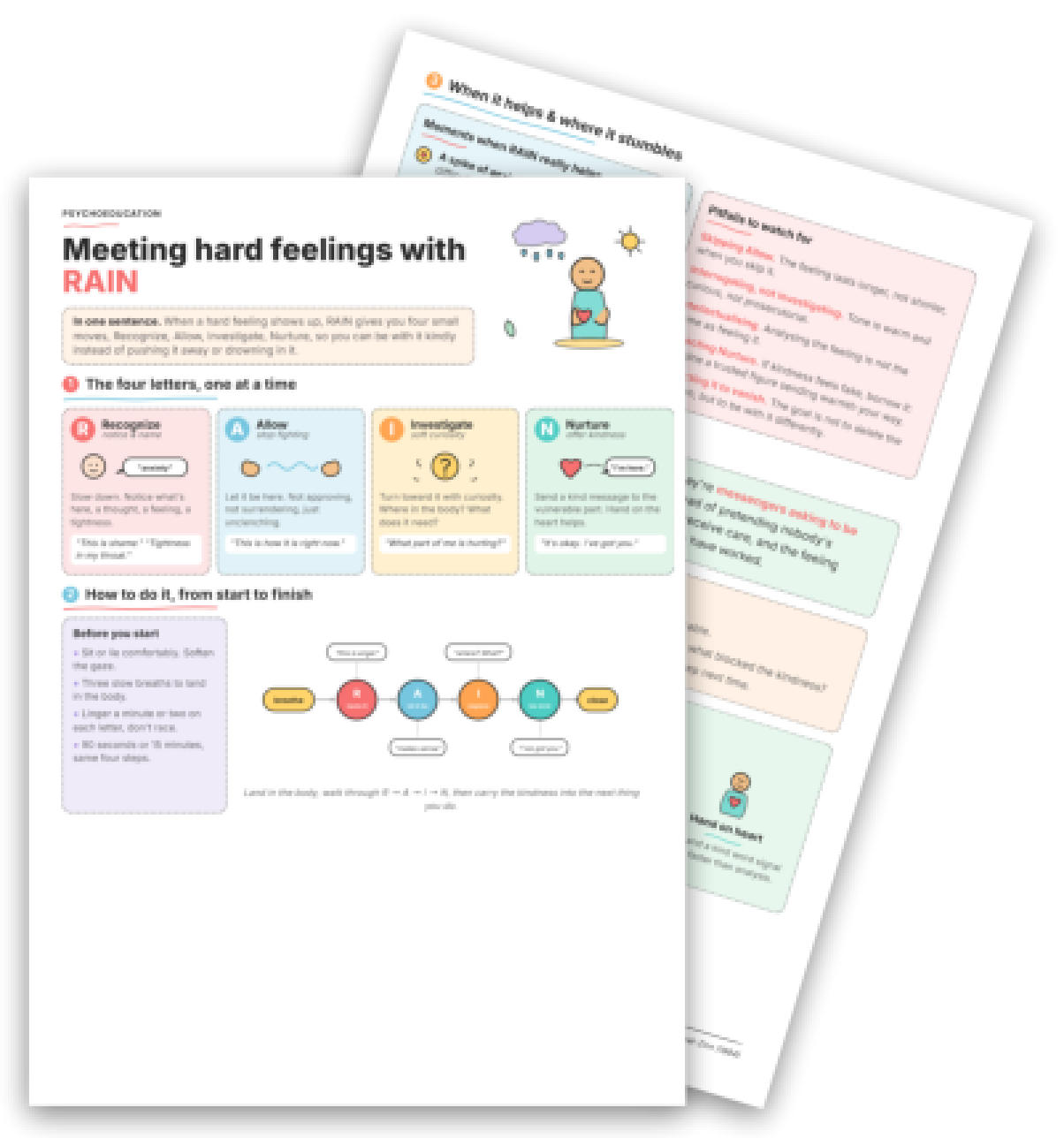
What the Fiche Contains: A Visual Map of the Four Steps
The sheet opens with a one-sentence anchor: "When a hard feeling shows up, RAIN gives you four small moves... so you can be with it kindly instead of pushing it away or drowning in it." That framing does clinical work immediately, positioning the technique as neither suppression nor flooding, a distinction worth naming explicitly with patients prone to experiential avoidance or adaptive and maladaptive coping strategies.
Panel 1 maps each letter with a tight definition and sample self-talk: R (Recognize) names the felt sense ("This is shame." / "Tightness in my throat."), A (Allow) frames unclenching without approval ("This is how it is right now."), I (Investigate) prompts somatic curiosity ("What part of me is hurting?"), and N (Nurture) offers a kind message alongside the physical anchor of a hand on the heart.
Panel 2 lays out the full practice as a visual flow, from three grounding breaths to a closing instruction to carry kindness into the next action. Seeing the sequence as a diagram, rather than hearing it described, helps patients grasp the temporal structure and stops them from rushing or looping.
Panel 3 is clinically the most immediately useful. It lists five specific scenarios where RAIN is particularly indicated (pre-meeting anxiety spikes, 3am chest tightness, urge states, post-mistake harsh self-talk) and, equally important, five pitfalls: skipping Allow, interrogating rather than investigating, intellectualising the feeling, rejecting Nurture, and expecting the emotion to vanish. Having the pitfalls printed on the sheet spares you the need to predict which one will catch a given patient.
Panel 4 carries a reframe worth reading aloud: "Difficult feelings aren't problems to fix, they're messengers asking to be seen." It closes with three "To discuss in session" prompts, structured explicitly for the clinical encounter, asking where Allow felt unbearable, whether Nurture was blocked, and which situation the patient would like to walk through together step by step.
> Key takeaway: This fiche is a visual support that facilitates the explanation of RAIN in session. The flow diagram, pitfall list, and session discussion prompts make the technique tangible and leave the patient a durable reference between appointments, not a task to complete alone.
750+ clinical tools
A library built with and for clinicians, ready to use in session and extend between appointments.
Access all the toolsWhen and How to Introduce the Fiche
RAIN fits naturally into work addressing emotion dysregulation, rumination, self-criticism and shame, and experiential avoidance. Within ACT it reinforces psychological flexibility and cognitive defusion; within DBT it complements mindfulness what and how skills and distress tolerance; within MBCT it anchors the turning toward stance at the core of the protocol.
Propose it after the working formulation is in place and once the patient has a functional understanding of the emotion-avoidance cycle. A low-pressure introduction: "Here is a four-step practice I would like to walk through with you now. We will go at your pace, and you will have this sheet to take with you." That framing preserves the therapeutic alliance by making it a shared exercise rather than assigned homework.
Use the panel 4 prompts as debrief anchors in the following session. A patient who stalled at Allow is pointing directly to the felt-sense work still needed, often connected to a nervous system regulation deficit or an emotional inhibition schema. A patient for whom Nurture felt impossible opens a route into self-compassion work and, when available, a guided self-compassion audio as between-session reinforcement. For patients with significant trauma history, pace the Investigate step carefully: somatic inquiry can activate hypervigilance before adequate safety is established.
The fiche does not replace the clinical frame. It makes the explanation more efficient, installs a shared vocabulary, and gives the patient a concrete map for the moments when you are not in the room.
Use it with your patients
Share this tool in the mobile app and follow the work between sessions.
Sources
- Brach, T. (2019). Radical Compassion: Learning to Love Yourself and Your World with the Practice of RAIN. Viking / Penguin Random House.
- Brach, T. (2020). RAIN: A Practice of Radical Compassion (free printable guide).
- Brach, T.. RAIN: Recognize, Allow, Investigate, Nurture - Resources.
- Hedderman, E., O'Doherty, V., O'Connor, S. (2020). Mindfulness moments for clinicians in the midst of a pandemic. Irish Journal of Psychological Medicine.
Your session continues in your patients' pocket
Use with a patientYour resources, available everywhere
The handouts, exercises, programs and audios above: you choose which ones to make available to your patients, in the mobile app dedicated to them.
And far more than a library
The app goes well beyond resources, to support your patients every day:
Related categories
Explore other clinical resources by category.

Anxiety
Clinical hub for anxiety disorders: CBT and ACT worksheets, psychoeducation sheets, and exercises for assessment and treatment across the anxiety spectrum.

Mood
Evidence-based worksheets and clinical tools for mood disorders: CBT, ACT, and positive psychology resources for psychologists and therapists.

Identity
Clinical resources for self-identity work in therapy: CBT, ACT, schema tools for clinicians addressing self-concept, core beliefs, and identity disruption.

Emotions
Clinical resources on emotion regulation: worksheets, coping tools, CBT, REBT, and ACT exercises for therapists working across diagnoses and age groups.

Build awareness
Clinical worksheets and tools to build awareness in therapy: cognitive distortions, schemas, emotions, ACT and CBT resources for practitioners.

Regulate
Clinical resources for emotion regulation: worksheets, ACT exercises, and psychoeducation tools for affect regulation across diagnoses. For clinicians.