
Clinical picture. A woman in her early forties, referred to here as R., presents with a diagnosis of PTSD following a road traffic accident two years prior. She reports frequent dissociative episodes during the working day, describing them as "going somewhere else" for several minutes at a time, after which she feels disoriented and ashamed. The clinician introduces the grounding informational sheet in session, walking through the four categories together rather than simply handing it over. R. immediately discounts the sensory options involving smell (she reports anosmia), which the worksheet's menu format accommodates without friction; she selects foot-pressing, anchor facts, and carrying a rough-edged key as her starting set. Two weeks later she reports using the floor-pressure technique reliably at her desk, noting that episodes resolve faster, though she remains ambivalent about verbalising anchor phrases aloud in an open office.
Grounding Techniques: PDF Worksheet, Tools and Exercises for Clinical Practice
A structured visual menu of grounding exercises clinicians can use in session to help patients with dissociation, flashbacks, and acute distress return to the present moment.
Clinical vignettes
Building a Personalised Grounding Menu
Grounding Sheet After Acute Decompensation
Clinical picture. T., a man in his late twenties with a longstanding complex trauma history, is seen in an outpatient setting following a brief crisis admission. He arrives to the first post-discharge session visibly hypervigilant, scanning the room repeatedly. The clinician uses the sheet as a shared reference point rather than a formal teaching exercise, asking T. which of the listed states he recognises from the past week. He identifies "going blank" and "freezing" without prompting, which opens a brief normalising conversation. Together they draft a four-item personal menu weighted toward body-based techniques, specifically star jumps, cold water on the wrists, and a slow named walk, alongside one safety-now phrase he agrees to test. At the following session T. reports that the cold water technique was the only one he actually used, but that using it once had interrupted a dissociative spiral before it fully established.
Explaining grounding techniques verbally in session is, almost by definition, poorly timed: the patients who need this skill most are the ones least able to absorb a spoken list of strategies when they are in the middle of dissociation, a flashback, or a hyperarousal spike. This fiche PDF solves that problem by giving both you and the patient a concrete, scannable visual reference, built around a personalised menu the patient can keep in their wallet or on their phone.
Use this resource with your patients
Handout, exercises and materials ready to use, right inside SessionFuel.
Why Grounding Is Difficult to Transmit in Session
Oral psychoeducation about grounding tends to produce polite nodding rather than lasting skill acquisition. The core obstacle is state-dependent learning: what a patient hears while calm and regulated often fails to transfer to the moment of acute distress, when prefrontal access is genuinely compromised. The fight-flight-freeze response reduces cognitive bandwidth exactly when a structured response is needed most.
There is also a conceptual muddle to untangle. Many patients conflate grounding with suppression (pushing feelings away) or with mindfulness (open, non-directive observation). Both conflations get in the way of correct use. And for PTSD and depersonalisation presentations especially, a technique that requires closing the eyes or sustained introspection can worsen rather than help. These nuances are genuinely hard to convey once, verbally, without a durable reference the patient can consult on their own.
What the Fiche Contains: a Visual Menu, Not a Checklist
The fiche is structured around four sequential sections that you can walk through together at the pace the patient needs.
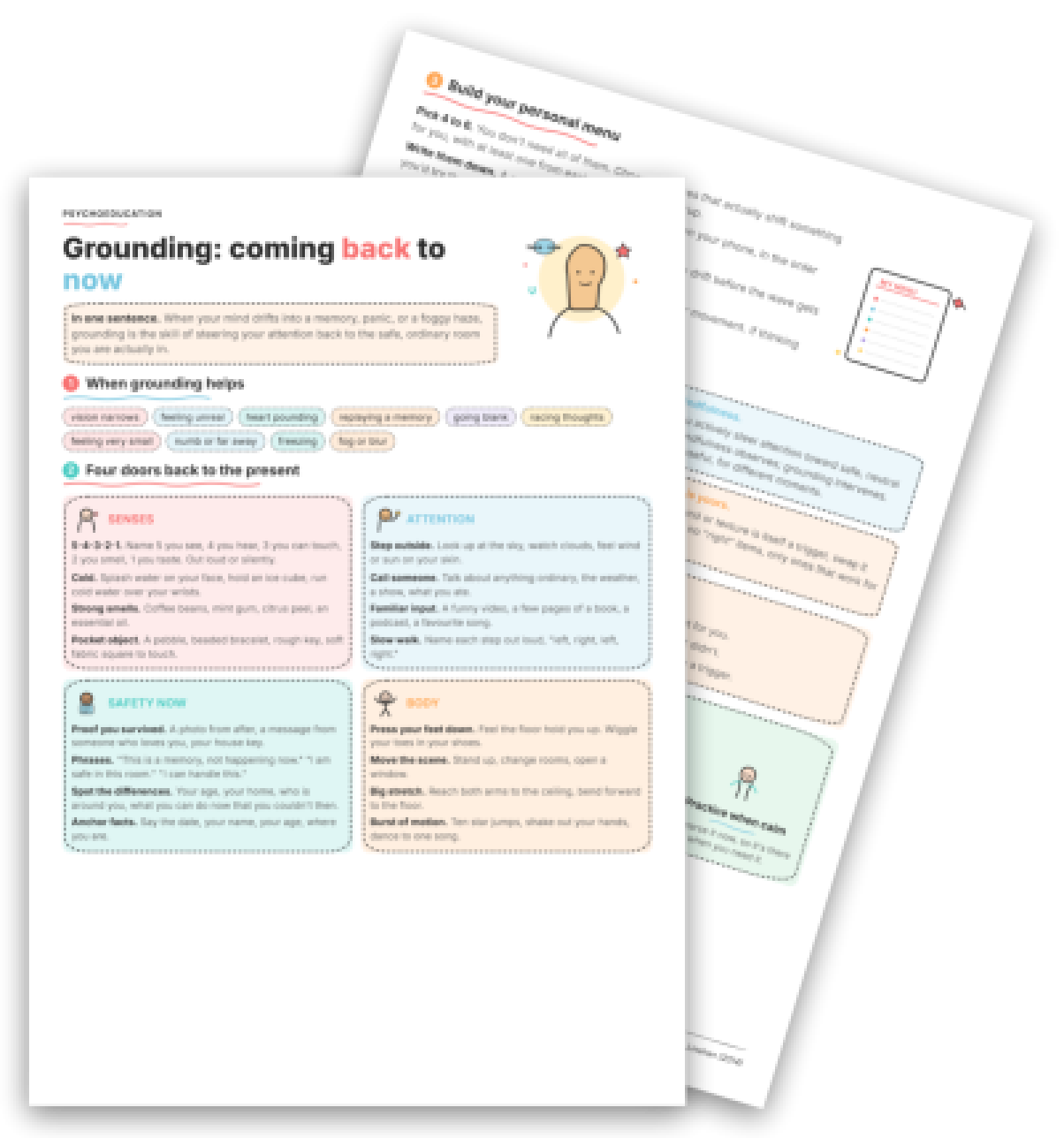
Section 1 maps the when: ten clinical presentations where grounding is indicated, listed concisely (vision narrows, heart pounding, replaying a memory, freezing, fog or blur, among others). Seeing this list often produces immediate recognition, which itself has alliance value.
Section 2 is the therapeutic core: "Four doors back to the present", organising techniques across four categories: SENSES, ATTENTION, SAFETY NOW, and BODY. Each category contains three to five concrete techniques, worded accessibly. The BODY door, for instance, includes "Press your feet down. Feel the floor hold you up. Wiggle your toes in your shoes" and "Burst of motion: ten star jumps, shake out your hands, dance to one song." The SAFETY NOW door includes anchor phrases ("This is a memory, not happening now") and cognitive anchoring ("Say the date, your name, your age, where you are"). This four-door layout is what makes the fiche irreplaceable as a visual support: a patient who cannot access language or cognition under acute autonomic arousal can point to or land on a category and begin there. The body-first path is explicitly shown as an alternative to cognition-first approaches.
Section 3 structures the personalisation task: "Pick 4 to 6. You don't need all of them." The patient builds their own ordered menu, with guidance to include at least one technique per category as a backup. A blank MY MENU field invites them to write it down before leaving session.
Section 4 addresses common confusions directly and will save you several minutes of disambiguation: grounding versus suppression, grounding versus mindfulness, and the note that closed-eye exercises are not required. The "To discuss in session" prompts at the bottom give you ready-made debrief questions for the follow-up appointment.
> Key point: the fiche is a visual support for the explanation you give in session; the patient leaves with a printed or photographed copy, not a homework form to complete alone. The menu they build with you is what they use in the moment of need.
750+ clinical tools
A library built with and for clinicians, ready to use in session and extend between appointments.
Access all the toolsWhen and How to Introduce the Fiche
This resource is indicated from the earliest stabilisation phase onward, well before processing work begins in PTSD protocols. It sits naturally at the intersection of trauma psychoeducation, distress tolerance skills (Linehan's DBT framework), and safety-first stabilisation à la Najavits. You can propose it in a second or third session once the patient has described at least one episode of dissociation, flashback, or acute avoidance collapse.
A low-pressure framing: "I'd like to show you something that organises a few strategies we've touched on. We'll look through it together and you'll pick the ones that feel most usable for you." Avoid framing it as a rescue kit for worst-case scenarios, which can itself trigger anticipatory anxiety.
For adolescent presentations, the coping strategies resource for children and adolescents pairs well alongside this fiche. For patients building a broader regulation toolkit, the short present-moment grounding audio and the sensory grounding exercise are natural complements. In crisis presentations, the fiche gives patients something to consult between DBT TIPP skills and environmental change.
Debrief at the next session using the fiche's own prompts: which techniques actually produced a shift, which fell flat, and whether any sensory item has become a trigger since. The Ehlers and Clark PTSD model helps contextualise why some items work and others do not at different stages of treatment. Update the menu together. The fiche is a living document, not a one-time handout.
Use it with your patients
Share this tool in the mobile app and follow the work between sessions.
Sources
- Najavits, L. M. (2002). Seeking Safety: A Treatment Manual for PTSD and Substance Abuse. Guilford Press.
- Substance Abuse and Mental Health Services Administration (SAMHSA) (2014). Trauma-Informed Care in Behavioral Health Services: Treatment Improvement Protocol (TIP) Series 57. Substance Abuse and Mental Health Services Administration.
- Substance Abuse and Mental Health Services Administration (SAMHSA) (2014). TIP 57 Exhibit 1.4-1: Grounding Techniques. National Institutes of Health, NCBI Bookshelf.
Your session continues in your patients' pocket
Use with a patientYour resources, available everywhere
The handouts, exercises, programs and audios above: you choose which ones to make available to your patients, in the mobile app dedicated to them.
And far more than a library
The app goes well beyond resources, to support your patients every day:
Related categories
Explore other clinical resources by category.

Anxiety
Clinical hub for anxiety disorders: CBT and ACT worksheets, psychoeducation sheets, and exercises for assessment and treatment across the anxiety spectrum.

Trauma
Clinical hub on trauma and PTSD: assessment, differential diagnosis, treatment phases, and printable resources for practitioners. 155 chars.

Emotions
Clinical resources on emotion regulation: worksheets, coping tools, CBT, REBT, and ACT exercises for therapists working across diagnoses and age groups.

Regulate
Clinical resources for emotion regulation: worksheets, ACT exercises, and psychoeducation tools for affect regulation across diagnoses. For clinicians.

Process trauma
Clinical resources to process trauma: worksheets, psychoeducation, and exercises for trauma-focused practitioners working with PTSD and complex presentations.
Repair & soothe
Clinical resources for the repair and soothe therapeutic aim: worksheets, exercises and tools to build self-compassion, reduce shame and restore emotional safety.