
Clinical picture. A., a woman in her late thirties, presents with generalised anxiety disorder and reports spending most evenings caught in recursive worry loops that prevent her from sleeping. Her therapist introduces the 5-4-3-2-1 exercise as a structured between-session task, framing it as a way to interrupt the cognitive spiral before it consolidates. During the following session, A. describes completing the exercise at her kitchen table: she found naming five visible objects straightforward, but paused at the olfactory step before identifying the smell of dish soap. By the final question she reported a modest but noticeable shift, describing herself as "less inside the noise." The therapist noted this partial reconnection as a useful entry point for further grounding work, without attributing broader symptom change to a single practice.
5-4-3-2-1 Sensory Grounding: A Guided Clinical Exercise
A structured homework exercise helping patients interrupt cognitive overload through sequential sensory anchoring and present-moment reconnection.
Clinical vignettes
Rumination Cycle in Generalised Anxiety
Dissociative Episodes in Trauma History
Clinical picture. T., a man in his mid-forties with a trauma history and recurrent dissociative episodes, struggles to use cognitive reappraisal techniques when he is already detached from his surroundings. His clinician offers the sensory grounding sequence as a concrete anchor he can apply independently, emphasising the stepwise structure rather than any required outcome. At the next appointment, T. reported using the exercise during a brief episode at work: he worked through the visual and auditory steps with some effort, then paused at tactile contact, noticing the texture of his chair. He did not complete the full sequence but described returning to a clearer sense of where he was. The clinician acknowledged this partial engagement as clinically meaningful and adjusted the exercise pace for the following week.
When the Mind Becomes a Trap
Many patients arrive at sessions describing the same experience: thoughts and sensations that spiral, feed on each other, and cut them off from the world around them. Cognitive overload of this kind is not just uncomfortable. It actively prevents the patient from functioning, from making decisions, from regulating. And it is notoriously hard to address with words alone.
Explaining the concept of present-moment anchoring verbally is one thing. Helping a patient actually feel the shift from internal chaos to environmental contact is another. Psychoeducation fiches on mindfulness or grounding techniques can build the conceptual scaffolding, but the body learns through doing, not through reading. That is where a structured sensory exercise fills a gap that words cannot.
The 5-4-3-2-1 method is grounded in the same logic as nervous system regulation work and DBT mindfulness what and how skills: redirect attentional resources outward, progressively and sensorially, to interrupt the rumination loop from the bottom up.
Use this resource with your patients
Handout, exercises and materials ready to use, right inside SessionFuel.
What the Exercise Contains
This exercise is a five-step sequential grounding protocol, structured as a series of guided questions the patient works through autonomously.
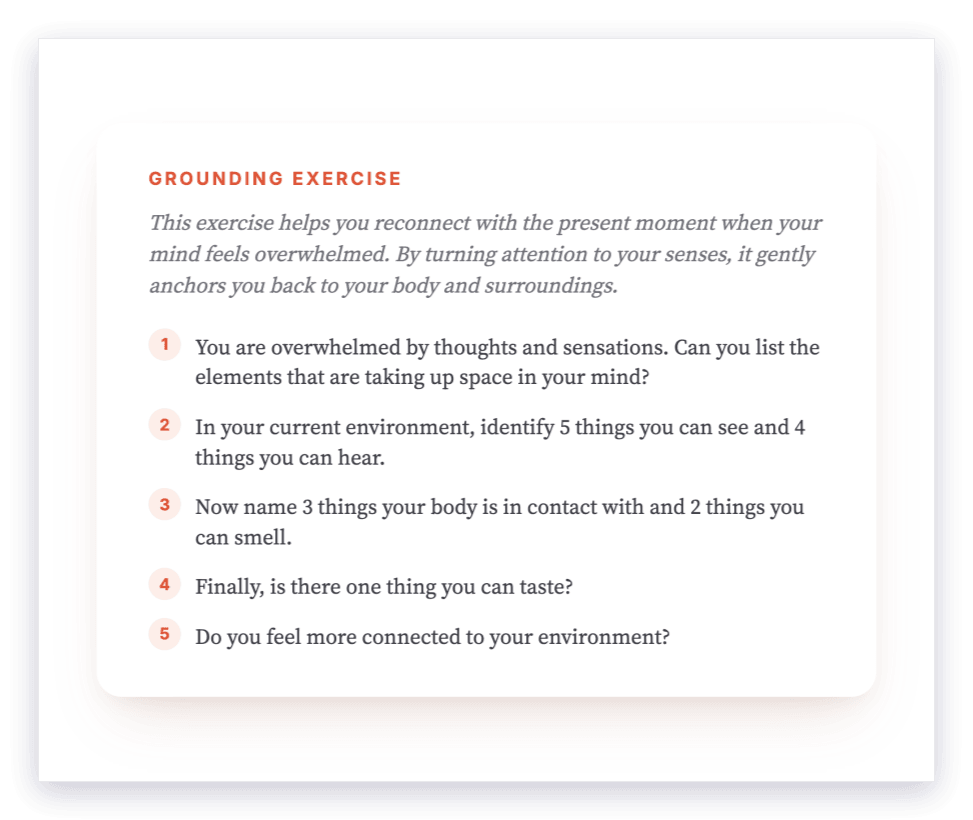
The patient begins by naming what is overwhelming them: the thoughts, images, and sensations currently occupying mental space. This is not rumination. It is a deliberate inventory that externalises internal noise before the sensory reorientation begins.
The patient then moves through the senses in descending order: five things they can see, four they can hear, three points of physical contact between their body and its surroundings, two smells, and finally one thing they can taste. The final question asks them to check in: do they feel more connected to their environment?
The progression is clinically precise. Each step narrows attentional focus to one sensory channel, anchoring awareness progressively in the present moment. This is the same logic used in somatic grounding audios and body scan practices, but here the patient drives the process entirely through their own written responses.
The image above lists the exercise questions in order with a short introductory framing. It is a static preview only: the full guided exercise, with patient-facing instructions and space to write responses, is experienced by the patient directly in the app, not in this image.
This exercise is available to patients through the patient mobile application of SessionFuel, the dedicated patient-side interface for clinicians who use SessionFuel. You assign the exercise from your clinician account, and your patient completes it directly on their phone, on their own, between sessions.
750+ clinical tools
A library built with and for clinicians, ready to use in session and extend between appointments.
Access all the toolsIntegrating It as Between-Session Work
This exercise is best assigned as autonomous homework between two consultations, precisely because the patient needs to be alone, in their own environment, to use it. The clinical payoff comes from what the patient brings back.
Who is it for? It suits a broad range of presentations: patients with anxiety or generalised worry, those prone to overthinking loops, patients with dissociative tendencies or trauma histories, and anyone currently working on present-moment contact as a core skill. It is accessible enough for adolescents and adults with no prior mindfulness experience.
How to introduce it: Name the phenomenon first. Ask the patient to describe what it feels like to be "stuck in their head." Then frame the exercise as a concrete, repeatable tool they can activate the next time that happens. Pair it with psychoeducation on the fight-flight-freeze response or how breathing affects feelings if the patient needs a physiological rationale.
What to do with what they bring back: At the next session, ask whether they used it, at what moment, and what they noticed at step five. The final question in the exercise ("do you feel more connected to your environment?") is designed to generate exactly that material. Even a partial shift, or a patient who found it difficult, gives you clinical data about attentional rigidity, interoceptive access, and readiness for deeper ACT defusion work or RAIN practice.
Key takeaway: The 5-4-3-2-1 exercise converts an abstract clinical concept into a repeatable sensory practice patients can reach for independently, and its built-in final question makes every use a structured piece of between-session data.
Use it with your patients
Share this tool in the mobile app and follow the work between sessions.
Articulation with Other Tools
This exercise works naturally alongside distress tolerance skills for patients in acute overwhelm, and as a complement to coping in crisis protocols where immediate regulation is the priority. For patients building a broader mindfulness foundation, it pairs well with the short present-moment anchoring audio or the Worry and Attention Capture exercise, which targets the cognitive dimension of the same stuck-in-the-head experience.
Your session continues in your patients' pocket
Use with a patientYour resources, available everywhere
The handouts, exercises, programs and audios above: you choose which ones to make available to your patients, in the mobile app dedicated to them.
And far more than a library
The app goes well beyond resources, to support your patients every day:
Related categories
Explore other clinical resources by category.
Anxiety
Clinical hub for anxiety disorders: CBT and ACT worksheets, psychoeducation sheets, and exercises for assessment and treatment across the anxiety spectrum.

Mood
Evidence-based worksheets and clinical tools for mood disorders: CBT, ACT, and positive psychology resources for psychologists and therapists.

Emotions
Clinical resources on emotion regulation: worksheets, coping tools, CBT, REBT, and ACT exercises for therapists working across diagnoses and age groups.

Behaviours
Clinical hub for behaviors in therapy: worksheets and tools for coping, eating disorders, CBT formulation, and maladaptive behavioral patterns.

Cognition
Printable cognitive therapy worksheets and clinical tools for therapists: CBT, ACT, schema work, defusion, distortions, and belief restructuring.

Regulate
Clinical resources for emotion regulation: worksheets, ACT exercises, and psychoeducation tools for affect regulation across diagnoses. For clinicians.