
Clinical picture. A, a 38-year-old manager, presented with performance anxiety that had begun disrupting her sleep and concentration in the days before high-stakes presentations. She described a familiar spiral: anticipatory muscle tension and shallow breathing that she interpreted as evidence she would lose her train of thought, which in turn heightened somatic arousal. The clinician introduced the 4-4-6 diaphragmatic breathing technique using the informational sheet, emphasising the longer exhalation as the physiological anchor rather than the depth of the inhale. A practised the sequence twice during the session, noting mild dizziness on the first attempt when she inhaled too forcefully; the clinician guided her to slow the rate rather than increase volume. By the following appointment she reported using the technique discreetly before two team meetings, with a modest but noticeable reduction in pre-presentation heart rate and a clearer sense of having a concrete entry point into managing the cycle.
Coping Skills for Anxiety: PDF Worksheet, Tools and Exercises
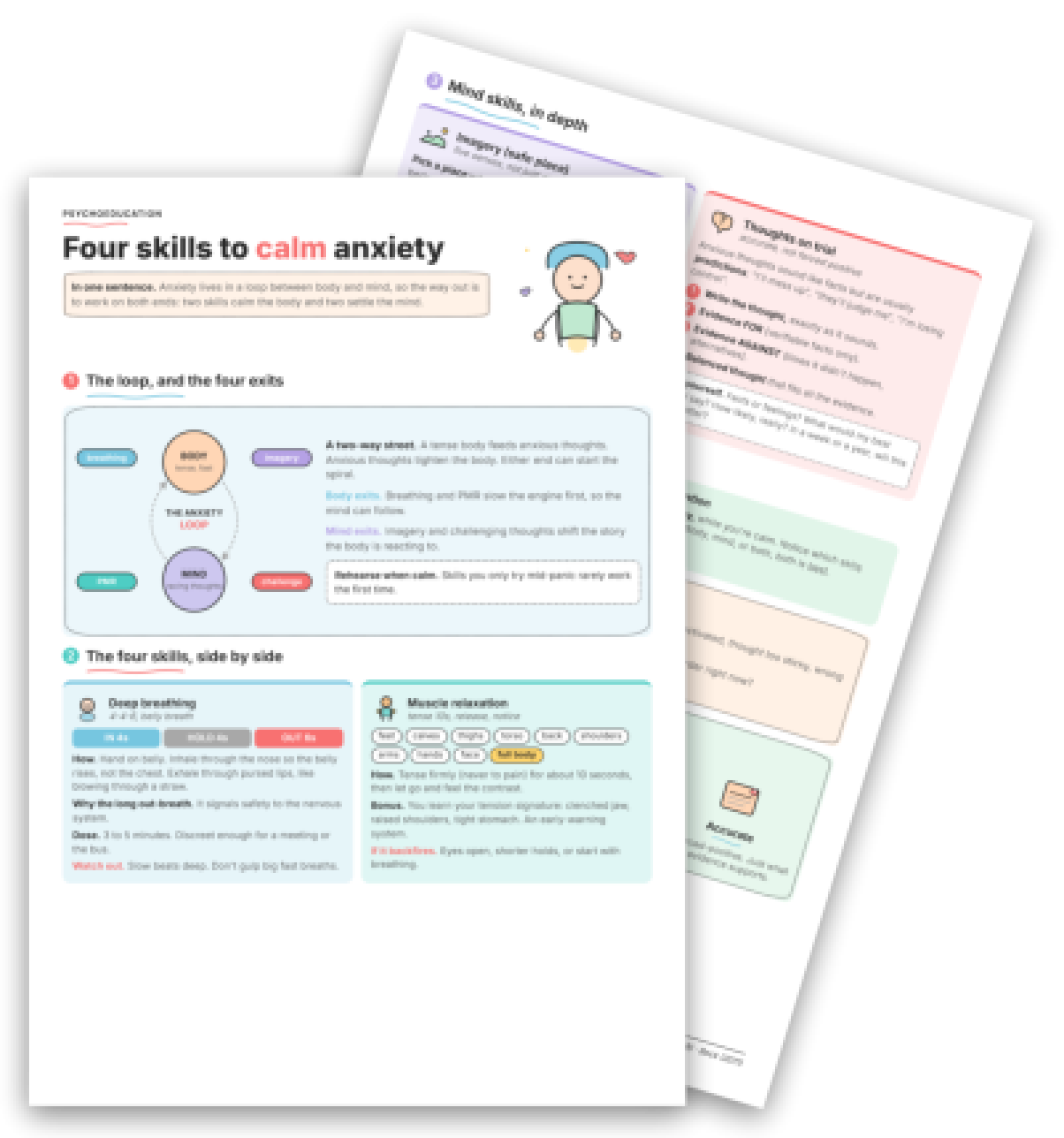
A visual psychoeducation tool clinicians can use in session to introduce, explain, and hand over four evidence-based anxiety coping skills.
Clinical vignettes
Breathing Before the Board Meeting
PMR and the Tension Signature
Clinical picture. T, a 52-year-old secondary school teacher, sought support for generalised anxiety characterised by near-constant muscular bracing, particularly across the shoulders and jaw, which he had not previously linked to his worry patterns. The clinician used the informational sheet to introduce progressive muscle relaxation, framing the tense-and-release sequence not only as a calming technique but as a tool for recognising his personal tension signature. T completed a guided run-through in session and identified that he had been holding his jaw clenched for most of the day without awareness. Over three weeks of home practice he began using jaw and shoulder tension as early-warning signals, allowing him to intervene earlier in the anxiety loop before cognitive rumination intensified. He did not report full symptom resolution, though he described feeling less caught off guard by the escalation pattern.
Explaining anxiety coping skills verbally is often less effective than it looks in session. Patients may understand each technique in isolation, agree to try them, and then freeze mid-spike because no clear decision tree exists in their mind. This coping skills for anxiety fiche PDF gives you a structured visual support to explain four core techniques, their underlying rationale, and how to sequence them, all during the session itself, so the patient leaves with a concrete reference rather than a fading memory.
Use this resource with your patients
Handout, exercises and materials ready to use, right inside SessionFuel.
Why Coping Skills Resist Verbal Explanation
The core difficulty is bidirectionality. Most patients understand, abstractly, that anxiety has a somatic component. What they miss is the feedback loop: a tense body amplifying cognitive threat appraisal, and catastrophic thoughts tightening the body further. Without a clear model of this cycle, patients cannot identify which end to intervene on, and they default to whatever they stumbled on first, usually ineffective cognitive suppression or avoidance.
A second obstacle is skill generalization under high arousal. A technique rehearsed once in session rarely survives contact with a genuine spike. Patients need to understand, before that moment arrives, why breathing exercises work faster at peak activation than imagery, and why thought challenging requires the body to be partially settled first. Oral instruction alone rarely conveys that sequencing logic durably. The fiche addresses precisely this.
What the Fiche Contains: A Visual Map of Four Skills
The fiche PDF opens with a central loop diagram labeled THE ANXIETY LOOP, showing BODY and MIND as two nodes feeding each other, with the four exits mapped explicitly: breathing and PMR on the somatic side, imagery and challenge on the cognitive side. This single diagram does something a verbal explanation rarely achieves: it shows the patient that neither body nor mind is the "right" target, both are valid entry points, depending on context.
The second panel presents the four skills side by side, with enough clinical detail to support genuine practice. Deep breathing is specified as a 4-4-6 pattern (inhale 4 seconds, hold 4, exhale 6), with the physiological rationale stated plainly: "It signals safety to the nervous system." PMR is laid out as a progressive sequence from feet to face, with a clinical note on idiosyncratic tension signatures (clenched jaw, raised shoulders) as an early-warning system. This maps directly onto the interoceptive work you may already be developing with the autonomic nervous system fiche.
The imagery panel structures the safe-place exercise across five sensory modalities, sight, sound, touch, smell, taste, with explicit cues for each. The fourth skill, Thoughts on Trial, walks through a four-step cognitive restructuring sequence and includes orienting questions: "Facts or feelings? What would my best friend say? In a week or a year, will this still matter?" These map directly onto the REBT-informed restructuring approach and complement the challenging anxious thoughts worksheet.
A dedicated panel on putting it together distinguishes spike management (start with breathing, then one additional skill) from daily prevention (five minutes while calm). The fiche closes with three session discussion prompts designed for the follow-up appointment: what interfered when a skill didn't land, whether body or mind work feels harder, and which thought the patient wants to bring to trial together.
> Key takeaway: the fiche is a visual support that facilitates psychoeducation in session, not a self-administered questionnaire. The loop diagram, the side-by-side skill layout, and the sequencing panel show what a verbal explanation cannot: how the four skills fit together as a system.
750+ clinical tools
A library built with and for clinicians, ready to use in session and extend between appointments.
Access all the toolsWhen and How to Propose the Fiche
This fiche is a natural fit from session two onward, once you have an initial formulation and the patient has named at least one somatic or cognitive anxiety pattern. It works across GAD presentations, panic-prone profiles, and social anxiety, wherever the treatment plan includes skill-building alongside cognitive work.
A low-stakes introduction: "I'd like to show you a map of what's happening when anxiety spikes, and four ways to interrupt it. We'll go through it together, and you'll take it home as a reference." This frames the fiche as a collaborative explanation, not an assignment. Walk through the loop diagram first, name which end of the cycle the patient tends to engage first, then present the two body skills and the two mind skills in that order.
For patients who have already tried PMR audio practice or progressive muscle relaxation, the fiche reinforces the rationale they've already experienced somatically. For patients earlier in the process, it complements a broader anxiety psychoeducation program and pairs well with graded exposure work once avoidance is in focus.
At the follow-up, use the fiche's own discussion prompts to debrief: what was the patient's body-to-mind ratio, and what got in the way? A patient who struggled with imagery but tolerated breathing is giving you useful formulation data. The fiche's structure makes that debrief concrete rather than anecdotal, and it signals that you expected practice to be imperfect the first time.
The fiche does not replace case formulation or the therapeutic relationship. It makes the explanation clearer, the rationale visible, and leaves the patient with something they can return to between sessions.
Use it with your patients
Share this tool in the mobile app and follow the work between sessions.
Sources
- Bernstein, D. A., & Borkovec, T. D. (1973). Progressive Relaxation Training: A Manual for the Helping Professions. Research Press.
Your session continues in your patients' pocket
Use with a patientYour resources, available everywhere
The handouts, exercises, programs and audios above: you choose which ones to make available to your patients, in the mobile app dedicated to them.
And far more than a library
The app goes well beyond resources, to support your patients every day:
Related categories
Explore other clinical resources by category.

Anxiety
Clinical hub for anxiety disorders: CBT and ACT worksheets, psychoeducation sheets, and exercises for assessment and treatment across the anxiety spectrum.

Emotions
Clinical resources on emotion regulation: worksheets, coping tools, CBT, REBT, and ACT exercises for therapists working across diagnoses and age groups.

Cognition
Printable cognitive therapy worksheets and clinical tools for therapists: CBT, ACT, schema work, defusion, distortions, and belief restructuring.

Regulate
Clinical resources for emotion regulation: worksheets, ACT exercises, and psychoeducation tools for affect regulation across diagnoses. For clinicians.

Restructure
Clinical hub for cognitive restructuring worksheets: distortion identification, belief disputation, ABC model, and schema work for evidence-based practice.

Build skills
Skill-building resources for clinicians: printable worksheets and exercises for coping, assertiveness, and communication skills training in therapy.