
Clinical picture. T., a man in his early forties, presented with persistent work-related stress, reporting shallow breathing, difficulty concentrating during meetings, and broken sleep. He had no prior experience with relaxation methods and was skeptical that anything "that simple" could help. The clinician introduced the informational sheet and walked through the 4-4-8 breathing pattern in session, drawing T.'s attention to the elongated exhale and belly expansion. T. practiced twice that week before board calls; he reported his shoulders felt noticeably less braced by the end of each trial, though he noted the effect was modest and inconsistent at first. By the third week he had added a brief guided imagery sequence at bedtime, choosing a coastal scene, and described falling asleep somewhat faster on most nights.
Three Relaxation Techniques: PDF Worksheet, Tools and Exercises
A printable PDF clinicians can use in session to explain diaphragmatic breathing, guided imagery, and progressive muscle relaxation, and give patients a clear somatic regulation reference to take home.
Clinical vignettes
Breath and Imagery for Work-Related Tension
PMR for Unnoticed Somatic Tension
Clinical picture. M., a woman in her late thirties with generalized anxiety, described a near-constant sense of physical bracing that she could not locate precisely until she developed jaw pain and tension headaches. The clinician used the worksheet to explain how muscle tension accumulates below awareness and introduced progressive muscle relaxation, starting with the feet-to-hands sequence outlined in the sheet. In session, M. was visibly surprised by the contrast between the tense and release phases in her shoulder group, commenting that she had not realized how much effort she was holding there. She practiced the sequence on three evenings over the following week and reported slightly fewer morning headaches, though she acknowledged the technique felt effortful and required a quiet space she did not always have. The clinician framed this as a skill under construction rather than an immediate fix, and they agreed to review consistency at the next appointment.
Explaining somatic regulation techniques verbally rarely produces autonomous practice. The patient nods, leaves the session, attempts the breathing exercise once under peak activation, and reports that "it didn't work." This fiche PDF provides a structured visual support to use during the explanation itself, three techniques presented side by side, with the physiological rationale already integrated, so the patient leaves with both understanding and a concrete reference card.
Use this resource with your patients
Handout, exercises and materials ready to use, right inside SessionFuel.
Why relaxation techniques are hard to explain in session
When a patient presents with chronic sympathetic overdrive, the kind documented in research on the autonomic nervous system, with persistent shallow breathing, muscular bracing, and attentional narrowing, verbal description of calming techniques frequently falls flat. Not because the patient lacks motivation, but because the instruction arrives detached from any explanatory frame. Patients often conflate "relaxation" with passive rest, miss the active physiological mechanism, and therefore approach practice with the wrong set of expectations.
A second difficulty is technique selection. Clinicians routinely recommend "breathing exercises" as a category, without differentiating that a visualisation approach suits patients who find breath-focus aversive, or that PMR addresses the muscular tension component specifically. Without a comparative structure, the patient samples one technique once, finds it a poor fit, and abandons somatic regulation entirely. The fight-or-flight response is already well-established as a habit; the antidote requires the same repetition, and patients need to understand why before they commit.
What the fiche contains: a side-by-side visual for the explanation
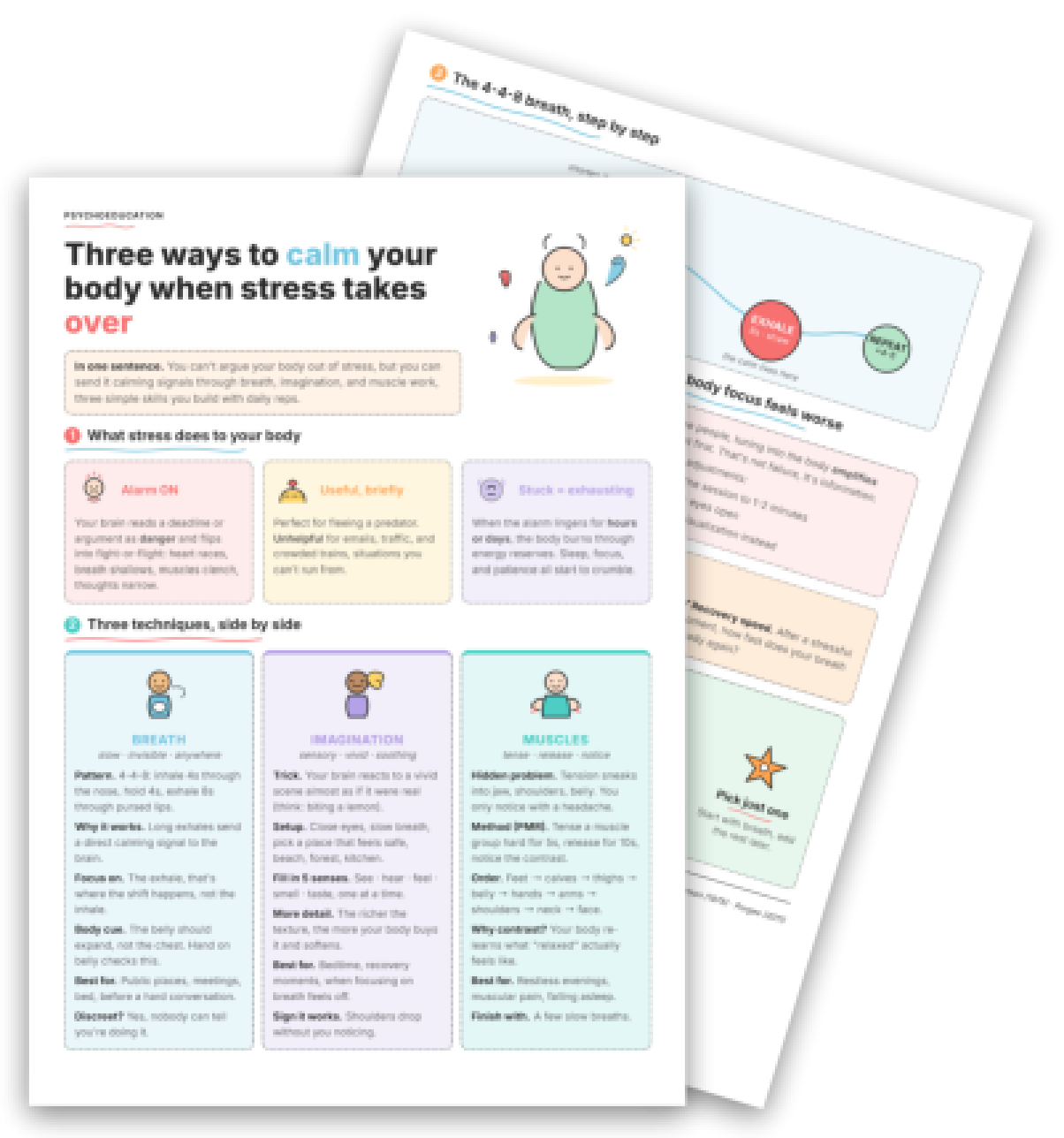
The fiche PDF is organised into five clearly delineated panels, and its central pedagogical device is a three-column table comparing the techniques on the same set of dimensions: mechanism, focus cue, a body check, the best contexts for use, and discretion level.
The opening panel explains stress physiology in plain physiological terms: "Your brain reads a deadline or argument as danger and flips into fight-or-flight: heart races, breath shallows, muscles clench, thoughts narrow." This gives you a ready-made psychoeducation anchor consistent with how the body responds to stress, requiring no additional verbal elaboration.
The comparison panel then covers:
- Breath (4-4-8): the exhale-centred rationale ("long exhales send a direct calming signal to the brain"), the belly-expansion cue, and its advantage in public or social situations, directly relevant when working with patients on coping skills for anxiety or social avoidance
- Imagination (guided visualisation): anchored in the lemon-biting heuristic to explain why "your brain reacts to a vivid scene almost as if it were real", with the five-sense filling method and a sign-of-efficacy marker ("shoulders drop without you noticing"), a useful complement to structured safe-place visualisation audio
- Muscles (PMR): the body-order sequence (feet to face), the tense-hold-release timing (5s/10s), and the contrast rationale grounding it in Jacobson's original model
A fourth panel walks through the 4-4-8 breath step by step with a visual timing diagram, and a fifth panel addresses the important clinical edge case: patients for whom interoceptive focus initially amplifies anxiety. The fiche names adjustments explicitly (shorter sessions, eyes open, switching to visualisation), which lets you pre-empt the dropout before it happens.
> Key point: this fiche is a visual support that facilitates the in-session explanation of three somatic regulation techniques; it is not a self-administered questionnaire. The clinician uses it during the session to anchor the rationale, then hands it over as a between-session reference.
750+ clinical tools
A library built with and for clinicians, ready to use in session and extend between appointments.
Access all the toolsWhen and how to propose it in session
The fiche fits cleanly at a psychoeducation phase, typically from the second or third session onward, once the initial formulation has established that somatic dysregulation is a maintaining factor. It is particularly indicated in presentations involving generalised anxiety, panic, burnout-adjacent stress accumulation, and any patient whose nervous system regulation has become a treatment target. It also works well with adolescents, a natural complement to breathing exercises adapted for children.
A practical introduction: "I want to show you three different approaches to the same problem, calming your body when it's on alert. Each works differently. We'll look at them together and see which one fits your life best." This framing bypasses the stigma of "relaxation" as a passive or trivial activity and positions the choice as an evidence-based clinical decision.
Debrief in the following session by asking which column the patient actually used, what got in the way, and whether the contextual fit matched the fiche's suggestions. Patients who report that body focus amplified their distress can be redirected toward visualisation; those with strong somatic awareness often take to PMR quickly. For structured audio practice between sessions, the progressive muscle relaxation audio and the quick relaxation audio extend the fiche's exercises into an autonomous format. The stress management reference sheet and the grounding techniques menu offer complementary broadening once the patient has a first technique consolidated.
The fiche closes with a reminder aligned with Porges' polyvagal framework: the reflex must be built before the alarm fires. "Short and consistent beats long and occasional." That is the message worth repeating in session, the fiche simply makes it visible.
Use it with your patients
Share this tool in the mobile app and follow the work between sessions.
Sources
- Jacobson, E. (1938). Progressive Relaxation: A Physiological and Clinical Investigation of Muscular States and Their Significance in Psychology and Medical Practice. University of Chicago Press.
- Bernstein, D. A., Borkovec, T. D. (1973). Progressive Relaxation Training: A Manual for the Helping Professions. Research Press.
- Manzoni, G. M., Pagnini, F., Castelnuovo, G., Molinari, E. (2008). Relaxation training for anxiety: a ten-years systematic review with meta-analysis. BMC Psychiatry.
- Magnon, V., Dutheil, F., Vallet, G. T. (2021). Benefits from one session of deep and slow breathing on vagal tone and anxiety in young and older adults. Scientific Reports.
Your session continues in your patients' pocket
Use with a patientYour resources, available everywhere
The handouts, exercises, programs and audios above: you choose which ones to make available to your patients, in the mobile app dedicated to them.
And far more than a library
The app goes well beyond resources, to support your patients every day:
Related categories
Explore other clinical resources by category.
Anxiety
Clinical hub for anxiety disorders: CBT and ACT worksheets, psychoeducation sheets, and exercises for assessment and treatment across the anxiety spectrum.

Emotions
Clinical resources on emotion regulation: worksheets, coping tools, CBT, REBT, and ACT exercises for therapists working across diagnoses and age groups.

Health
Somatic health clinical resources for practitioners: worksheets, psychoeducation, and exercises for somatic symptom disorder, chronic pain, and more.

Understand
Clinical hub for the therapeutic aim 'Understand': worksheets and tools to build patient insight across CBT, ACT, schema therapy and more.

Regulate
Clinical resources for emotion regulation: worksheets, ACT exercises, and psychoeducation tools for affect regulation across diagnoses. For clinicians.

Build skills
Skill-building resources for clinicians: printable worksheets and exercises for coping, assertiveness, and communication skills training in therapy.