
Clinical picture. M., a woman in her late thirties, presented with a history of complex trauma and frequent episodes of hyperarousal during sessions, marked by shallow breathing, jaw clenching, and difficulty retaining anything discussed verbally. The clinician introduced the informational sheet on somatic exercises and walked her through the feet-grounding sequence: pressing both feet into the floor, naming three visible objects, then attending to the sensation of weight through the soles. M. reported that the prompt "what do I notice right now?" felt more manageable than relaxation instructions she had previously found pressure-laden. Over several sessions, she began using the sequence independently at the start of appointments, arriving slightly less dysregulated and able to engage with verbal material for longer stretches.
Somatic Exercises: PDF Worksheet, Tools and Exercises for Clinical Practice
A visual psychoeducation tool to introduce body-based regulation techniques in session, with six grounded exercises patients can use independently.
Clinical vignettes
Grounding After Trauma-Related Hyperarousal
Psychoeducation for Shutdown and Numbness
Clinical picture. T., a man in his mid-forties with persistent depressive disorder, described chronic low-grade numbness and an inability to feel much during his day, which he found distressing and hard to explain. The clinician used the window-of-tolerance diagram from the informational sheet to name what T. was experiencing as hypoarousal rather than laziness or indifference. Slow belly breathing with a hand on the abdomen was introduced, with emphasis on the extended exhale, and T. was encouraged simply to notice any shift in sensation without judging its size. He returned the following week noting that the exercise had not resolved the numbness but had given him a brief, repeatable moment of bodily contact that felt different from his baseline. The clinician framed this as a modest and accurate outcome, consistent with widening the window gradually rather than eliminating symptoms at once.
Explaining somatic exercises to patients without a visual support tends to produce polite nodding rather than genuine uptake. The concept sits at the intersection of body awareness, nervous system regulation, and present-moment attention, and patients regularly conflate it with yoga, relaxation, or mindfulness, arriving at the next session unsure what they were actually supposed to do. This PDF worksheet gives you a structured visual to anchor the explanation in session and send home a concrete reference.
Use this resource with your patients
Handout, exercises and materials ready to use, right inside SessionFuel.
Why "somatic" is so hard to explain verbally
The core difficulty is conceptual, not motivational. Patients trained by fitness culture to monitor external form (posture, range, effort) resist being asked to attend to internal sensation instead. The distinction between "what should I look like?" and "what do I notice right now?" sounds trivial when spoken; it genuinely lands when shown side by side.
There is also the window of tolerance problem. Patients who are chronically above or below their window often cannot locate the concept in their own experience until they can see it mapped. Telling a dissociated or hyperactivated patient to "tune into your body" without first orienting them to the window risks confusion at best, and destabilisation at worst. The fiche's visual layout of above/within/below the window, with explicit signs for each state (racing heart and restless movement versus numbness, fog, and freeze), makes this immediately legible. Clinicians working with fight-flight-freeze physiology or teaching nervous system regulation will recognise the framework instantly; the fiche translates it into language patients can hold.
What the fiche contains: a visual walk through the concept
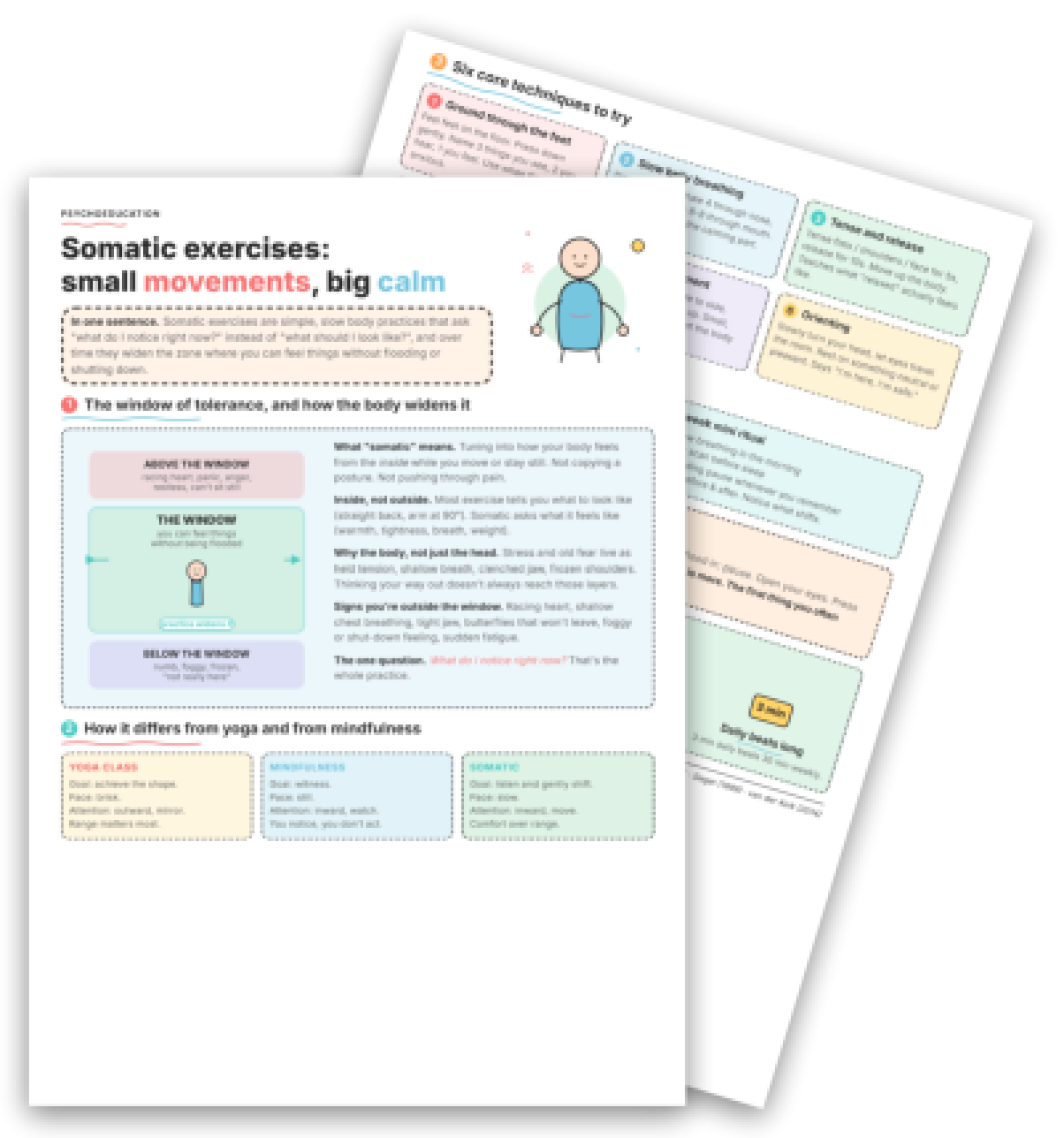
The sheet is organised into five substantive panels plus a closing "remember" block. The first panel presents the window of tolerance as a labelled diagram, with the three zones, their somatic markers, and the explicit note that "practice widens it." This single image replaces several minutes of verbal explanation and provides a shared vocabulary for the rest of the work.
Panel 2 draws a three-column comparison table contrasting yoga, mindfulness, and somatic practice across goal, pace, attentional direction, and priority. The visual contrast clarifies what somatic work uniquely involves ("listen and gently shift", "comfort over range") in a way that spoken contrasts rarely do, especially for patients who have already tried a mindfulness app and found it unhelpful.
Panel 3 describes six core techniques: grounding through the feet, slow belly breathing with a 4/6-8 ratio, progressive tense-and-release, body scan, intuitive movement, and orienting. Each is named, briefly described, and tagged with a clinical indication. This maps naturally onto work you may already be doing with grounding techniques, breathing and its effect on affect, or the sensory anchoring protocol in the 5-4-3-2-1 grounding exercise.
Panel 4 provides a pocket script for distressing moments ("Feet on the floor. Long exhale. What do I see around me?") and a one-week mini ritual structured around three daily touchpoints with a 0-10 self-monitoring prompt. Panel 5 addresses safety explicitly, listing signs to slow down or stop: overwhelming sensation, dissociation onset, flooding of trauma-related material.
> Key takeaway: the fiche is a visual support that facilitates the explanation of somatic exercises in session; it is not a self-completion questionnaire. You use it with the patient to build a shared conceptual map, then leave it with them as a concrete between-session anchor.
750+ clinical tools
A library built with and for clinicians, ready to use in session and extend between appointments.
Access all the toolsWhen and how to introduce it
This fiche fits naturally at the psychoeducation phase of any body-aware work, typically sessions two to four once the initial formulation is in place. It is particularly indicated for patients presenting with anxiety-related physical sensations, chronic hyperactivation, or the somatic residue of trauma, including those meeting criteria for PTSD. It also pairs well with introductory work on the autonomic nervous system and on how the body responds to stress.
A low-threshold introduction: "I'd like to show you a diagram that maps what happens in your body when stress builds up. It also describes some small, slow movements that can shift that. We'll look at it together." This framing separates the tool from performance pressure and focuses the patient on observation rather than achievement.
Debrief by asking which of the six techniques felt most accessible, and whether the patient noticed any resistance (often a sign of hypervigilance to internal states worth exploring). For patients already assigned body scan audio practice or progressive muscle relaxation, the fiche provides the conceptual container those audio exercises assume but rarely supply.
Contraindication: for patients with significant dissociative symptoms, skip panel 1's window-of-tolerance discussion until stabilisation is established. Introduce the orienting and grounding techniques first, and follow the fiche's own safety guidance closely.
The fiche does not replace clinical formulation or a trauma-informed framework. It makes the body-based rationale visible, gives patients a vocabulary for their own physiology, and leaves something concrete in their hands between sessions.
Use it with your patients
Share this tool in the mobile app and follow the work between sessions.
Sources
- Levine, P. A., Frederick, A. (1997). Waking the Tiger: Healing Trauma. North Atlantic Books.
- Siegel, D. J. (1999). The Developing Mind: Toward a Neurobiology of Interpersonal Experience. Guilford Press.
- Payne, P., Levine, P. A., Crane-Godreau, M. A. (2015). Somatic Experiencing: Using Interoception and Proprioception as Core Elements of Trauma Therapy. Frontiers in Psychology.
- Kain, K. L., Terrell, S. J. (2018). Nurturing Resilience: Helping Clients Move Forward from Developmental Trauma. North Atlantic Books.
Your session continues in your patients' pocket
Use with a patientYour resources, available everywhere
The handouts, exercises, programs and audios above: you choose which ones to make available to your patients, in the mobile app dedicated to them.
And far more than a library
The app goes well beyond resources, to support your patients every day:
Related categories
Explore other clinical resources by category.

Trauma
Clinical hub on trauma and PTSD: assessment, differential diagnosis, treatment phases, and printable resources for practitioners. 155 chars.

Mood
Evidence-based worksheets and clinical tools for mood disorders: CBT, ACT, and positive psychology resources for psychologists and therapists.

Emotions
Clinical resources on emotion regulation: worksheets, coping tools, CBT, REBT, and ACT exercises for therapists working across diagnoses and age groups.

Health
Somatic health clinical resources for practitioners: worksheets, psychoeducation, and exercises for somatic symptom disorder, chronic pain, and more.

Understand
Clinical hub for the therapeutic aim 'Understand': worksheets and tools to build patient insight across CBT, ACT, schema therapy and more.

Regulate
Clinical resources for emotion regulation: worksheets, ACT exercises, and psychoeducation tools for affect regulation across diagnoses. For clinicians.