
Clinical picture. M., a woman in her mid-thirties, presents with a history of relational trauma and reports frequent conflict with her partner that she describes as coming out of nowhere. During a session in which the clinician introduces the window of tolerance diagram, M. recognises her pattern immediately: racing heart, pressured speech, and a near-total loss of access to alternatives before she has registered that she is upset. The clinician uses the diagram to locate her experience above the window rather than labelling it as overreaction, which M. finds less shaming. Over the following two sessions, she begins to name the physical onset cues earlier, which creates a small but workable pause before she acts on the urge to lash out.
HandoutTrauma & PTSDEmotions & stressAnxietyPersonalityUnderstandRegulateBuild awarenessCBTIntegrative
Window of Tolerance: PDF Worksheet, Tools and Exercises for Clinical Practice
A visual PDF worksheet clinicians can use in session to explain hyperarousal, hypoarousal, and dysregulation to patients, and to map concrete regulation strategies.
Clinical vignettes
Naming Hyperarousal in Session
Hypoarousal Mistaken for Calm
Clinical picture. T., a man in his late forties referred following a workplace incident, initially presents as flat and cooperative, describing himself as finally feeling nothing, which he interprets as progress. When the clinician introduces the lower half of the window of tolerance model, T. recognises the description of hypoarousal: numbness, zoning out, time gaps, a sense of watching himself from a distance. He had not considered that this state was also outside the window; he had assumed shutdown meant stability. The psychoeducation reframes the goal from reducing distress to rebuilding enough capacity to stay inside the window, which shifts the early treatment contract in a clinically useful direction.
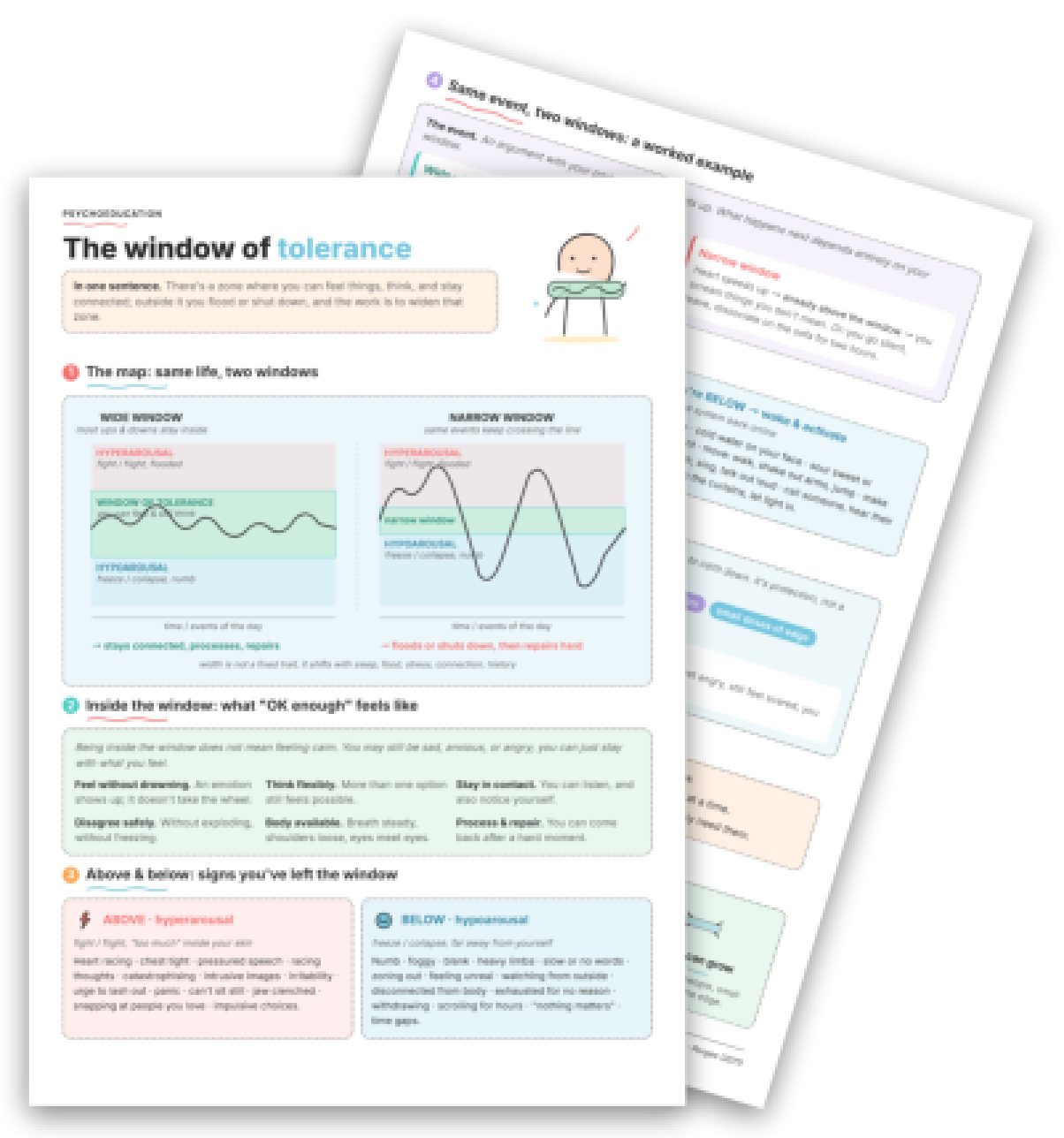
When you explain the window of tolerance verbally, most patients nod along without the concept truly landing. The mental map stays abstract until they can see it. This window of tolerance PDF worksheet is a visual support designed for in-session psychoeducation: you point to it, the patient follows, and the idea clicks faster than any oral explanation alone.
Use this resource with your patients
Handout, exercises and materials ready to use, right inside SessionFuel.
Why the Window of Tolerance Resists Verbal Explanation
The core difficulty is that hyperarousal and hypoarousal look like character, not dysregulation. The patient who snaps, catastrophises, and can't sit still doesn't think "I've left my window." They think they're anxious, reactive, or out of control. The patient who zones out, feels nothing, and withdraws thinks they're lazy or broken. Without a shared map, these states remain unnamed and, clinically, much harder to work with.
There is also a subtler confusion you'll encounter regularly: patients assume the window means calm. The fiche addresses this directly. "Being inside the window does not mean feeling calm. You may still be sad, anxious, or angry, you can just stay with what you feel." That single distinction, made visible, saves several minutes of misunderstanding in early sessions. It also positions emotional tolerance as the goal, not emotional suppression, which matters enormously in ACT-informed or somatic work.
For patients with a trauma history, the autonomic nervous system worksheet and the fight-flight-freeze response fiche cover the underlying physiology. The window of tolerance fiche builds directly on that neurobiological ground.
Clinical library
750+ clinical tools
A library built with and for clinicians, ready to use in session and extend between appointments.
Access all the toolsSeveral resource types
Psychoeducation handouts
Understand at a glance
Interactive exercises
To do and fill in
Interactive programs
A structured path
Audios
Meditation and relaxation
Psychometric tests
Automatic scoring
What the Fiche Contains: A Visual Map for Session Use
The eight-panel layout moves from orientation to application without the patient ever needing to read independently. You work through it together.
Panel 1 presents the central diagram: a wide window vs. a narrow window, both on the same timeline. Hyperarousal (fight/flight) sits above, hypoarousal (freeze/collapse) below, and the window of tolerance runs between them. The visual immediately shows that "width is not a fixed trait, it shifts with sleep, food, stress, connection, history", which reframes the narrow window as a response, not a defect.
Panel 2 describes what functioning inside the window actually feels like in practice: the capacity to feel without drowning, to think flexibly, to stay in contact, to disagree without exploding or freezing.
Panel 3 lists the clinical signs of each zone, racing heart, jaw clenching, impulsive choices for hyperarousal; numbness, fogginess, dissociation, and "nothing matters" for hypoarousal. Patients often recognise themselves immediately, sometimes for the first time.
Panel 4 gives a worked example (an argument) played out through a wide window and a narrow one. This concretises the abstract model in a way oral description rarely achieves.
Panel 5 is operationally central: two distinct columns, "If you're ABOVE → slow & ground" and "If you're BELOW → wake & activate." The grounding techniques here pair naturally with what you'll find in the grounding techniques worksheet, the 5-4-3-2-1 sensory exercise, and the DBT TIPP skills fiche.
Panels 6-8 address window widening over time, common confusions, and a short clinical discussion guide for tracking which events consistently push the patient out of their window.
> Key takeaway: The fiche is a visual support that facilitates in-session explanation of a concept that rarely transfers through speech alone. It gives the patient a spatial, intuitive map they can keep and return to between sessions, not a questionnaire to complete alone.
Use it with your patients
Share this tool in the mobile app and follow the work between sessions.
When and How to Introduce It in Session
The fiche fits best in the early-to-mid phase of stabilisation work, once you have enough of an alliance to introduce a psychoeducational model without it feeling diagnostic or pathologising. For patients presenting with PTSD symptoms, complex trauma, chronic hypervigilance, or dissociative features, it is often the most clinically useful psychoeducation resource to introduce before any trauma processing begins. It also serves well with patients whose common reactions to trauma you're currently mapping.
You might introduce it with something like: "I'd like to show you a map that might explain some of what you've been describing. It doesn't mean anything is wrong with you, it just shows what happens in any nervous system under pressure."
Once you've worked through the diagram together, ask the patient to identify their most common zone and the events that reliably push them there. Panel 7's discussion prompts ("When you notice the same kind of event keeps pushing you above or below the window") structure that conversation cleanly. The fiche then becomes a reference point for later sessions when tracking regulation progress, and pairs well with somatic exercises and nervous system regulation tools you assign between sessions.
For patients who are predominantly hypoaroused and struggle to recognise their state, the threat responses worksheet adds useful granularity. For those working on building their window width over time, the comfort, stretch and panic zones fiche makes a natural follow-on.
The fiche does not replace clinical formulation, and with patients in acute crisis or with severe dissociation, working through all eight panels in one sitting may be premature. Use it selectively and move at the pace the clinical relationship allows.
Patient mobile app
Your session continues in your patients' pocket
Use with a patientYour resources, available everywhere
The handouts, exercises, programs and audios above: you choose which ones to make available to your patients, in the mobile app dedicated to them.
Psychoeducation handoutsInteractive exercisesInteractive programsAudiosPsychometric tests
And far more than a library
The app goes well beyond resources, to support your patients every day:
Standardized tests
Therapy journal
Gamification
Wellbeing challenges
Introspection prompts
Therapist homework
Related categories
Explore other clinical resources by category.

Anxiety
Clinical hub for anxiety disorders: CBT and ACT worksheets, psychoeducation sheets, and exercises for assessment and treatment across the anxiety spectrum.

Trauma
Clinical hub on trauma and PTSD: assessment, differential diagnosis, treatment phases, and printable resources for practitioners. 155 chars.

Emotions
Clinical resources on emotion regulation: worksheets, coping tools, CBT, REBT, and ACT exercises for therapists working across diagnoses and age groups.

Understand
Clinical hub for the therapeutic aim 'Understand': worksheets and tools to build patient insight across CBT, ACT, schema therapy and more.

Build awareness
Clinical worksheets and tools to build awareness in therapy: cognitive distortions, schemas, emotions, ACT and CBT resources for practitioners.

Regulate
Clinical resources for emotion regulation: worksheets, ACT exercises, and psychoeducation tools for affect regulation across diagnoses. For clinicians.