
Clinical picture. M., a woman in her early forties, was referred after a third failed attempt at couple therapy; her partner described her as emotionally unavailable and prone to abrupt withdrawal. In initial sessions she presented as composed, articulate, and quick to attribute relational difficulties entirely to herself, with no apparent anger toward the partner. The clinician noted that her self-critical stance was not reactive or fluctuating but fixed and almost categorical: she described herself as 'structurally unkind,' a belief she dated back to childhood years spent caring for an unpredictable, violent parent. Screening with the ITQ clarified that alongside hypervigilance and some intrusive imagery, she met criteria for all three disturbances of self-organization: blunted affect alternating with shame flooding, a stable negative self-concept, and a chronic avoidance of closeness she experienced as protective rather than painful. Sharing the CPTSD psychoeducation sheet gave her a framework that separated her symptoms from her character, which she described as 'the first explanation that did not feel like another accusation.'
Complex PTSD: PDF Worksheet, Tools and Exercises for Clinical Practice
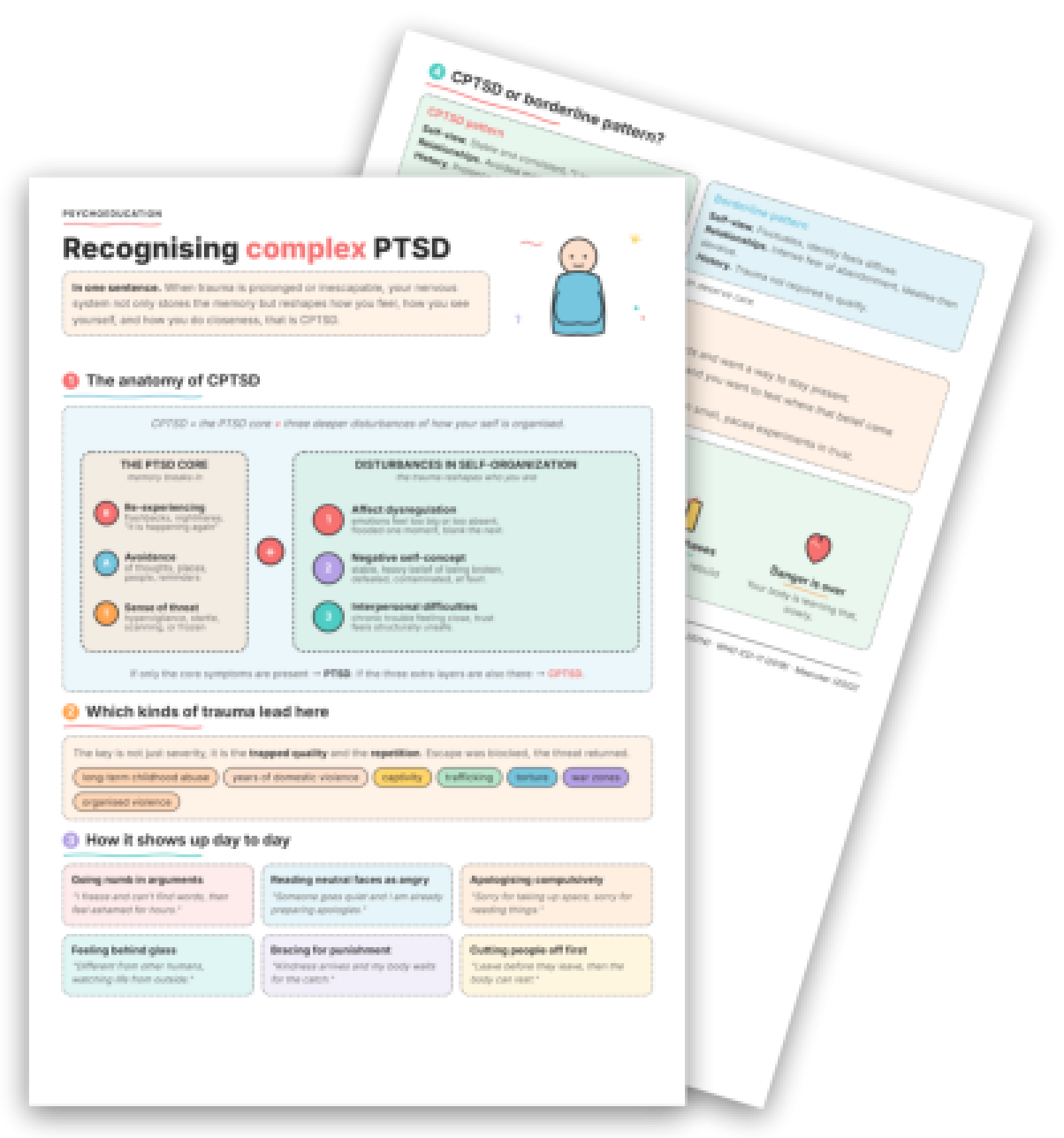
A printable fiche mapping the ICD-11 CPTSD architecture, core cluster, three self-organization disturbances, and BPD differential, to support psychoeducation and formulation in session.
Clinical vignettes
Stable Self-Blame Beneath Surface Calm
Hypervigilance Misread as Personality Disorder
Clinical picture. T., a man in his mid-thirties, had carried a working diagnosis of borderline personality disorder for several years following two psychiatric admissions during periods of intense emotional dysregulation. A new treating clinician reviewed the history and observed that his self-image, though deeply negative, was consistent across time rather than rapidly shifting, and that his relational difficulties centred on withdrawal and pre-emptive termination of contact rather than on the idealisation-devaluation cycle. T. disclosed, when asked directly, a prolonged history of institutional violence during adolescence from which escape had not been possible. The clinician introduced the CPTSD informational sheet and walked through the distinction between the PTSD core and the three self-organization layers, noting how each mapped onto T.'s presentation. He engaged with particular recognition at the section on 'bracing for punishment' when kindness arrives, saying it described something he had never found words for.
Patients with complex trauma histories arrive with labels that almost fit, PTSD, recurrent depression, borderline features, without a framework that maps the full picture. This fiche PDF on Complex PTSD gives you a compact visual scaffold to introduce the ICD-11 CPTSD construct directly in session, name the three disturbances of self-organization, and open the diagnostic conversation without it feeling like a labeling exercise.
Use this resource with your patients
Handout, exercises and materials ready to use, right inside SessionFuel.
Why CPTSD Resists Oral Explanation
The ICD-11 distinction between PTSD and CPTSD, grounded in Herman's original formulation (1992) and refined by Maercker et al. (2022), captures something clinically precise: prolonged, inescapable trauma does not only generate the core RAT cluster (re-experiencing, avoidance, threat sense) but reorganizes the self at a deeper level. The problem is that this architecture is hard to convey verbally. Patients either flatten everything into "I have PTSD," or they absorb affect dysregulation, negative self-concept, and interpersonal difficulties as an abstract list and fail to recognize themselves in it. Structural distrust does not feel like trauma to someone who associates trauma exclusively with flashbacks. A chronic belief of being broken reads as character, not sequela.
The CPTSD / BPD differential adds another layer of difficulty. Without a visual frame, that conversation easily drifts into labeling, which can rupture the alliance thérapeutique at exactly the moment the patient needs containment. The PTSD PDF Worksheet addresses the core symptom cluster; this fiche extends the picture to the self-organization layer that standard PTSD resources leave out.
750+ clinical tools
A library built with and for clinicians, ready to use in session and extend between appointments.
Access all the toolsWhat the Fiche Contains: A Visual Map of the CPTSD Architecture
The sheet opens with a single orienting sentence: "When trauma is prolonged or inescapable, your nervous system not only stores the memory but reshapes how you feel, how you see yourself, and how you do closeness."
Panel 1 renders the ICD-11 additive logic visually: the PTSD core (Re-experiencing, Avoidance, Threat sense) as a distinct block, with three Disturbances in Self-Organization stacked beneath it, each defined in one concrete line. Seeing "Core + 3 layers" on the page makes the diagnostic reasoning immediately readable in a way that oral explanation rarely achieves.
Panel 2 names the trauma types that generate CPTSD, foregrounding what the fiche calls "the trapped quality and the repetition" rather than severity alone: long-term childhood abuse, domestic violence, captivity, trafficking, torture, war zones, organized violence. Listing these explicitly helps patients stop minimizing histories that felt "normal" precisely because escape was never possible. This articulates well with formulation tools such as the Common Reactions to Trauma sheet and the How Your Past Affects Your Present worksheet.
Panel 3 translates the criteria into six day-to-day presentations with first-person quotes beside each: going numb in arguments, reading neutral faces as threatening, apologizing compulsively, feeling behind glass, bracing for the catch when kindness arrives, and "Leave before they leave, then the body can rest." Patients can scan the sheet and point. This is the moment the concept lands, because it shifts from diagnostic language to lived experience.
Panel 4 compares the CPTSD pattern and the borderline pattern across three axes, self-view, relationship style, and trauma history, and closes with: "They can co-exist, both deserve care." That single line keeps the formulation conversation from becoming adversarial. It connects usefully to schema work on the Mistrust/Abuse schema, the Defectiveness/Shame schema, and the Abandonment schema.
A "To discuss in session" block offers three structured prompts, and a closing "Remember" panel names four anchor points: not a flaw, core plus three layers, healing in phases, danger is over.
> Key point: This fiche is a visual support for explaining Complex PTSD in session, not a self-administered checklist. The layout makes the construct's architecture visible at a glance, giving you and the patient a shared reference point that a verbal explanation rarely achieves alone.
Use it with your patients
Share this tool in the mobile app and follow the work between sessions.
When and How to Introduce the Fiche
The fiche fits naturally into early-to-mid formulation work, once the trauma history has been mapped and the alliance supports naming a diagnosis. It is particularly indicated when the patient carries a PTSD or BPD label that doesn't quite fit, when affect dysregulation and interpersonal withdrawal are prominent but unconnected (in the patient's mind) to their trauma history, or when the diagnostic conversation risks feeling clinical.
Introduce it with minimal framing: "There's a model that may describe your experience more precisely than PTSD alone. Let me show you the map." Walk through the panels together, pause on Panel 3 to ask which presentations resonate, and use the "To discuss in session" prompts as a natural debrief.
One practical limit: in patients with significant dissociation or acute fragmentation, the full diagnostic picture, including the CPTSD/BPD differential, may be premature. Build stabilization first using grounding techniques and autonomic nervous system psychoeducation. Once stabilized, the fiche integrates cleanly with EMDR preparation (the EMDR negative and positive cognitions sheet pairs well at the processing stage), and with trauma memory work focused on the intrusive re-experiencing cluster.
The fiche does not replace formulation or trauma processing; it gives the patient a legible reference to carry between sessions, one that names their experience without reducing it to a symptom list.
Your session continues in your patients' pocket
Use with a patientYour resources, available everywhere
The handouts, exercises, programs and audios above: you choose which ones to make available to your patients, in the mobile app dedicated to them.
And far more than a library
The app goes well beyond resources, to support your patients every day:
Related categories
Explore other clinical resources by category.

Trauma
Clinical hub on trauma and PTSD: assessment, differential diagnosis, treatment phases, and printable resources for practitioners. 155 chars.

Emotions
Clinical resources on emotion regulation: worksheets, coping tools, CBT, REBT, and ACT exercises for therapists working across diagnoses and age groups.

Understand
Clinical hub for the therapeutic aim 'Understand': worksheets and tools to build patient insight across CBT, ACT, schema therapy and more.

CBT
CBT worksheets, cognitive restructuring exercises & behavioral tools for clinicians. Evidence-based resources for every phase of cognitive behavioral therapy.

Anxiety
Clinical hub for anxiety disorders: CBT and ACT worksheets, psychoeducation sheets, and exercises for assessment and treatment across the anxiety spectrum.

Mood
Evidence-based worksheets and clinical tools for mood disorders: CBT, ACT, and positive psychology resources for psychologists and therapists.