
Clinical picture. P., a woman in her late thirties, presents with chronic shame and recurrent low mood linked to emotional neglect in childhood. During an EMDR preparation session, the clinician introduces the NC/PC framework and asks her to hold the worst image from a specific memory of being left alone after an injury. When invited to notice what that image says about her now, P. hesitates, then scans the domain list and reports a quiet bodily recognition at "I do not matter," describing a tightening in her chest. The clinician validates this as a well-formed NC (self-referential, present tense, generalised) and guides her toward a candidate PC in the same self-worth domain: "I matter." P. rates her Validity of Cognition at 2 out of 7, which the clinician notes as a realistic starting point rather than a deficit, and they proceed to target phase with the NC and PC clearly articulated.
EMDR Negative and Positive Cognitions: PDF Worksheet, Tools and Exercises
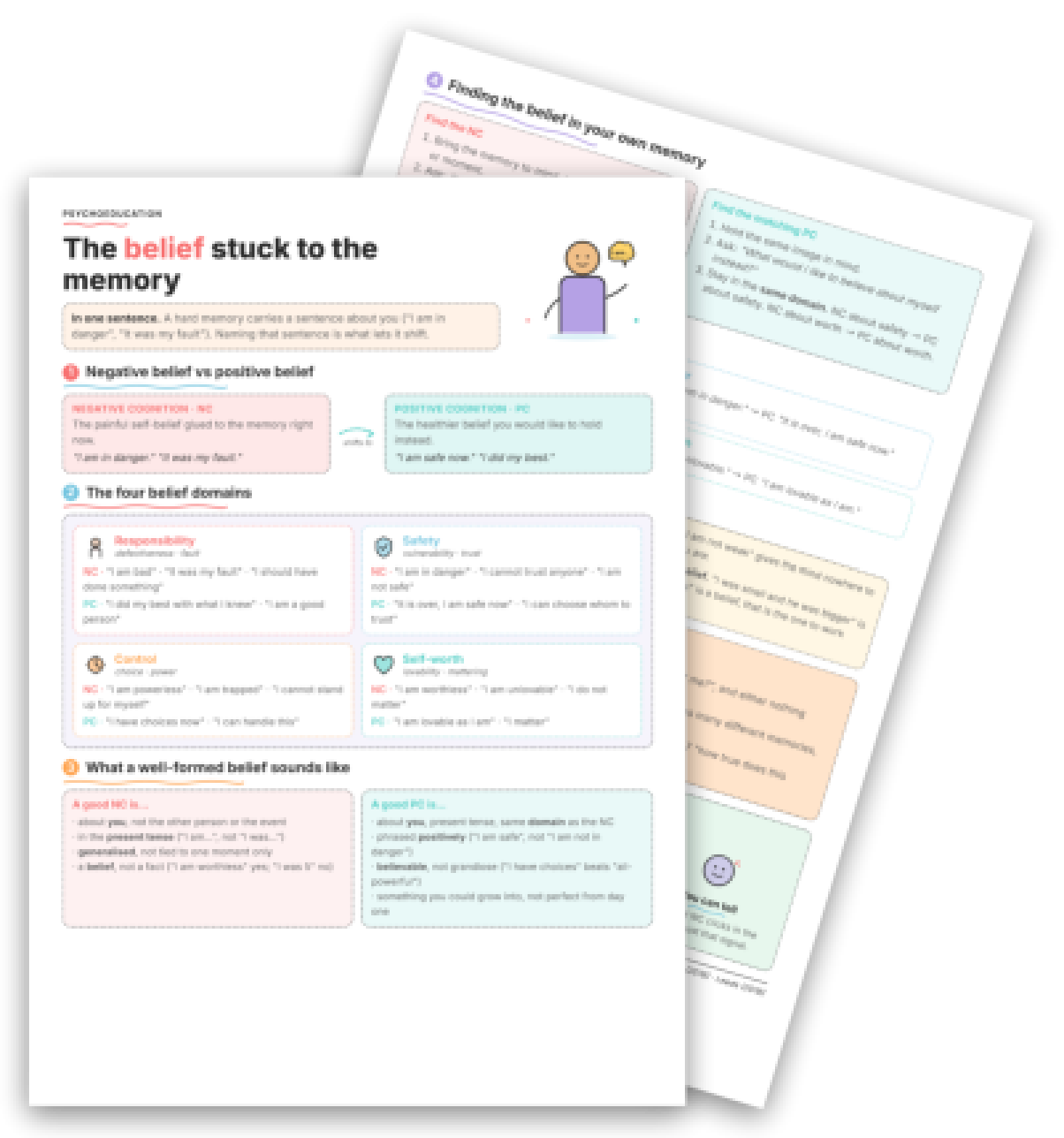
A visual PDF worksheet to help clinicians explain NC/PC identification clearly in EMDR sessions, establish shared vocabulary, and leave patients with a concrete reference they can actually use.
Clinical vignettes
Locating the NC in a Childhood Neglect Memory
Correcting a Misplaced NC Before Reprocessing
Clinical picture. T., a man in his mid-forties, is preparing to reprocess a road traffic incident in which he was a passenger. He initially offers "the driver was reckless" as his negative cognition. The clinician gently explains that a workable NC must be self-referential and reflects back the four domain categories; after a short pause, T. identifies "I am powerless" as the belief that actually resonates when he holds the memory. A matching PC in the control domain, "I have choices now," is then co-constructed and tested for plausibility. T. agrees it feels reachable rather than empty, and the clinician documents both cognitions before opening the bilateral stimulation.
Asking a patient to identify their negative cognition verbally, mid-session, often stalls the work before bilateral stimulation even begins. Patients offer facts, descriptions of the perpetrator, or emotions rather than a self-referential belief in the present tense, and correcting them repeatedly erodes the alliance. This PDF worksheet provides a structured visual support to make the NC/PC distinction clear and precise before you ever pick up the tappers.
Use this resource with your patients
Handout, exercises and materials ready to use, right inside SessionFuel.
Why NC and PC Identification Breaks Down Without a Visual Support
The conceptual gap is not ignorance; it is domain confusion. Patients spontaneously generate event-level statements ("he was cruel"), emotion labels ("I felt terrified"), or past-tense descriptions ("I was helpless back then") when asked what the memory says about them now. Explaining the difference verbally is slow and tends to generate defensiveness or blank compliance.
The same difficulty appears with positive cognitions: patients either overshoot into grandiosity ("I am invincible") or negate rather than affirm ("I am not weak"), neither of which carries the adaptive loading the PC needs to do. For clinicians new to the protocol, or working with patients whose core beliefs are heavily entrenched, having every criterion visible on the page shortens that corrective loop considerably.
There is also a subtler problem: patients conflate the NC with a core belief that spans all domains, rather than identifying the specific self-belief glued to this memory. The fiche's domain structure addresses exactly that.
What the Fiche Contains: A Structured Visual Map of Beliefs
The fiche PDF organises the NC/PC framework across six clearly numbered panels, working from definition to application to troubleshooting.
- Panel 1 states the principle in a single sentence: "A hard memory carries a sentence about you... Naming that sentence is what lets it shift." This anchors the entire session in Shapiro's core rationale without requiring the clinician to re-explain the model from scratch.
- Panel 2 presents the NC-to-PC shift side by side, with paired examples ("I am in danger" → "I am safe now"), making the transformation visible rather than abstract.
- Panel 3 organises four belief domains (Responsibility, Safety, Control, Self-worth) with prototypical NC and PC examples for each, so patients can scan for a somatic click rather than construct a belief from nothing.
- Panel 4 specifies the formal criteria for a well-formed NC (self-referential, present tense, generalised, belief not fact) and a well-formed PC (same domain, positively phrased, believable, growth-oriented), criteria that are straightforward to apply when they appear on the page rather than recited aloud.
- Panel 5 offers worked NC/PC pairings domain by domain, useful when a patient's belief is partially formed and needs calibration.
- Panel 6 names four common traps: the opposite extreme, negation, attribution to the other person, and fact dressed as belief. Pointing to these during session normalises the error without pathologising the patient's attempt.
A final "To discuss in session" block prompts disclosure of three specific situations: when no cognition surfaces, when the same NC recurs across many memories, and when the PC rates very low on the 1-7 Validity of Cognition scale. This panel functions as a debriefing guide embedded in the resource itself.
> Key takeaway: The fiche is a visual psychoeducation support to be used with the patient in session, not a self-administered questionnaire. It allows you to point, compare, and anchor shared clinical vocabulary without interrupting the session's momentum.
750+ clinical tools
A library built with and for clinicians, ready to use in session and extend between appointments.
Access all the toolsWhen and How to Introduce This Worksheet
The optimal moment is during EMDR preparation phase (Phase 2), once the patient has a working understanding of the model but before processing begins. For patients with complex PTSD or high alexithymia, introducing it a session earlier, alongside a psychoeducation on common trauma reactions, reduces cognitive load when the target memory is accessed.
A low-pressure introduction: "Before we start working with the memory itself, I'd like to show you a short reference sheet. It maps out the kinds of beliefs that tend to get attached to difficult memories, we'll use it together to find the one that fits yours."
During the belief-identification phase, direct the patient to the domain grid (Panel 3) rather than asking an open question. Many patients immediately recognise the NC domain somatically, the fiche describes this accurately: "a sigh, a tightness, a quiet 'yes, that one'." That body signal is clinically significant and worth naming explicitly.
For debriefing: revisit the PC after processing to check whether the patient's felt sense has shifted toward the chosen belief. If the PC now rates higher on the VoC, the fiche becomes a concrete marker of change the patient can take home. If it does not, the domain analysis often reveals a mismatch worth exploring, and resources like the downward arrow technique or a guided core belief clarification exercise can support the next step.
For patients who require further belief-level work between EMDR sessions, pairing the fiche with structured exercises on tracing the origins of a negative belief or consolidating a positive alternative extends the session work without overloading the therapeutic frame. The Ehlers and Clark PTSD model provides a useful parallel framework if you are also working within a TCC trauma protocol alongside EMDR. If automatic thoughts rather than trauma-level beliefs are the primary target, the cognitive distortions worksheet or restructuring a negative core belief may be better suited.
The fiche does not replace clinical judgment in belief selection; it reduces the verbal overhead so that judgment can be applied where it matters.
Use it with your patients
Share this tool in the mobile app and follow the work between sessions.
Sources
- Shapiro, F. (2018). Eye Movement Desensitization and Reprocessing (EMDR) Therapy: Basic Principles, Protocols, and Procedures (3rd ed.). Guilford Press.
- Morgan, S. (2021). Inclusive Negative and Positive Cognitions and Emotions List. EMDR International Association (EMDRIA).
- Leeds, A. M. (2016). A Guide to the Standard EMDR Therapy Protocols for Clinicians, Supervisors, and Consultants (2nd ed.). Springer Publishing Company.
Your session continues in your patients' pocket
Use with a patientYour resources, available everywhere
The handouts, exercises, programs and audios above: you choose which ones to make available to your patients, in the mobile app dedicated to them.
And far more than a library
The app goes well beyond resources, to support your patients every day:
Related categories
Explore other clinical resources by category.

Trauma
Clinical hub on trauma and PTSD: assessment, differential diagnosis, treatment phases, and printable resources for practitioners. 155 chars.

Build awareness
Clinical worksheets and tools to build awareness in therapy: cognitive distortions, schemas, emotions, ACT and CBT resources for practitioners.

Process trauma
Clinical resources to process trauma: worksheets, psychoeducation, and exercises for trauma-focused practitioners working with PTSD and complex presentations.

EMDR
Clinical hub for EMDR therapy resources: worksheets, stabilisation tools, and guided audio for all 8 phases of trauma reprocessing. For trained clinicians.

Anxiety
Clinical hub for anxiety disorders: CBT and ACT worksheets, psychoeducation sheets, and exercises for assessment and treatment across the anxiety spectrum.

Mood
Evidence-based worksheets and clinical tools for mood disorders: CBT, ACT, and positive psychology resources for psychologists and therapists.