
Clinical picture. T., a woman in her late thirties, presented with persistent self-critical rumination that typically escalated during work evaluations. Between two sessions, her therapist introduced the informational sheet on non-activated parts and invited her to spend a few minutes with the Critic on a quiet Sunday morning, before any professional stress had arisen. T. reported that, in that calm window, she could picture the part as a tense figure standing slightly behind her left shoulder, and she identified its core fear as being exposed as inadequate. She did not merge with it: she wrote "a part of me worries" rather than "I am a failure," a distinction she described as genuinely new. When the Critic resurfaced sharply at her next appraisal, she recognised it faster and was able to name it aloud in session rather than becoming submerged in its content.
Exploring a Non-Activated IFS Part: PDF Worksheet, Tools and Exercises
A visual clinical tool to help patients meet inner parts while calm, build Self-leadership, and prepare for therapeutic encounters with protector and exile parts in IFS practice.
Clinical vignettes
Mapping the Critic Between Sessions
A Pleaser Part, Studied at Rest
Clinical picture. M., a man in his mid-forties with a history of chronic boundary difficulties in close relationships, had previously struggled to observe his accommodating part because it activated so quickly around interpersonal conflict that he was fused with it before any reflection was possible. His clinician suggested using the worksheet during a neutral moment, on a weekday afternoon when no relational tension was present. M. identified the part as young, smooth-voiced, and seated just at his sternum; he articulated its job as preventing rejection by making himself agreeable at any cost. The exercise did not resolve the pattern, but it gave him a stable internal reference point. In a subsequent session involving a conflict scenario, he was able to pause and say "that part is showing up" rather than immediately deferring, which opened a small but workable gap for further exploration.
In IFS practice, the most common clinical pitfall isn't theoretical, it's a timing problem. When a patient arrives activated, they can't explore a part; they've become it. This fiche PDF gives you a structured visual anchor to help patients meet an inner part while it's quiet, building the relational foundation that makes later unburdening possible.
Use this resource with your patients
Handout, exercises and materials ready to use, right inside SessionFuel.
Why Part Exploration Fails When the Patient Is Flooded
The core IFS move, shifting from "I AM anxious" to "a part of me feels anxious," depends on a minimum of Self-energy being present. When a part is loud, that shift becomes impossible. Schwartz's concept of unblending is clear in theory but often falls flat when described verbally mid-session. The clinician repeats the distinction, the patient nods, and the fusion continues.
The same difficulty applies to protector parts, whether overachieving manager parts or impulsive firefighters. Attempting to build a therapeutic relationship with a part that is actively flooding the patient is like, to borrow the fiche's own image, trying to meet a guard dog while it's barking. Patients grasp this comparison instantly when they see both states laid out side by side. That is precisely what a visual support does that oral explanation cannot.
This difficulty is compounded by the multiple selves framework itself, which is genuinely unfamiliar to most patients. Without a visual map, the idea of "inner parts" can sound either too mystical or too vague to hold. Early maladaptive schemas and core beliefs about self and others often show up as exactly these parts, yet patients lack the vocabulary to separate them from identity. The fiche builds that vocabulary in session.
What the Fiche Contains: A Visual Map for the Encounter
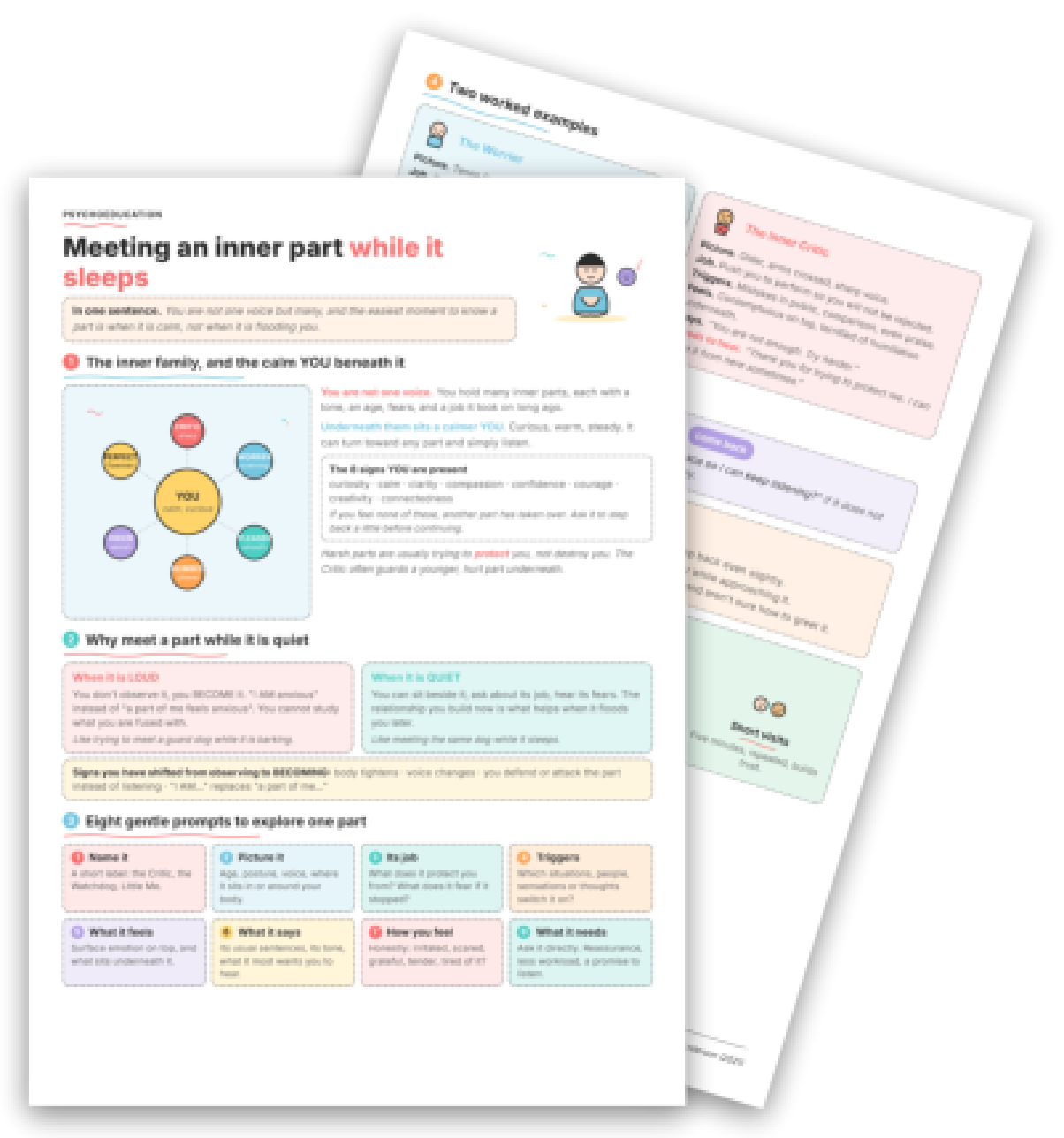
The fiche PDF is organized into five numbered panels plus a crisis protocol and a debrief section for session use. Panel 1 opens with an inner family diagram: six named parts (CRITIC, WORRIER, PLEASER, HIDER, and others) arranged around a central, calm YOU, with the 8 signs of Self-presence listed alongside (curiosity, calm, clarity, compassion, confidence, courage, creativity, connectedness). Seeing the internal system externalized on one page is what makes the concept land.
Panel 2 makes the central clinical distinction explicit through a direct contrast: "When it is LOUD, you don't observe it, you BECOME it" versus "like meeting the same dog while it sleeps." Panel 3 offers eight structured prompts covering name, picture, job, triggers, surface emotion and what sits underneath, the part's characteristic sentences, the patient's own reaction to it, and crucially, "What it needs." That last prompt routinely opens a relational shift even in the most defended patients.
Panels 4 and 5 provide two fully worked examples, the Worrier and the Inner Critic, showing how the prompts translate into real clinical language. A patient presenting with approval-seeking and pleasing patterns or with a shame-driven inner critic can read the worked example closest to their part and understand the depth of inquiry expected before writing a single word of their own.
> Key point: This fiche is a visual explanation tool designed to be used in session with you, not a self-administered questionnaire. You introduce it, read through it together, and the patient leaves with a concrete map of their inner system and the language to work with it.
750+ clinical tools
A library built with and for clinicians, ready to use in session and extend between appointments.
Access all the toolsWhen and How to Introduce It
The fiche fits naturally after at least one session in which you've named the IFS framework. It works well in three specific situations:
- After a flooding episode: the patient reported being overwhelmed during the week; you debrief, then use the fiche to orient toward meeting that same part while it's calm.
- Before approaching an exile: when a protector is guarding a younger, hurt part tied to abandonment or deprivation, the fiche helps the patient build the protector relationship first, rather than reaching past it prematurely.
- With patients for whom inner self-talk is ego-syntonic: patients who identify completely with their Inner Critic or their Worrier often respond faster to the diagram than to any verbal reframe.
A workable introduction: "I'd like to show you something that maps what we've been talking about. We'll look at this together, not as homework, but as a shared reference." Avoid framing it as a writing task to complete alone, especially with patients whose shame schema would make self-examination feel like self-indictment.
For debrief, use the fiche's own "To discuss in session" cues as your guide. If a part activated while the patient was reading or writing, that moment of becoming the part is clinical data in itself. The fiche doesn't replace defusion exercises from ACT or inner guide visualization work, both of which address adjacent territory. Used at the right moment, it gives the patient a legible inner map and leaves something concrete in their hands between sessions.
Use it with your patients
Share this tool in the mobile app and follow the work between sessions.
Sources
- Schwartz, R. C., Sweezy, M. (2019). Internal Family Systems Therapy, Second Edition. Guilford Press.
- Schwartz, R. C. (2021). No Bad Parts: Healing Trauma and Restoring Wholeness with the Internal Family Systems Model. Sounds True.
- Earley, J. (2010). Self-Therapy: A Step-by-Step Guide to Creating Wholeness and Healing Your Inner Child Using IFS. Mill City Press.
- Shadick, N. A., Sowell, N. F., Frits, M. L., Hoffman, S. M., Hartz, S. A., Booth, F. D., Sweezy, M., Rogers, P. R., Dubin, R. L., Atkinson, J. C., Friedman, A. L., Augusto, F., Iannaccone, C. K., Fossel, A. H., Quinn, G., Cui, J., Losina, E., Schwartz, R. C. (2013). A Randomized Controlled Trial of an Internal Family Systems-based Psychotherapeutic Intervention on Outcomes in Rheumatoid Arthritis: A Proof-of-Concept Study. The Journal of Rheumatology.
- IFS Institute. Research - Evidence Base for Internal Family Systems.
Your session continues in your patients' pocket
Use with a patientYour resources, available everywhere
The handouts, exercises, programs and audios above: you choose which ones to make available to your patients, in the mobile app dedicated to them.
And far more than a library
The app goes well beyond resources, to support your patients every day:
Related categories
Explore other clinical resources by category.

Anxiety
Clinical hub for anxiety disorders: CBT and ACT worksheets, psychoeducation sheets, and exercises for assessment and treatment across the anxiety spectrum.

Trauma
Clinical hub on trauma and PTSD: assessment, differential diagnosis, treatment phases, and printable resources for practitioners. 155 chars.

Mood
Evidence-based worksheets and clinical tools for mood disorders: CBT, ACT, and positive psychology resources for psychologists and therapists.

Identity
Clinical resources for self-identity work in therapy: CBT, ACT, schema tools for clinicians addressing self-concept, core beliefs, and identity disruption.

Behaviours
Clinical hub for behaviors in therapy: worksheets and tools for coping, eating disorders, CBT formulation, and maladaptive behavioral patterns.

Cognition
Printable cognitive therapy worksheets and clinical tools for therapists: CBT, ACT, schema work, defusion, distortions, and belief restructuring.