
Clinical picture. P., a woman in her early forties, presented with burnout after two decades in a high-demand role. She described her productivity as the one thing that kept her anxiety at bay, and rest as something that felt, in her words, pointless and slightly frightening. In a psychoeducation session, the clinician introduced the three-system model using the informational sheet, inviting P. to locate her own patterns in the diagram showing threat and drive circles crowding out the soothing system. P. recognised almost immediately that her drive had never been about enjoyment: she had been using achievement to suppress threat activation, and the sheet gave her a shared language for this. She left the session with no homework beyond noticing, once a day, which system seemed loudest at that moment.
Three Motivational Systems: PDF Worksheet, Tools and Exercises
A printable PDF fiche and clinical tools to explain Paul Gilbert's three-system model in session, making CFT psychoeducation concrete, visual, and immediately usable.
Clinical vignettes
Drive as Threat Escape in Burnout
Soothing Anxiety in a Self-Critical Patient
Clinical picture. T., a man in his late twenties with a long-standing self-critical inner voice and subclinical social anxiety, had made modest progress with cognitive restructuring but reported that calm still felt unfamiliar and vaguely wrong. The clinician introduced the three motivational systems sheet to normalise this reaction, explaining that when the threat system has been dominant for years, soothing cues can initially register as a new threat rather than relief. T. found the phrase on the sheet, that his brain adapted to an environment where rest was not safe, genuinely settling: he had assumed his discomfort with kindness was a personal defect. Over the following two sessions the sheet served as a reference point when soothing exercises produced unexpected irritability or tearfulness, reframing these responses as predictable system recalibration rather than treatment failure.
Explaining Paul Gilbert's three motivational systems in words alone tends to produce polite understanding and very little shift. Patients intellectually accept the framework, then return the following week still interpreting their exhaustion as weakness and their compulsive productivity as a personality trait. This PDF fiche turns an abstract evolutionary model into a shared visual map you can work from directly in the room.
Use this resource with your patients
Handout, exercises and materials ready to use, right inside SessionFuel.
Why the Three-System Model Resists Verbal Explanation
The threat system is usually the easiest entry point: patients already label those states as anxiety, anger, or shame. What resists comprehension is the functional role of the drive system as a coping strategy for threat, not a genuine motivational resource. The idea that striving can be a flight response dressed in productivity rarely lands without something concrete to point to. And the soothing system is routinely misread as rest, passivity, or reward. Patients with histories where warmth was absent or conditional often experience genuine calm as threatening, which means labelling it as laziness only deepens the problem.
This is where understanding the fight-flight-freeze cycle and nervous system regulation matter as groundwork. But neither resource gives patients the full three-system picture, especially the insight that a chronically loud threat system and an overworked drive system are both maintaining the dysregulation. Clinicians familiar with the autonomic nervous system framework will recognise the overlap, while the CFT framing adds the developmental and attachment layer that explains why soothing feels foreign to so many patients.
What the Fiche Contains: A Visual Support for System-Level Psychoeducation
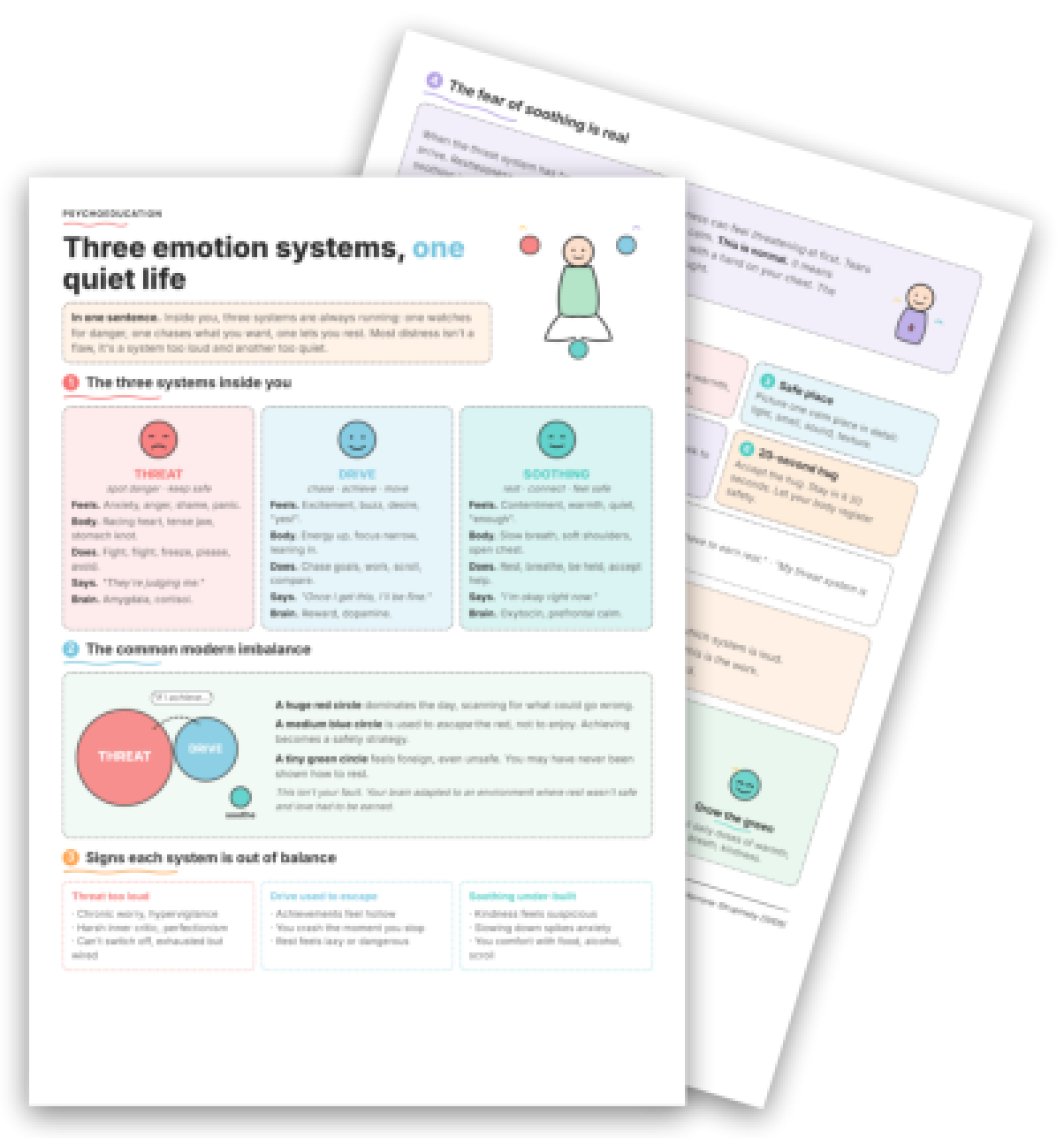
The fiche is structured across five numbered panels, each building on the last, designed to be talked through with the patient rather than handed over as reading.
Panel 1 maps all three systems in parallel columns: felt emotions, bodily signature, characteristic behaviour, and the internal monologue each system produces. The drive system entry reads, "Once I get this, I'll be fine", which consistently provokes recognition in high-achieving patients who have never named the hollowness behind their goals. Panel 2 uses three proportional circles to show the common modern imbalance: a dominant threat circle, a medium drive circle used to escape threat, and a tiny green soothing circle described as "foreign, even unsafe." Seeing this geometry lands differently than hearing it described.
Panel 3 lists signs of each system out of balance, including "achievements feel hollow" and "you crash the moment you stop" under drive, and "slowing down spikes anxiety" under soothing. These translate well into psychoeducation for burnout presentations and perfectionism where patients often struggle to connect their distress to a regulatory pattern rather than a character deficit.
Panels 4 and 5 address the fear of soothing directly, normalising tearfulness and restlessness as signs the intervention is working, then offering six concrete soothing exercises: a slow out-breath, a warm hand on the chest, safe-place imagery, a compassionate figure, a "friend voice" reframe, and a 20-second held hug. A set of phrases to practise is included ("I don't have to earn rest"), plus specific prompts flagged "to discuss in session".
> Key point: the fiche is a visual support that facilitates explanation in session; the clinician works through it alongside the patient. It is not a self-help handout to read at home. Its value is in giving the regulatory model a spatial, scannable form that the patient can keep as a reference point between appointments.
750+ clinical tools
A library built with and for clinicians, ready to use in session and extend between appointments.
Access all the toolsWhen and How to Introduce the Fiche
Timing matters. The fiche works best once a basic understanding of the stress response is in place and the therapeutic alliance is solid enough to name the patient's own system pattern without it feeling like a judgment. For patients presenting with chronic anxiety, maladaptive coping strategies, or pervasive self-criticism, introducing it in the second or third session of a CFT block is typical.
A low-resistance framing: "There's a model I find useful for understanding what's happening with your energy and your rest. I'd like to go through it with you now, because seeing it drawn out changes how it reads." Point to the circle diagram in Panel 2 and ask which circle they recognise as loudest in their own daily experience. That question alone usually generates 10 minutes of clinically dense material.
For patients whose healthy coping repertoire is heavily weighted toward control and avoidance, Panel 4 on the fear of soothing often needs explicit discussion before assigning any of the exercises in Panel 5. Refer patients showing somatic resistance to self-compassion-focused audio practice as a graduated complement to the fiche exercises.
The fiche does not replace the formulation or the relational work of building access to the soothing system. It gives both clinician and patient a common vocabulary and a map to return to when the system tilts again.
Use it with your patients
Share this tool in the mobile app and follow the work between sessions.
Sources
- Gilbert, P. (2009). Introducing compassion-focused therapy. Advances in Psychiatric Treatment, 15(3), 199-208.
- Gilbert, P. (2009). The Compassionate Mind: A New Approach to Life's Challenges. Constable-Robinson.
- Gilbert, P. (2010). Compassion Focused Therapy: Distinctive Features. Routledge.
- Moloney-Gibb, D., Sherwell, C., Lynn, S., Gilbert, P., Kirby, J. (2026). Preliminary Validation of a Novel Digital Measure of Emotion Regulation (The Three Circles) in Adolescents. Child and Adolescent Social Work Journal.
Your session continues in your patients' pocket
Use with a patientYour resources, available everywhere
The handouts, exercises, programs and audios above: you choose which ones to make available to your patients, in the mobile app dedicated to them.
And far more than a library
The app goes well beyond resources, to support your patients every day:
Related categories
Explore other clinical resources by category.

Anxiety
Clinical hub for anxiety disorders: CBT and ACT worksheets, psychoeducation sheets, and exercises for assessment and treatment across the anxiety spectrum.

Trauma
Clinical hub on trauma and PTSD: assessment, differential diagnosis, treatment phases, and printable resources for practitioners. 155 chars.

Mood
Evidence-based worksheets and clinical tools for mood disorders: CBT, ACT, and positive psychology resources for psychologists and therapists.

Identity
Clinical resources for self-identity work in therapy: CBT, ACT, schema tools for clinicians addressing self-concept, core beliefs, and identity disruption.

Emotions
Clinical resources on emotion regulation: worksheets, coping tools, CBT, REBT, and ACT exercises for therapists working across diagnoses and age groups.

Understand
Clinical hub for the therapeutic aim 'Understand': worksheets and tools to build patient insight across CBT, ACT, schema therapy and more.