
Clinical picture. T., a 34-year-old presenting with generalised anxiety and recurrent work-related stress, described a reliable pattern: after difficult meetings he would spend two to three hours scrolling social media, feel briefly calmer, then notice his anxiety had rebounded higher by evening. The clinician introduced the informational sheet and walked through the distress curve, naming the mechanism rather than the behaviour. T. recognised the pattern immediately and said, almost with relief, "So it actually does work, just not for long." Over the following two sessions he began tracking which coping choices corresponded to the slow-decline curve and which to the rebound. He did not abandon avoidance overnight, but he started describing his options in different terms, which allowed more deliberate choice.
Healthy vs. Unhealthy Coping Strategies: PDF Worksheet, Tools and Exercises
A visual PDF worksheet and practical tools to help patients understand the short-term/long-term coping trade-off, with exercises and session-ready psychoeducation.
Clinical vignettes
Recognising the Trade-Off in Practice
Widening the Menu After Prolonged Withdrawal
Clinical picture. M., a 47-year-old with a history of recurrent depression, had structured her life around social withdrawal as a primary coping strategy; she reported it as the only thing that reliably stopped acute distress. The sheet was introduced as a shared reference rather than a corrective, and the clinician pointed specifically to the section framing unhealthy coping as a solution the nervous system learned because it delivered. M. noted that no previous clinician had framed it that way and that reframing it as "too effective" felt less shaming than her own self-criticism. Work then shifted toward identifying one or two additions to her existing coping repertoire rather than removal, which she found tolerable where prior attempts at direct substitution had stalled.
Most patients agree, quickly and without resistance, that some of their coping strategies aren't serving them. The agreement rarely produces change. What's missing isn't motivation, it's a clear, visual grasp of why the unhealthy strategy keeps winning. This PDF fiche gives you a session-ready psychoeducation support to make that mechanism visible in the room.
Use this resource with your patients
Handout, exercises and materials ready to use, right inside SessionFuel.
Why Explaining Coping Strategies Verbally Often Falls Flat
The core problem is temporal. Unhealthy coping, avoidance, doomscrolling, alcohol, withdrawal, doesn't persist because patients are weak or uninformed. It persists because it delivers. Fast, reliable, measurable relief. When you describe this only in words, patients often hear a moral argument against something that genuinely works in the short run. The mechanism stays abstract.
Two other sticking points come up consistently. First, patients rarely see the rebound: distress dropping sharply, then climbing above where it started, while the problem waits untouched. Without a concrete representation of this temporal arc, adaptive strategies can sound like delayed gratification dressed up as clinical advice. Second, the concept of underlying need evaporates when presented orally. Naming a healthier alternative means nothing if the patient hasn't identified the function the unhealthy one is serving. The behavior-emotion-underlying need framework addresses this directly, and it pairs well here.
What the Fiche Contains: A Visual Tool for In-Session Psychoeducation
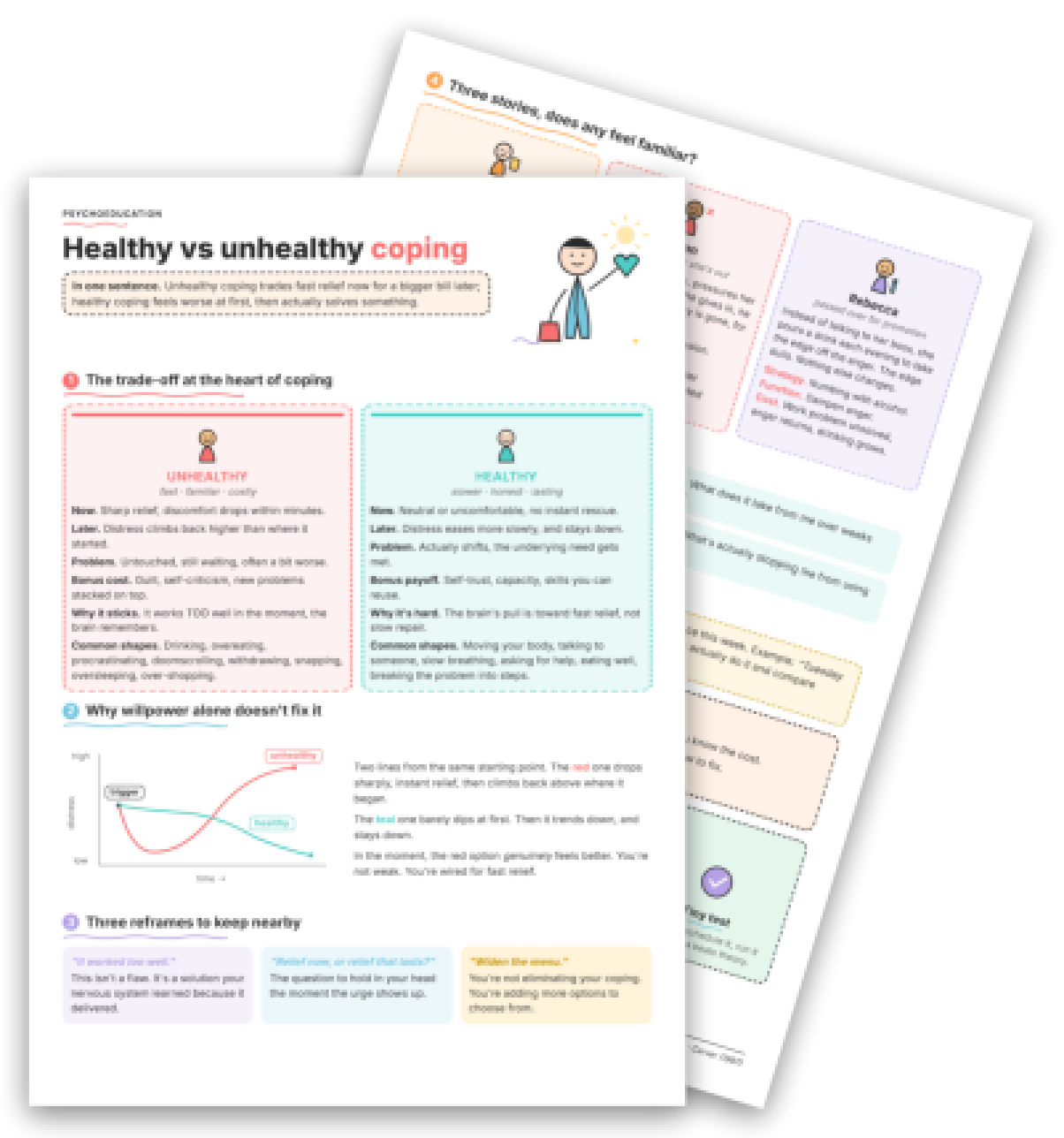
The fiche is a six-panel support designed for explanation in session, not for patients to complete alone. Each panel carries a specific clinical weight.
Panel 1 lays out the contrast in two columns: unhealthy coping (fast, familiar, costly) against healthy coping (slower, honest, lasting), covering the immediate experience, the delayed consequence, what happens to the underlying problem, and the bonus cost or payoff. The parallel structure makes the trade-off impossible to miss.
Panel 2 is the clinically decisive one: a two-curve graph, both lines starting from the same trigger point. The first drops sharply (instant relief) and then climbs back above baseline. The second barely moves at first, then trends steadily down and stays down. The caption reads: "In the moment, the red option genuinely feels better. You're not weak. You're wired for fast relief." That sentence does more than a paragraph of explanation.
> Key takeaway: The fiche works as a visual support that facilitates the in-session explanation of the coping trade-off; it is not a questionnaire the patient fills out alone, but an anchor the clinician uses to make a complex mechanism immediately legible.
Panel 3 offers three cognitive reframes to leave with the patient: "It worked too well," "Relief now, or relief that lasts?" and "Widen the menu", that last one especially useful for patients who hear the coping conversation as a demand to subtract behaviors rather than build a broader repertoire.
Panel 4 presents three brief clinical scenarios (procrastination, relational control, numbing with alcohol), each broken down by strategy, function, and cost. You can pair these with the coping strategies map or coping skills for addiction depending on the profile.
Panel 5 gives four structured questions: the payoff, the cost, the underlying need, and what's actually blocking the alternative. This is the functional assessment piece, and it flows naturally into the coping strategy effectiveness worksheet as a follow-up between sessions.
Panel 6 closes with a behavioral micro-experiment: pick one healthy strategy, schedule it once this week with a specific time, place, and duration, predict the outcome, then compare. Directly compatible with behavioral activation work and building new habits.
750+ clinical tools
A library built with and for clinicians, ready to use in session and extend between appointments.
Access all the toolsWhen and How to Introduce It in Your Practice
This fiche fits well in early-to-mid psychoeducation, once the therapeutic alliance is established and the patient has enough self-awareness to recognize at least one coping pattern they'd like to shift. It works across presentations, anxiety, depression, anger dysregulation, and adapts without modification for adolescent work if you simply narrate Panel 4 rather than assigning it to read.
A simple introduction: "I'd like to show you something that explains why even the strategies we want to change can feel impossible to put down, it's not a character issue, it's a timing issue." Then open with the two-curve graph in Panel 2. Patients who have felt judged for their coping often visibly relax at "you're not weak, you're wired."
Debrief the four questions in Panel 5 together in session before the patient takes the fiche home. For patients with strong avoidance cycles or procrastination patterns, the micro-experiment in Panel 6 makes an excellent structured homework assignment to review at the next appointment.
The fiche doesn't replace the clinical formulation, it makes one piece of it clear enough to act on.
Use it with your patients
Share this tool in the mobile app and follow the work between sessions.
Sources
- Lazarus, R. S., & Folkman, S. (1984). Stress, Appraisal, and Coping. Springer.
Your session continues in your patients' pocket
Use with a patientYour resources, available everywhere
The handouts, exercises, programs and audios above: you choose which ones to make available to your patients, in the mobile app dedicated to them.
And far more than a library
The app goes well beyond resources, to support your patients every day:
Related categories
Explore other clinical resources by category.

Anxiety
Clinical hub for anxiety disorders: CBT and ACT worksheets, psychoeducation sheets, and exercises for assessment and treatment across the anxiety spectrum.
Mood
Evidence-based worksheets and clinical tools for mood disorders: CBT, ACT, and positive psychology resources for psychologists and therapists.

Emotions
Clinical resources on emotion regulation: worksheets, coping tools, CBT, REBT, and ACT exercises for therapists working across diagnoses and age groups.

Behaviours
Clinical hub for behaviors in therapy: worksheets and tools for coping, eating disorders, CBT formulation, and maladaptive behavioral patterns.

Understand
Clinical hub for the therapeutic aim 'Understand': worksheets and tools to build patient insight across CBT, ACT, schema therapy and more.

Build awareness
Clinical worksheets and tools to build awareness in therapy: cognitive distortions, schemas, emotions, ACT and CBT resources for practitioners.