
Clinical picture. M., a woman in her late thirties, presents with a moderate depressive episode and reports spending most weekends in bed, stating she has no motivation to do anything. When asked in session to name one small activity she could try before the next appointment, she draws a blank and becomes visibly frustrated. The clinician introduces the Activity Menu as a structured worksheet, framing it not as a homework assignment but as a cognitive aid: the list handles the generative work that depression makes costly. Together they scan the domains and M. marks three low-effort options, one from "Self-care basics" and two from "Music," without committing to all of them. At the following session she reports having followed through on one, noting that seeing the options written down had made choosing feel possible rather than overwhelming.
Activity Menu: PDF Worksheet, Tools and Exercises for Behavioral Activation
A printable PDF fiche, clinical tools and exercises to explain the behavioral activation rationale and give depressed patients a concrete, portable starting point.
Clinical vignettes
Choosing From a List, Not From Scratch
Balancing Pleasure and Mastery Over a Week
Clinical picture. T., a man in his mid-fifties being treated for recurrent depression, understands behavioural activation in principle but tends to select only productivity tasks, such as tidying or fixing objects, while avoiding anything purely pleasurable, which he labels "pointless." The clinician uses the Activity Menu to make the pleasure-mastery distinction concrete, pointing to the "Cook and eat" and "Nature" columns alongside the "Mend and tidy" domain T. gravitates toward. T. agrees, with some scepticism, to schedule one item from a non-mastery column each day for a week. His mood ratings across that week show a modest but consistent improvement on days when he included a pleasure-oriented activity, which the clinician uses as behavioural evidence to revisit his belief that enjoyment serves no functional purpose.
In sessions with depressed patients, explaining behavioral activation verbally tends to produce polite agreement followed by no change. The patient nods, leaves, and waits to feel ready. This fiche PDF provides a ready-made, scannable activity menu you can open in session to make the whole rationale visible, concrete, and immediately usable, without asking the patient to generate anything from scratch.
Use this resource with your patients
Handout, exercises and materials ready to use, right inside SessionFuel.
Why behavioral activation is hard to communicate in session
The model is clinically sound and well-supported, rooted in the work of Lewinsohn, and later formalised in Martell's protocol and Jacobson's component analysis. The difficulty is not the model; it is the transmission.
Two things consistently obstruct uptake at the consultation level. First, depression flattens generativity. When you ask a patient to name activities they might try this week, the blankness you observe is not resistance; it is the cognitive symptom itself. Generating options from scratch demands exactly the executive and motivational resources the disorder has depleted. The patient leaves without a list, and the session's conceptual work evaporates.
Second, the temporal inversion at the heart of behavioral activation, that action precedes motivation rather than following it, runs directly against the patient's lived phenomenology. They are waiting to feel ready before they act. Repeating that inversion aloud rarely dislodges it. A visual support that externalises the sequence and makes it something the patient can look at, point to, and take home carries that message far more reliably than words alone. That is precisely the clinical gap this fiche fills, and why a structured baseline tool like My Current Inventory works well alongside it to anchor how time is actually being spent before any scheduling begins.
What the fiche contains: a visual structure that does the cognitive work
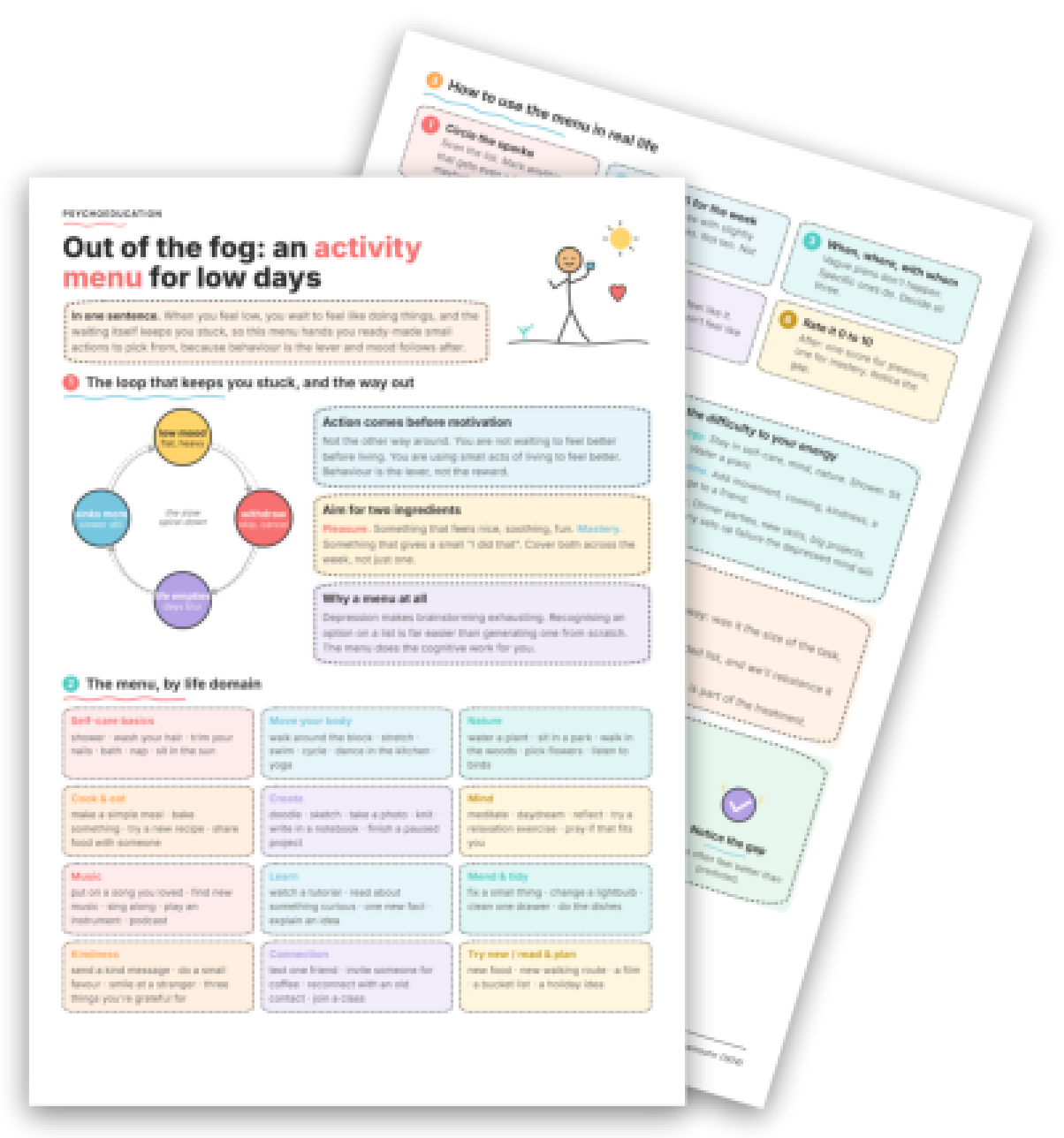
The fiche PDF opens with a withdrawal-spiral diagram: low mood → withdraw → life empties → sinks more, drawn as a closed loop so the self-reinforcing nature of inactivity is immediately legible. Below it, the fiche states plainly that "action comes before motivation. Not the other way around." That phrase becomes a shared anchor you can return to across sessions.
The core of the resource is a 12-domain activity menu, grouping options under headers such as self-care basics, move your body, nature, create, kindness, and connection. Each domain carries four to six concrete, low-demand examples. The visual organisation across domains accomplishes what a verbal list cannot: the patient scans rather than generates, which is cognitively far lighter under depressive load. Recognising an option on a page is a qualitatively different task from producing one under cognitive fog.
A six-step how-to-use section walks the patient through selection ("circle the sparks"), realistic planning ("when, where, with whom"), deliberate sizing ("start tiny"), and dual self-monitoring: rating both pleasure and mastery 0 to 10 after each activity. The pleasure-mastery distinction is made explicit, not just mentioned, which helps patients notice when they are systematically avoiding one pole.
A closing panel addresses the flat days directly: two reframes for motivational blankness and a three-tier energy-grading framework (floor energy, rising baseline, save for later). The fiche also includes "to discuss in session" prompts, making the debrief structured rather than open-ended.
> To retain: the Activity Menu is a visual support that facilitates the explanation of behavioral activation in session; patients keep it as a concrete reference between appointments, not a questionnaire they fill out alone.
750+ clinical tools
A library built with and for clinicians, ready to use in session and extend between appointments.
Access all the toolsWhen and how to introduce the fiche in clinical practice
The resource fits from the second or third session, once you have an initial formulation and low activity has been identified as a maintaining factor. For patients presenting with a clear depression and avoidance pattern, or who describe their days as blurring together without structure, it can come even earlier as a psychoeducational anchor alongside Understanding Depression.
A low-barrier opening: "Depression tends to make it hard to think of things to try, so I have a menu here, options already written out, and I'd like us to look at it together." This frames the cognitive support the fiche provides without pathologising the patient's blankness.
In session, scan the menu together, ask the patient to circle anything that produces even a faint reaction, then use the six-step structure to commit to three to five activities with specific timing. The Weekly Activity Planning exercise pairs naturally as a between-session complement, and the Weekly Self-Review exercise provides a structured debrief the following week.
The Depression and Behavioral Activation guided exercise works well when a patient is ready to go deeper on one specific avoided activity. When stalling persists and motivational inertia is the central obstacle, the Finding Motivation for Change program provides a fuller curriculum. Early gains, once a few activities have been completed, are worth consolidating explicitly with the Celebrating Progress in Depression exercise. For patients whose avoidance is also maintaining distorted beliefs about themselves, or where emotional numbing is prominent, the Emotions in Depression program and an ACT-informed approach can broaden the formulation.
When nothing on the menu generates any response, use the fiche's own energy-grading section as your clinical lever: anchor the recommendation in floor-energy basics (shower, sit in the sun, water a plant) before expanding scope. The fiche does not replace formulation; it makes one part of it visible, portable, and immediately usable.
Use it with your patients
Share this tool in the mobile app and follow the work between sessions.
Sources
- Martell, C. R., Dimidjian, S., Herman-Dunn, R. (2022). Behavioral Activation for Depression: A Clinician's Guide (2nd ed.). Guilford Press.
Your session continues in your patients' pocket
Use with a patientYour resources, available everywhere
The handouts, exercises, programs and audios above: you choose which ones to make available to your patients, in the mobile app dedicated to them.
And far more than a library
The app goes well beyond resources, to support your patients every day:
Related categories
Explore other clinical resources by category.

Mood
Evidence-based worksheets and clinical tools for mood disorders: CBT, ACT, and positive psychology resources for psychologists and therapists.

Engage & motivate
Clinical hub: printable worksheets and exercises to build therapeutic engagement and motivation across ACT, CBT, and integrative practice. For clinicians.

CBT
CBT worksheets, cognitive restructuring exercises & behavioral tools for clinicians. Evidence-based resources for every phase of cognitive behavioral therapy.
Anxiety
Clinical hub for anxiety disorders: CBT and ACT worksheets, psychoeducation sheets, and exercises for assessment and treatment across the anxiety spectrum.

Trauma
Clinical hub on trauma and PTSD: assessment, differential diagnosis, treatment phases, and printable resources for practitioners. 155 chars.

Identity
Clinical resources for self-identity work in therapy: CBT, ACT, schema tools for clinicians addressing self-concept, core beliefs, and identity disruption.