
Clinical picture. A woman in her early forties, referred to here as J., presented with recurrent depressive episodes and a well-established pattern of social withdrawal: she consistently declined invitations, citing low energy, and reported that isolation had intensified over the previous three months. The clinician introduced the Social Self-Care worksheet, focusing on the avoidance loop diagram and the reframe that small contact precedes, rather than follows, improved mood. Together they identified a micro-contact task: sending one voice note to a close friend, rated before and after on a 0-to-10 wellbeing scale. J. returned the following week noting her predicted score had been 2 out of 10 and her actual post-contact score 5; she described this discrepancy as "hard to argue with." The exercise opened a productive conversation about graduated contact rather than waiting for readiness that never arrived.
Social Self-Care Activities: PDF Worksheet, Tools and Exercises
A printable PDF worksheet, clinical tools, and structured exercises to help patients break isolation, dose social contact, and track what genuinely restores them.
Clinical vignettes
Breaking the Avoidance Loop, Step by Step
Calibrating Dose in a High-Anxiety Patient
Clinical picture. M., a man in his late twenties with generalised anxiety and a history of social burnout, reported that he avoided self-care guidance that involved groups or socialising, viewing it as incompatible with his current capacity. The clinician used the dose-matching section of the worksheet to reframe social self-care as a spectrum, and M. selected sitting in a neighbourhood café for thirty minutes with a book as a starting point, one notch below what he initially thought he "should" manage. He completed a brief before/after rating and noted mild but genuine relief afterward, which he attributed partly to ambient human presence rather than any direct interaction. This concrete, low-demand entry point reduced his anticipatory anxiety around future tasks and allowed the two to discuss extending contact incrementally across subsequent sessions.
Telling a depressed or anxious patient that social contact is protective rarely moves the needle. They already know, and they still pull back. This fiche PDF gives you a structured visual argument for the reversal of that logic, so the explanation lands differently, in session, with something the patient can take home and actually use.
Use this resource with your patients
Handout, exercises and materials ready to use, right inside SessionFuel.
Why Social Self-Care Resists Verbal Explanation Alone
The core difficulty is a sequencing belief: "I will see people when I feel better." Clinicians recognize this immediately as a maintenance mechanism. Patients experience it as common sense. Closing that gap verbally is possible, but it takes longer than it needs to, partly because the cycle of avoidance is easier to see than to hear described.
Social withdrawal in depression and anxiety is not simply a symptom. As Cacioppo's work on loneliness makes plain, isolation actively maintains the problem by removing the interpersonal scaffolding that supports recovery. The same mechanism is central to behavioral activation: contact first, affective shift second, not the other way around. Saying that once in session is fine. Showing it in a diagram, with the patient's own logic labeled on the loop, is considerably more efficient at building a shared formulation.
What the Fiche Contains: A Visual Support for the Explanation
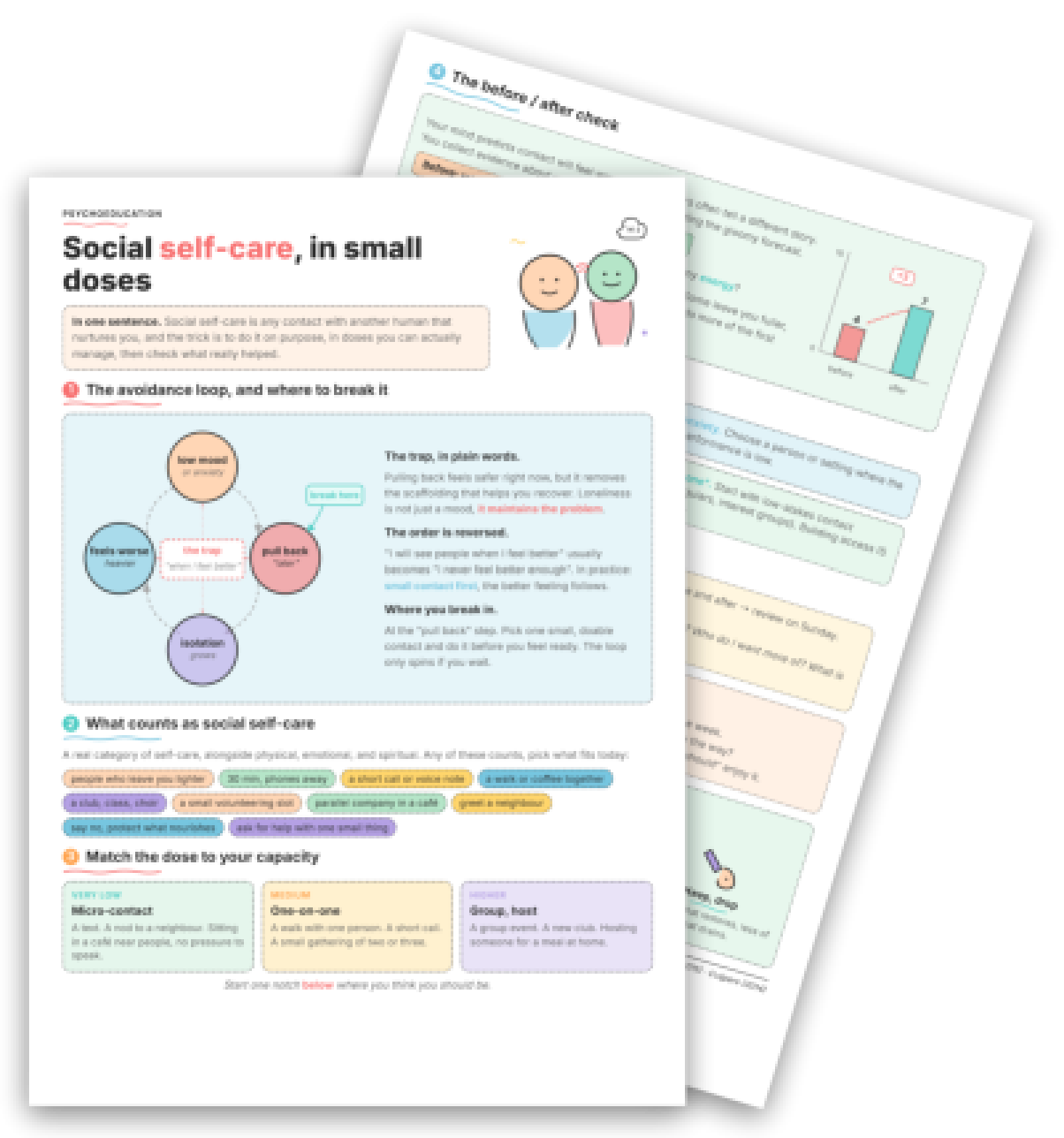
The fiche is organized across six clearly labeled panels, and its value lies precisely in making the clinical reasoning visible rather than abstract.
Panel 1 presents the avoidance loop as a circular diagram: low mood or anxiety triggers withdrawal, withdrawal feeds isolation, isolation worsens the presenting state, which triggers further withdrawal. The trap is labeled explicitly in the diagram: "when I feel better" sits at the entry point, with an arrow marking exactly where to break in. Pointing to this with the patient in the room is faster and more precise than the verbal equivalent.
Panel 2 lists what counts as social self-care across a broad range, including things patients rarely frame this way: sending a voice note, sitting with parallel company in a café, saying no to protect what nourishes, asking for help with one small thing. This range is clinically useful because it widens the behavioral menu for patients who insist they "have no one."
Panel 3 offers a three-tier dose-matching grid: micro-contact (a text, a nod), one-on-one (a walk, a short call), and group or hosting. The instruction "start one notch below where you think you should be" is printed directly on the panel, modeling the graded approach without requiring the clinician to say it every time.
Panels 4 and 5 introduce a before/after rating (0-10 on mood, body, thoughts, energy) and a brief list of common obstacles with concrete workarounds. The tracking logic is explicit: numbers beat the gloomy forecast. For patients whose negative predictions systematically overestimate social cost, this is a brief behavioral experiment with immediate evidence.
Panel 6 structures a weekly rhythm with a Sunday review, and closes with prompts flagged "to discuss in session", including what to do when the before/after rating is never actually reviewed.
> Key point: the fiche is a visual support that facilitates the explanation in session, not a standalone homework questionnaire. The diagrams carry the argument; the clinician uses them as reference points during the psychoeducation conversation, then leaves the patient with a concrete anchor.
750+ clinical tools
A library built with and for clinicians, ready to use in session and extend between appointments.
Access all the toolsWhen and How to Introduce It
This fiche fits naturally from the second or third session onward, once the maintenance cycle of depression or social isolation schema has been named in the formulation. It pairs well with behavioral activation work and is a useful complement to resources on loneliness or social anxiety when the withdrawal has a more anxious coloring.
To introduce it, you might say: "I want to show you something about how pulling back works, because the diagram makes the logic clearer than me just describing it." Then walk through Panel 1 together, ask the patient where they recognize themselves, and use Panel 3 to co-select one micro-contact for the week. The Sunday review in Panel 6 becomes the debrief agenda for the following session.
One limit to keep in mind: for patients with a significant social isolation schema or active abandonment fears, the before/after tracking may surface stronger material than anticipated. Name that possibility early and stay with what it brings up, rather than pressing toward the behavioral target.
The fiche does not replace the therapeutic frame; it makes the explanation sharper and leaves the patient with a reference point they can return to between sessions when the "I'll wait until I feel better" thought reappears.
Use it with your patients
Share this tool in the mobile app and follow the work between sessions.
Sources
- Sbarra, D. A., Ramadan, F. A., Choi, K. W., Treur, J. L., Levey, D. F., Wootton, R. E., et al. (2023). Loneliness and depression: bidirectional Mendelian randomization analyses using data from three large genome-wide association studies. Molecular Psychiatry.
Your session continues in your patients' pocket
Use with a patientYour resources, available everywhere
The handouts, exercises, programs and audios above: you choose which ones to make available to your patients, in the mobile app dedicated to them.
And far more than a library
The app goes well beyond resources, to support your patients every day:
Related categories
Explore other clinical resources by category.

Trauma
Clinical hub on trauma and PTSD: assessment, differential diagnosis, treatment phases, and printable resources for practitioners. 155 chars.

Mood
Evidence-based worksheets and clinical tools for mood disorders: CBT, ACT, and positive psychology resources for psychologists and therapists.

Identity
Clinical resources for self-identity work in therapy: CBT, ACT, schema tools for clinicians addressing self-concept, core beliefs, and identity disruption.

Behaviours
Clinical hub for behaviors in therapy: worksheets and tools for coping, eating disorders, CBT formulation, and maladaptive behavioral patterns.

Relationships
Clinical worksheets and tools on relational functioning: attachment, schemas, assertiveness, and communication skills for therapists. Printable PDF resources.

Engage & motivate
Clinical hub: printable worksheets and exercises to build therapeutic engagement and motivation across ACT, CBT, and integrative practice. For clinicians.