
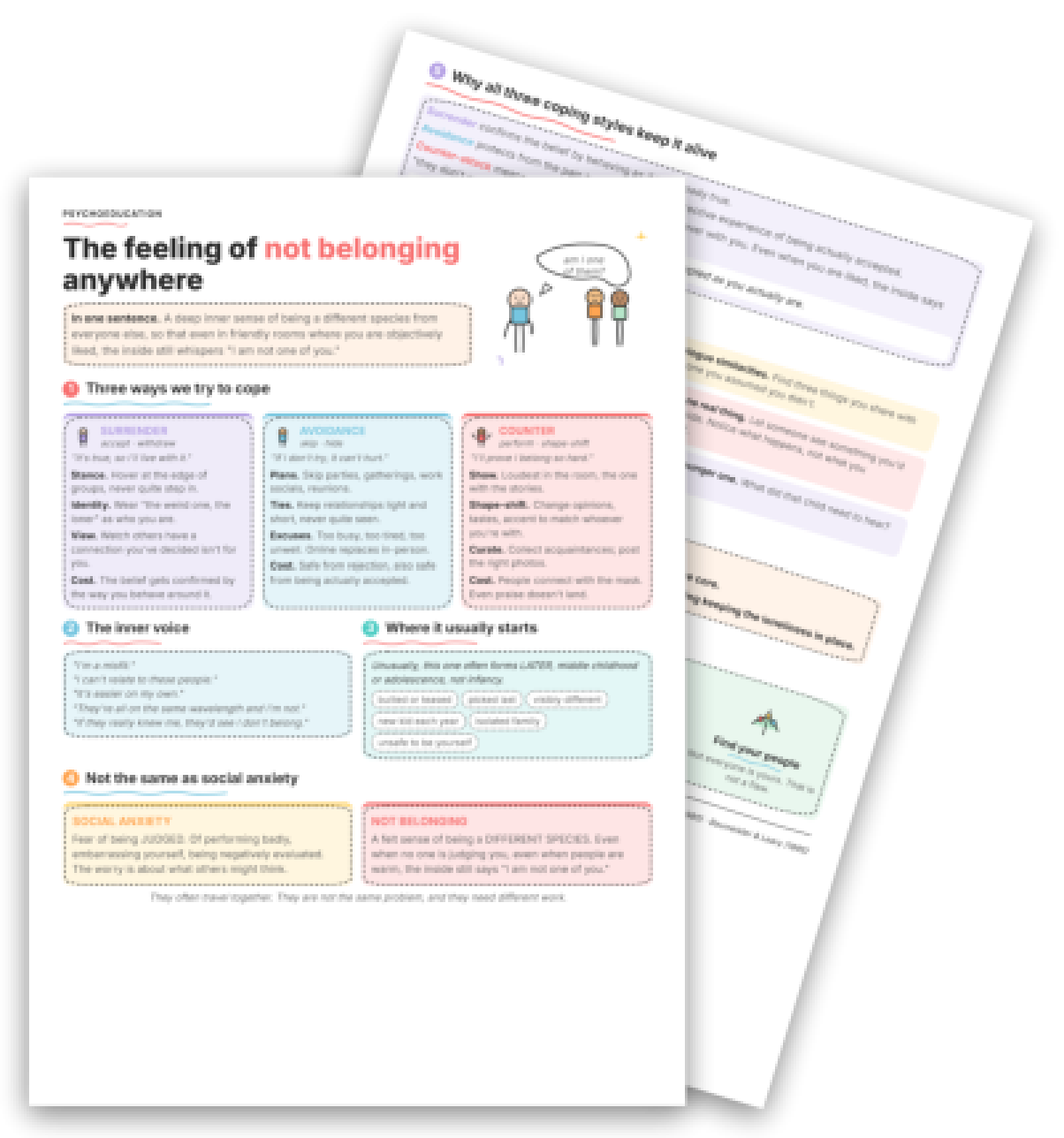
Clinical picture. T., a 34-year-old software engineer, presents with longstanding low mood and a pattern of withdrawing from colleagues he describes as genuinely friendly. He reports that even after successful team lunches he returns to his desk feeling, in his words, "like a tourist who learned the language but never got the passport." The clinician introduces the psychoeducational sheet on the Social Isolation Schema and asks T. to read the section distinguishing this schema from social anxiety. T. pauses at the phrase "even when people are warm, the inside still whispers I am not one of you" and says this is the first description that has felt accurate. Over the following session, identifying his habitual counter-stance, specifically shape-shifting his opinions to match colleagues, allows him to begin separating the schema's narrative from factual evidence about his relationships.
Social Isolation Schema: PDF Worksheet, Tools and Exercises
A visual psychoeducation tool to help clinicians explain the not-belonging schema, distinguish it from social anxiety, and map the three coping styles that keep it alive.
Clinical vignettes
Belonging Doubts Despite Warm Reception
Avoidance Mistaken for Introversion
Clinical picture. M., a woman in her late twenties, was referred after a second episode of depression; she had attributed her social thinning to being "just an introvert." She consistently declined invitations, kept friendships brief, and had framed this pattern as a stable personality trait rather than something worth examining. The clinician offered the informational sheet as pre-session reading and invited M. to note which coping column felt most familiar. She identified clearly with the avoidance column, particularly the line about keeping relationships "light and short, never quite seen," and acknowledged the cost described there had never occurred to her. This reframe opened a productive discussion about the difference between a chosen preference and a schema-driven withdrawal, without the clinician needing to challenge her self-concept directly.
Explaining the social isolation schema verbally tends to produce polite agreement and quiet confusion in equal measure. Patients nod, but what lands is often "I feel lonely" rather than the more precise clinical construct: a felt sense of being a different species, structurally distinct from social anxiety, with its own origin timeline and its own three-pronged coping response. This PDF worksheet gives you a visual architecture to make that distinction land, in session, in one pass.
Use this resource with your patients
Handout, exercises and materials ready to use, right inside SessionFuel.
Why the Social Isolation Schema Resists Verbal Explanation
The clinical difficulty is not conceptual; it is phenomenological. The not-belonging sense operates even in warm, accepting rooms. Patients who are objectively liked still report the schema whisper: "I am not one of you." When you describe this at the whiteboard, patients often reframe it as shyness, social anxiety, or ordinary introversion. The confusion matters clinically because, as the fiche states directly, "they often travel together; they are not the same problem, and they need different work."
A second resistance point concerns the three coping styles: surrender, avoidance, and counter-attack (performing, shape-shifting, curating). Patients rarely hold all three in mind simultaneously. Presented orally, each style sounds like a separate problem. The visual layout of the fiche makes their shared function visible at a glance: all three block the only corrective experience that can shift the schema.
What the Fiche Contains: A Visual Map for Session Use
The PDF worksheet is organized around seven numbered panels, designed to be worked through with the patient as a shared psychoeducation object rather than filled in alone.
- Panel 1 maps the three coping styles side by side: Surrender (hover at the edge, wear "the loner" as identity), Avoidance (skip gatherings, keep ties light, let online replace in-person), and Counter (be the loudest in the room, shape-shift, collect acquaintances). Each panel names the stance, the concrete behavior, and the cost in schema-maintenance terms.
- Panel 2 lists verbatim inner voice statements ("They're all on the same wavelength and I'm not", "If they really knew me, they'd see I don't belong"), which serve as rapid recognition anchors for the patient.
- Panel 3 addresses developmental origin, noting this schema forms later than most: bullying, being new each year, isolated family, being "unsafe to be yourself."
- Panel 4 delivers the clinical distinction between social anxiety (fear of negative evaluation) and not-belonging (felt different-species sense, even when no one is judging). This is the panel that prevents the most common cognitive distortion a patient brings: "I'm just anxious around people."
- Panel 5 closes the feedback loop: each coping style, rendered visually side by side, blocks the corrective experience of being "accepted as you actually are."
- Panels 6-7 offer six concrete softening strategies (cataloguing similarities, small behavioural risks, showing one real thing) and three starred takeaways including "Liked ≠ belong" and "Praise for the mask won't ever reach you."
> Key takeaway: The fiche is a visual support that facilitates the explanation of the social isolation schema in session. It is not a self-administered questionnaire; it is a psychoeducation anchor the clinician uses to name the construct precisely, build shared vocabulary, and leave the patient with a concrete reference between appointments.
750+ clinical tools
A library built with and for clinicians, ready to use in session and extend between appointments.
Access all the toolsHow and When to Introduce This Worksheet
The optimal window is early case formulation, typically once the presenting complaint has been mapped and you are beginning to introduce early maladaptive schemas as an organising framework. For patients with low self-esteem who describe chronic relational flatness despite active social lives, or with approval-seeking patterns that never produce felt acceptance, the not-belonging schema is often the hidden engine.
A workable introduction: "What you're describing isn't really about whether people like you. There's a specific pattern that explains why being liked doesn't always feel like belonging. I want to show you something that maps it." This framing avoids labelling the patient as defective and positions the fiche as explanatory rather than diagnostic.
Debrief by asking which coping style resonates most, and whether Panel 4's distinction between social anxiety and not-belonging changes how they understand their own experience. For patients also working with social anxiety or loneliness, the fiche makes explicit that these require different therapeutic tracks. Pair it with work on coping styles in schema therapy, schema maintenance cycles, and, where relevant, vulnerability in relationships as the behavioural target most likely to produce corrective experience.
One contraindication: with patients in an active counter coping mode (high performance, strong identity investment in the social persona), Panel 4 can land as exposing. Name the possibility directly before handing the sheet over.
The fiche does not replace the therapeutic relationship. What it does is compress a genuinely difficult psychoeducation into a format the patient can return to, and that you can point to rather than re-explain each session.
Use it with your patients
Share this tool in the mobile app and follow the work between sessions.
Sources
- Young, J. E., Klosko, J. S., & Weishaar, M. E. (2003). Schema Therapy: A Practitioner's Guide. Guilford Press.
- Young, J. E., & Klosko, J. S. (1994). Reinventing Your Life: The Breakthrough Program to End Negative Behavior and Feel Great Again. Plume.
- Rafaeli, E., Bernstein, D. P., & Young, J. E. (2011). Schema Therapy: Distinctive Features. Routledge.
- Pozza, A., Starcevic, V., Ferretti, F., Pedani, C., Mucci, F., & Dettore, D. (2022). Early Maladaptive Schemas and Mental Disorders in Adulthood: a Systematic Review and Meta-analysis. International Journal of Cognitive Therapy.
Your session continues in your patients' pocket
Use with a patientYour resources, available everywhere
The handouts, exercises, programs and audios above: you choose which ones to make available to your patients, in the mobile app dedicated to them.
And far more than a library
The app goes well beyond resources, to support your patients every day:
Related categories
Explore other clinical resources by category.

Anxiety
Clinical hub for anxiety disorders: CBT and ACT worksheets, psychoeducation sheets, and exercises for assessment and treatment across the anxiety spectrum.

Identity
Clinical resources for self-identity work in therapy: CBT, ACT, schema tools for clinicians addressing self-concept, core beliefs, and identity disruption.
Relationships
Clinical worksheets and tools on relational functioning: attachment, schemas, assertiveness, and communication skills for therapists. Printable PDF resources.

Cognition
Printable cognitive therapy worksheets and clinical tools for therapists: CBT, ACT, schema work, defusion, distortions, and belief restructuring.

Understand
Clinical hub for the therapeutic aim 'Understand': worksheets and tools to build patient insight across CBT, ACT, schema therapy and more.

Build awareness
Clinical worksheets and tools to build awareness in therapy: cognitive distortions, schemas, emotions, ACT and CBT resources for practitioners.