
Clinical picture. A., a 34-year-old woman, presents with chronic anxiety within her five-year partnership, describing persistent fear that her partner is secretly disengaged. She reports checking his tone of voice after every exchange, replaying conversations at night to locate signs of coldness, and asking for reassurance several times a day. In session, the clinician introduces the psychoeducational sheet on the emotional deprivation schema and invites A. to read the nurturance and empathy subtypes aloud. She pauses at "no voice softened your fear" and identifies a pattern from childhood: a mother who was consistently present but rarely attuned, dismissing distress with "you are fine, stop overthinking." A. does not achieve immediate relief, yet names the behaviour as a strategy rather than evidence her partner is withdrawing, which opens a small but workable therapeutic gap.
Emotional Deprivation Schema: PDF Worksheet, Tools and Exercises
A visual PDF worksheet to explain the emotional deprivation schema in session, name its two coping faces, and give patients a concrete psychoeducation anchor.
Clinical vignettes
Clinging Presentation in a Long-Term Relationship
Counter-Dependent Avoidance After Repeated Loss
Clinical picture. M., a 47-year-old man referred following a second divorce, describes choosing partners he retrospectively recognises as emotionally unavailable, then leaving relationships precisely when genuine closeness begins to develop. He frames this as self-sufficiency and states, matter-of-factly, that he has never needed much from others. The clinician uses the informational sheet to name the counter-dependent face of the deprivation schema, highlighting the sentence "if I let them in, the disappointment will be worse." M. is initially sceptical of the framework, yet acknowledges that his father provided materially while remaining emotionally opaque throughout his adolescence. By the end of the session, M. tentatively accepts that withdrawing first may be a protective manoeuvre rather than evidence that closeness is genuinely unimportant to him.
The emotional deprivation schema is among the most clinically slippery of Young's early maladaptive schemas: patients rarely name it "I feel emotionally deprived." They present instead with chronic relational dissatisfaction, oscillations between clinging and self-sufficiency, or a vague but persistent sense that something is always missing. This fiche PDF gives you a structured visual support to name that wound precisely and work with it in session.
Use this resource with your patients
Handout, exercises and materials ready to use, right inside SessionFuel.
Why the Emotional Deprivation Schema Is Hard to Explain Without a Visual
Oral psychoeducation on this schema tends to hit a wall. Patients either over-identify ("so everyone failed me") or dismiss the concept entirely ("my parents were fine, I have no reason to complain"). The layered nature of the schema, covering three distinct deprivation subtypes, plus the paradox of two diametrically opposite coping modes in the same person, is genuinely difficult to hold in working memory without a concrete scaffold.
The schema also intersects heavily with attachment styles, approval-seeking patterns, and the fear of partner abandonment, all of which can blur the clinical picture if the underlying schema stays unnamed. A visual support anchors the formulation and prevents the session from fragmenting across too many constructs at once.
750+ clinical tools
A library built with and for clinicians, ready to use in session and extend between appointments.
Access all the toolsWhat the Fiche Contains, and What the Visual Layout Shows
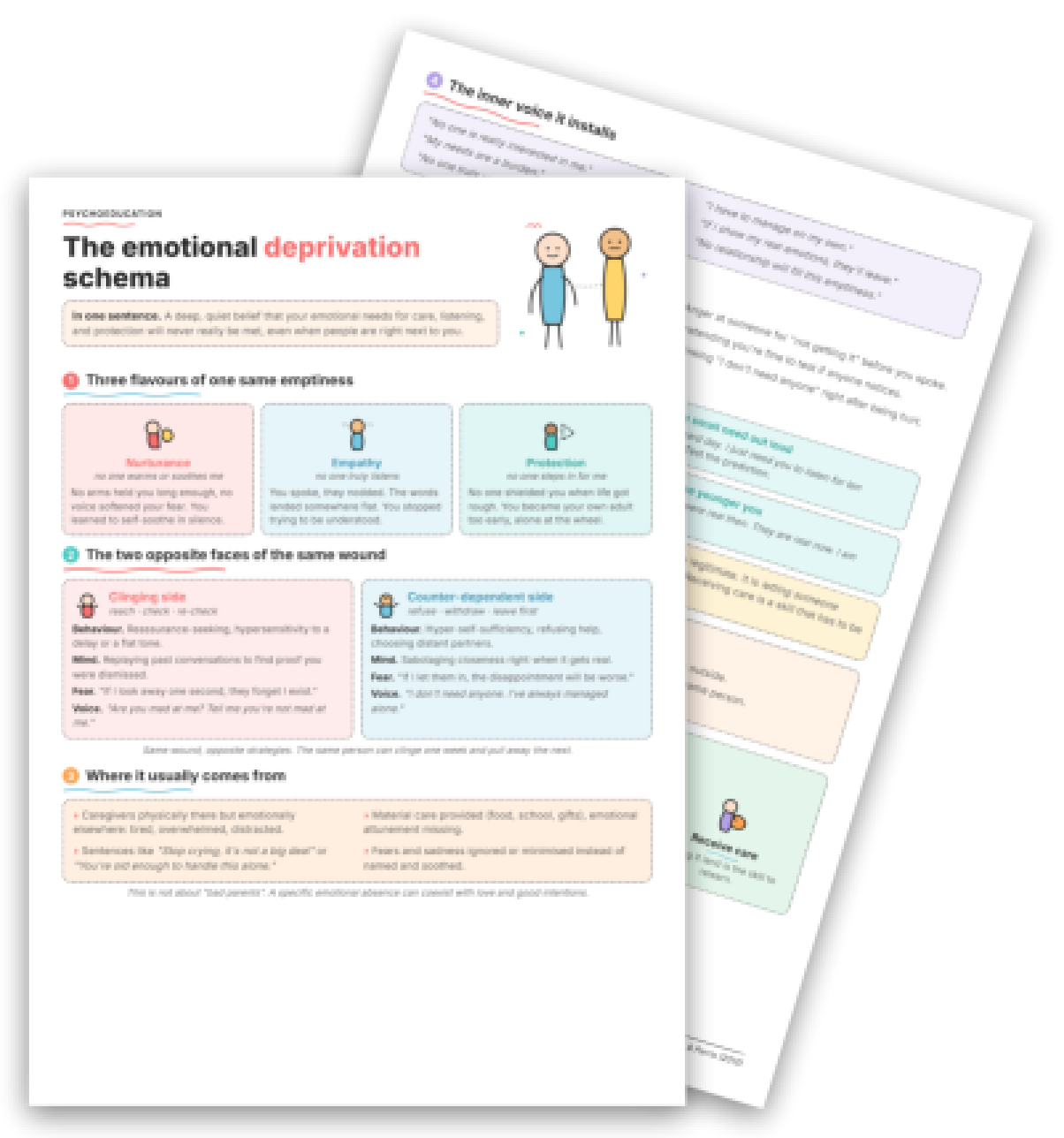
The fiche PDF organises the schema across six numbered panels, designed to be walked through collaboratively with the patient rather than handed over as reading homework.
- Panel 1 identifies three distinct subtypes: Nurturance ("no one warms or soothes me"), Empathy ("no one truly listens"), and Protection ("no one steps in for me"). Seeing all three side by side helps patients locate which dimension is most active without generalising to a global accusation of neglect.
- Panel 2 is the clinical centrepiece: the clinging face (reassurance-seeking, hypervigilance to tone and delay, replaying conversations) set against the counter-dependent face (hyper-self-sufficiency, refusing help, choosing unavailable partners). The fiche states plainly: "Same wound, opposite strategies. The same person can cling one week and pull away the next." Patients who oscillate between these poles often feel confused or ashamed about the contradiction; seeing both modes mapped visually normalises the ambivalence.
- Panel 4 lists six core belief statements, including "My needs are a burden" and "No one truly understands what I need." These function as direct entry points into cognitive restructuring of core beliefs.
- Panel 5 offers six observable in-vivo signals (sudden loneliness in company, replaying conversations, pretending to be fine to test whether anyone notices), useful for schema-activation monitoring.
- Panel 6 introduces four brief clinical exercises, with a counter-intuitive note the fiche names explicitly: "Receiving care is a skill that has to be re-learned." This reframe is more portable when the patient can read it back between sessions.
A closing "To discuss in session" block provides three ready-made prompts for your debrief.
> Key point: the fiche is a visual support that facilitates the explanation in session. It is not a self-administered questionnaire; it is a psychoeducation tool the clinician walks through with the patient, panel by panel, to build a shared vocabulary and reduce the shame that often surrounds this schema.
Use it with your patients
Share this tool in the mobile app and follow the work between sessions.
When and How to Introduce the Fiche
The fiche is most useful once the therapeutic alliance is solid enough for the patient to tolerate the idea that a deep relational pattern, rather than a problematic partner, is partly driving their distress. That typically places it in the mid-phase of schema-focused work, after an initial case formulation and before schema-mode work begins. It pairs naturally with the Coping Styles in Schema Therapy fiche if the patient oscillates strongly between surrender and overcompensation.
For patients presenting with emotional dependency or chronic reassurance-seeking, you can introduce the fiche with a straightforward frame: "I'd like to show you something that might explain why the reassurance never quite lands, even when it's genuine." For the counter-dependent patient who insists they need no one, Panel 2 is the entry point: show them both faces first, before naming the schema.
The fiche complements work on secure attachment and integrates smoothly alongside the abandonment schema and defectiveness/shame schema resources when comorbid schemas are active. The ACT Schemas and Modes worksheet offers a useful third-wave complement for patients more receptive to defusion work than direct schema restructuring.
The fiche does not replace the relational work of schema therapy; it accelerates the moment of recognition that makes that work possible.
Your session continues in your patients' pocket
Use with a patientYour resources, available everywhere
The handouts, exercises, programs and audios above: you choose which ones to make available to your patients, in the mobile app dedicated to them.
And far more than a library
The app goes well beyond resources, to support your patients every day:
Related categories
Explore other clinical resources by category.

Mood
Evidence-based worksheets and clinical tools for mood disorders: CBT, ACT, and positive psychology resources for psychologists and therapists.

Identity
Clinical resources for self-identity work in therapy: CBT, ACT, schema tools for clinicians addressing self-concept, core beliefs, and identity disruption.

Relationships
Clinical worksheets and tools on relational functioning: attachment, schemas, assertiveness, and communication skills for therapists. Printable PDF resources.

Cognition
Printable cognitive therapy worksheets and clinical tools for therapists: CBT, ACT, schema work, defusion, distortions, and belief restructuring.

Understand
Clinical hub for the therapeutic aim 'Understand': worksheets and tools to build patient insight across CBT, ACT, schema therapy and more.

Build awareness
Clinical worksheets and tools to build awareness in therapy: cognitive distortions, schemas, emotions, ACT and CBT resources for practitioners.