
Clinical picture. A, a woman in her early thirties with a history of anxious attachment, presented after a heated argument with her partner of two years; she was convinced the relationship was ending. The clinician introduced the five-question reappraisal exercise, beginning with what had concretely triggered the fear. Working through questions two and three, A identified that her partner had reduced contact for three days, but also recalled several recent gestures of commitment he had made. By question four she was able to articulate a more differentiated appraisal: conflict was present, but evidence of imminent abandonment was thin. She left the session with a specific action to initiate a calm conversation with her partner about the argument, which she reported doing the following week.
Fear of Partner Leaving: A Guided Cognitive Restructuring Exercise
Help patients examine and challenge abandonment fears in romantic relationships with a structured five-question cognitive reappraisal exercise.
Clinical vignettes
Reappraising Abandonment Fear After Conflict
Distinguishing Anxiety From Relational Reality
Clinical picture. M, a man in his mid-forties with recurrent depressive episodes, reported a persistent conviction that his partner would leave him, despite no explicit threat from her. The clinician guided him through the structured questions, and M struggled initially to name any objective facts supporting his fear beyond a general sense of unworthiness. Questions three and four proved pivotal: listing his partner's consistent behaviour over several months shifted his framing from certainty of loss to recognition of a depressive cognitive pattern. The exercise did not resolve his underlying low self-worth, but it gave him a replicable way to slow down catastrophic inference when it arose between sessions.
The clinical challenge: when fear of abandonment resists words
Fear of being left by a partner sits at the intersection of attachment anxiety, cognitive distortion, and emotional urgency. Patients who arrive with this fear are rarely in doubt about its intensity. They are, however, often blind to the degree to which it is driven by interpretation rather than fact.
The clinical difficulty is not explaining that "thoughts are not facts." Most patients understand that conceptually. What they cannot do, on their own, is slow the fear down long enough to examine the evidence underneath it. In session, the emotional charge tends to dominate. The patient spirals; the clinician guides; and the moment the consultation ends, the spiral resumes. What the situation calls for is a structured moment of autonomous reflection, close enough to the triggering episode that the memory is still vivid, yet guided enough to produce genuine cognitive work.
This is also a domain where interpersonal beliefs and relational loops operate invisibly. The fear of abandonment often feeds exactly the behaviors that create distance, making schema maintenance cycles and reciprocal CBT formulations directly relevant. Words alone, delivered in a 50-minute consultation, rarely interrupt that loop.
Use this resource with your patients
Handout, exercises and materials ready to use, right inside SessionFuel.
What this exercise contains
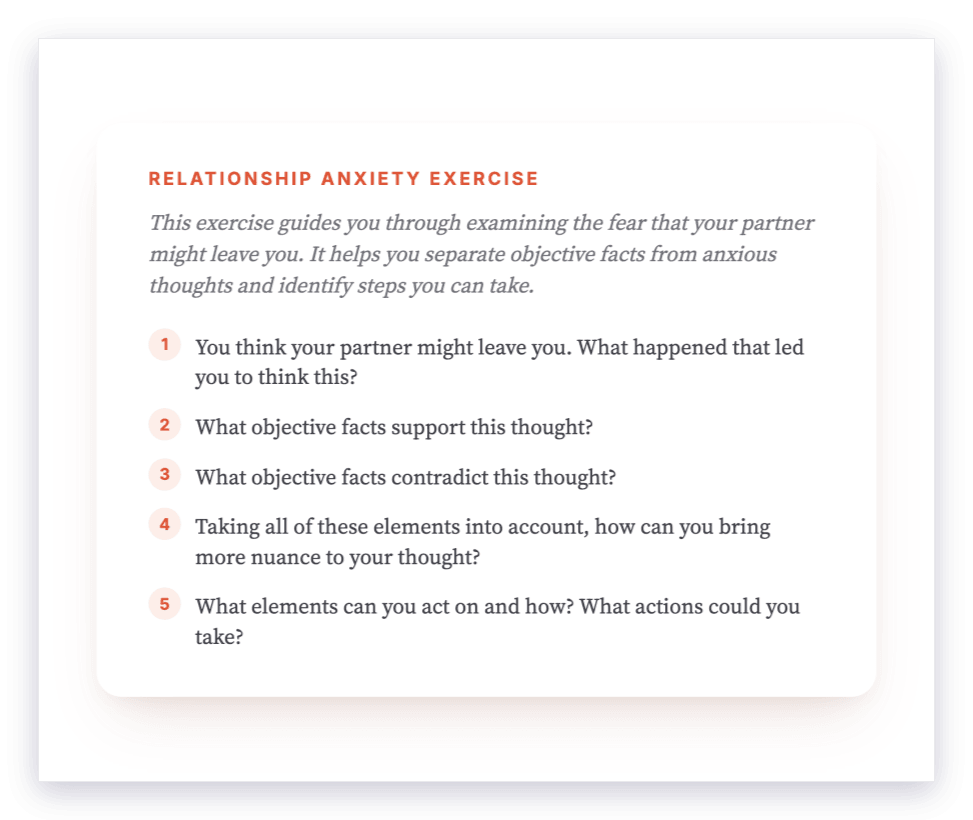
The exercise guides the patient through five questions in sequence. The image above lists those questions with a short introductory framing.
The five questions of the exercise, shown here as a static preview for clinicians. The full guided exercise, with patient-facing instructions and space to write, is completed by the patient independently in the app, not in this image.
The first question asks the patient to describe what happened to generate the fear: the triggering situation, in concrete terms. This anchors the work in a specific episode rather than a diffuse feeling.
Questions two and three apply a classic evidence-for / evidence-against structure drawn from cognitive restructuring. The patient is asked to list objective facts on each side, separately, which prevents premature fusion and forces a genuine search for disconfirming data. This structure echoes the logic of the Feeling Bad: A Cognitive Restructuring Exercise for Clinicians and connects naturally to the work done with the Fables of Faulty Thinking on distortions such as arbitrary inference or fortune-telling.
Question four asks the patient to build a nuanced alternative thought from the two lists. This is the cognitive restructuring pivot: not forced positivity, but honest reappraisal.
The final question turns toward agency. Which elements of the situation are actually actionable? What concrete steps could the patient take? This move toward behavioral commitment makes the exercise clinically complete and prevents it from remaining purely introspective.
Key takeaway: The sequential structure of this exercise does the scaffolding work you would otherwise do verbally in session, freeing the consultation for deeper formulation and the patient's genuine discoveries.
This exercise is available to patients through the patient app of SessionFuel, the mobile application reserved for patients whose clinician uses the SessionFuel platform. You assign the exercise directly from your clinician interface, and your patient completes it on their phone, on their own, between two appointments.
750+ clinical tools
A library built with and for clinicians, ready to use in session and extend between appointments.
Access all the toolsUse it with your patients
Share this tool in the mobile app and follow the work between sessions.
Integrating this between sessions
This exercise is best assigned as homework after a session in which abandonment fear has surfaced, either as a presenting concern or as a live example of a broader relational schema. It suits patients presenting with attachment anxiety, those working on jealousy in romantic relationships, or patients who show emotional dependency patterns.
To introduce it, frame it simply: "Before our next appointment, I would like you to go through this exercise at a moment when the fear feels present, or just after an episode that triggered it. Do it on your own, as fully as you can."
When the patient returns, the written output becomes your clinical material. You can examine which facts they listed on each side, notice what they omitted, and use the nuanced thought in question four as a starting point for tracing the origin of that fear to an underlying core belief. The action step in question five often opens directly into assertive communication work or a behavioral experiment around expressing needs in the relationship.
For patients with a defectiveness or shame schema alongside the abandonment fear, the evidence-against step (question three) deserves particular attention: these patients systematically underweight disconfirming data, and naming that pattern in session, using their own written answers as evidence, is considerably more potent than a verbal explanation.
This exercise also pairs naturally with the Trust Rupture in Couples: A Guided Clinical Exercise and the Weekly Couple Check-In for patients working on relational patterns over several months.
Your session continues in your patients' pocket
Use with a patientYour resources, available everywhere
The handouts, exercises, programs and audios above: you choose which ones to make available to your patients, in the mobile app dedicated to them.
And far more than a library
The app goes well beyond resources, to support your patients every day:
Related categories
Explore other clinical resources by category.

Relationships
Clinical worksheets and tools on relational functioning: attachment, schemas, assertiveness, and communication skills for therapists. Printable PDF resources.

Build awareness
Clinical worksheets and tools to build awareness in therapy: cognitive distortions, schemas, emotions, ACT and CBT resources for practitioners.

Restructure
Clinical hub for cognitive restructuring worksheets: distortion identification, belief disputation, ABC model, and schema work for evidence-based practice.

CBT
CBT worksheets, cognitive restructuring exercises & behavioral tools for clinicians. Evidence-based resources for every phase of cognitive behavioral therapy.

Anxiety
Clinical hub for anxiety disorders: CBT and ACT worksheets, psychoeducation sheets, and exercises for assessment and treatment across the anxiety spectrum.

Trauma
Clinical hub on trauma and PTSD: assessment, differential diagnosis, treatment phases, and printable resources for practitioners. 155 chars.