
Clinical picture. A, a woman in her mid-thirties, presented with persistent low-grade dysphoria and somatic fatigue. She described a pattern of agreeing to requests at work and at home while privately feeling overwhelmed, telling herself that raising objections would make her seem difficult. The clinician introduced the four communication styles from the psychoeducation sheet, and A quickly identified her default position as passive, noting the phrase 'invisible and resentful' as accurate. In session, she practised a single assertive statement directed at her line manager, using 'I' language and holding her position through one round of imagined pushback. By the following appointment she had declined one non-urgent task at work, reporting neither the feared rejection nor the relief she had expected, but a quiet steadiness she had not felt before.
Assertive Communication: PDF Worksheet, Tools and Exercises
A visual PDF worksheet, practical tools, and ready-to-use exercises to explain assertive communication clearly and build it session by session.
Clinical vignettes
Passive Style Shifting Toward Assertion
Reframing Aggression as Misdirected Assertion
Clinical picture. M, a man in his late forties referred after a workplace conflict, described himself as someone who 'says it straight' but acknowledged that colleagues had begun avoiding him in meetings. Review of recent exchanges revealed a recurring aggressive pattern: raised voice, generalising statements such as 'you never listen', and speaking over others when he anticipated being dismissed. The clinician used the communication styles grid to distinguish aggression from assertiveness, emphasising that the goal of assertiveness is clarity and fairness rather than winning. M was initially resistant, holding the belief that any softening of tone would leave him dominated; the sheet's reframe, that the alternative to assertion is explosion or resentment, gave him a formulation he could accept. Over three sessions he rehearsed stating his position once, clearly and at a normal volume, then tolerating the discomfort of waiting for a response rather than escalating.
Assertiveness is one of those concepts patients nod at immediately and then systematically misapply between sessions. The confusion is predictable: without a clear visual anchor, "be more assertive" collapses into "be more aggressive," and the distinction evaporates before the next appointment. This PDF worksheet gives you a concrete visual support to explain assertive communication in session, establish shared vocabulary, and send the patient home with something they can actually refer back to.
Use this resource with your patients
Handout, exercises and materials ready to use, right inside SessionFuel.
Why Assertive Communication Resists Oral Explanation
The core difficulty is that assertiveness sits inside a four-style spectrum, and patients can only locate themselves once they can see all four positions simultaneously. When you describe passivity and assertiveness verbally, in sequence, the comparison fades. Patients working through low self-esteem or social anxiety are especially likely to conflate assertiveness with aggression, which then functions as a powerful avoidance justification: "I don't want to be that person."
A second layer of resistance comes from schema-level beliefs. Patients carrying approval-seeking or subjugation schemas have internalised scripts that actively block the behaviour change you are working toward. Naming the concept is not sufficient. The patient needs to see those scripts externalised and reframed before the behavioural techniques make sense.
What the Worksheet Contains
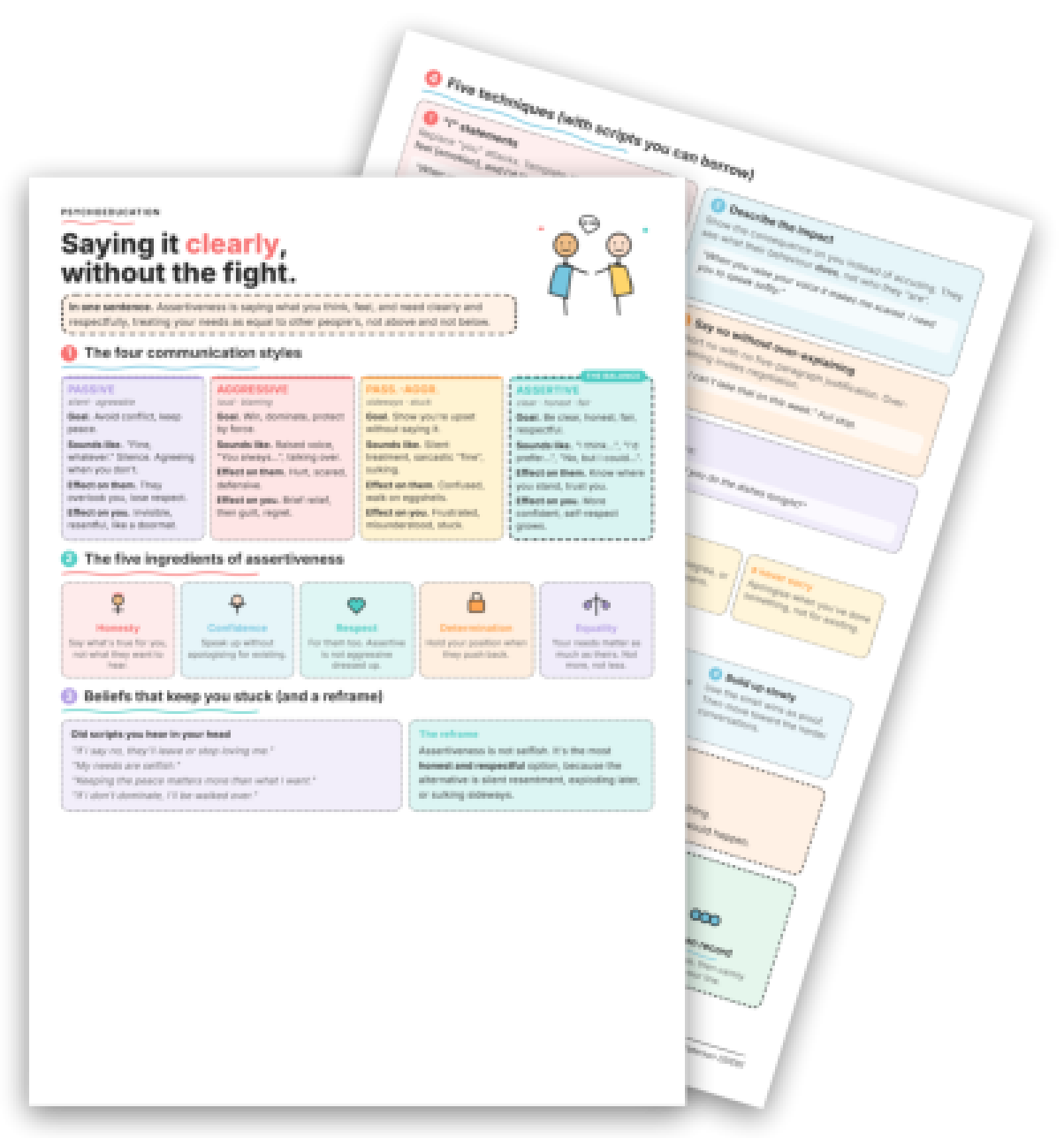
The fiche is structured around six numbered panels, each targeting a specific clinical obstacle.
- Panel 1: The four communication styles (passive, aggressive, passive-aggressive, assertive) laid out side by side, each with its goal, a sound-bite of how it sounds, and its effect on the other person and on the self. The parallel layout is the visual payoff: patients locate themselves instantly, without you having to ask directly.
- Panel 2: The five ingredients of assertiveness (honesty, confidence, respect, determination, equality), framed as building blocks rather than a personality trait.
- Panel 3: Beliefs that keep you stuck, listing schema-level scripts verbatim ("If I say no, they'll leave or stop loving me", "My needs are selfish") alongside a single, clear reframe. This panel is particularly useful before any skills work.
- Panel 4: Five techniques with ready-made scripts, covering "I" statements, describing impact rather than intent, the broken-record technique, brief refusals without justification, and clear behavioural requests (who, what, when). Each technique includes a worked example the patient can borrow directly.
- Panel 5: What assertive is NOT, addressing the four most common confusions (aggression, always winning, rudeness, never apologising).
- Panel 6: A graded practice plan for the week, built on low-stakes situations first, script preparation, and checking predictions against what actually happens.
The closing "To discuss in session" prompts ("When you notice yourself agreeing and feeling resentful afterwards") give you ready-made re-entry points for the next appointment.
> Key point: this worksheet is a visual support that facilitates the explanation in session, not a self-directed homework questionnaire. The four-style grid and the scripted techniques make a conceptual map tangible in ways that oral explanation alone rarely achieves.
750+ clinical tools
A library built with and for clinicians, ready to use in session and extend between appointments.
Access all the toolsWhen and How to Introduce the Worksheet
The fiche fits naturally from the second or third session onward, once you have a working formulation and the patient has identified at least one relational pattern to address. It pairs well with assertive rights work, assertive body language, or the Assertiveness Ladder as the next step in graduated practice.
Useful entry phrases: "I want to show you something that maps out the different ways people communicate under pressure, and we can look together at where you tend to land." This frames the fiche as a shared observation tool, not a deficit label.
For patients presenting with aggressive communication patterns, Panel 5 is the anchor: start there, establish that assertiveness and force are distinct, then work backward through the grid. For patients whose difficulty is more interpersonal conflict or active-listening deficits, the "I" statement and clear-request techniques in Panel 4 are the clinical priority.
In couples work or communication programmes, the four-style grid can be used with both partners in the same session, with each locating their own default style: this externalises the pattern without allocating blame.
Debrief the practice plan one week later by asking which situation the patient chose, what they predicted, and what actually happened. Panel 6's instruction to "check predictions" against outcome directly targets the catastrophic appraisals that typically sustain avoidance.
The worksheet does not replace formulation work around relational schemas or the beliefs that damage relationships. It makes the psychoeducation component concrete, saves session time, and leaves the patient with a portable reference they can return to between appointments.
Use it with your patients
Share this tool in the mobile app and follow the work between sessions.
Sources
- Smith, M. J. (1975). When I Say No, I Feel Guilty. Bantam Books.
- Jakubowski, P., Lange, A. J. (1978). The Assertive Option: Your Rights and Responsibilities. Research Press.
- Paterson, R. J. (2000). The Assertiveness Workbook: How to Express Your Ideas and Stand Up for Yourself at Work and in Relationships. New Harbinger Publications.
Your session continues in your patients' pocket
Use with a patientYour resources, available everywhere
The handouts, exercises, programs and audios above: you choose which ones to make available to your patients, in the mobile app dedicated to them.
And far more than a library
The app goes well beyond resources, to support your patients every day:
Related categories
Explore other clinical resources by category.

Anxiety
Clinical hub for anxiety disorders: CBT and ACT worksheets, psychoeducation sheets, and exercises for assessment and treatment across the anxiety spectrum.

Identity
Clinical resources for self-identity work in therapy: CBT, ACT, schema tools for clinicians addressing self-concept, core beliefs, and identity disruption.

Emotions
Clinical resources on emotion regulation: worksheets, coping tools, CBT, REBT, and ACT exercises for therapists working across diagnoses and age groups.

Relationships
Clinical worksheets and tools on relational functioning: attachment, schemas, assertiveness, and communication skills for therapists. Printable PDF resources.

Transitions
Clinical hub for life transitions: tools, worksheets and exercises to support psychosocial adjustment, role change and identity work in practice.

Understand
Clinical hub for the therapeutic aim 'Understand': worksheets and tools to build patient insight across CBT, ACT, schema therapy and more.