
Clinical picture. A and B, a couple in their early forties, presented after a recurring pattern in which arguments about household responsibilities ended in prolonged silence and separate sleeping arrangements. Neither partner identified as aggressive; both described feeling unheard and, eventually, hopeless about resolution. The clinician introduced the Ten Principles sheet mid-treatment, focusing first on principles 1 and 8: identifying the feeling beneath the anger, and calling a structured timeout before physiological arousal became unmanageable. In the following session, A reported having said aloud, "I need twenty minutes and then I want to come back to this," rather than withdrawing without explanation. B described the named pause as the first moment in years that the conflict had not ended in complete shutdown.
Ten Principles for Healthy Conflict: PDF Worksheet, Tools and Exercises
A visual PDF worksheet clinicians can use in session to teach constructive conflict skills, establish shared language, and give patients a concrete reference they can return to between appointments.
Clinical vignettes
Pausing Before the Point of Escalation
Shifting From Accusation to Ownership
Clinical picture. C, a man in his mid-thirties seen individually for adjustment difficulties following a separation, described a persistent communication pattern in which disagreements with his co-parent rapidly shifted toward personal attacks and catalogue grievances stretching back several years. The clinician used the sheet to work through principles 2, 3, and 4 in a role-play exercise, asking C to rephrase a representative accusation as an "I" statement limited to one current issue. C found the constraint uncomfortable at first, noting that limiting himself to one topic felt like "giving up ammunition." Over two sessions, he began to recognise that the accumulation of past grievances was lengthening every argument without resolving any of them, and he agreed to trial a single-issue rule in his next scheduled co-parenting call.
Explaining healthy conflict verbally in session tends to produce nodding without genuine uptake: patients agree with the principles in the room, then revert to the same escalation loops the moment their nervous system is activated. This fiche PDF gives you a visual anchor to make the psychoeducation stick and leaves the patient with a concrete reference to consult when things heat up at home.
Use this resource with your patients
Handout, exercises and materials ready to use, right inside SessionFuel.
Why Healthy Conflict Principles Are Hard to Convey Without a Visual Support
The core clinical difficulty is not conceptual. Most patients understand, intellectually, that stonewalling and contempt are corrosive. The problem is state-dependent access: principles learned in a calm therapeutic conversation are exactly the kind of higher-order knowledge that goes offline under physiological arousal. What your patient retains from a verbal explanation is a vague impression; what they can retrieve from a printed sheet pinned to the fridge is a specific phrase.
There is also a framing problem. Many patients come in with a binary map of conflict: either fight or avoid. Reorienting them toward a third position, moving through disagreement with the bond intact, requires more than a reframe said once aloud. It requires a shared structure they can internalise progressively. Without that structure, patterns of aggressive or contemptuous communication keep filling the vacuum.
Finally, couple work specifically suffers when each partner leaves with a different memory of what was agreed. A printed fiche PDF functions as a shared artefact, not one person's version of what the therapist said.
What the Fiche Contains: A Visual Map of Constructive Conflict
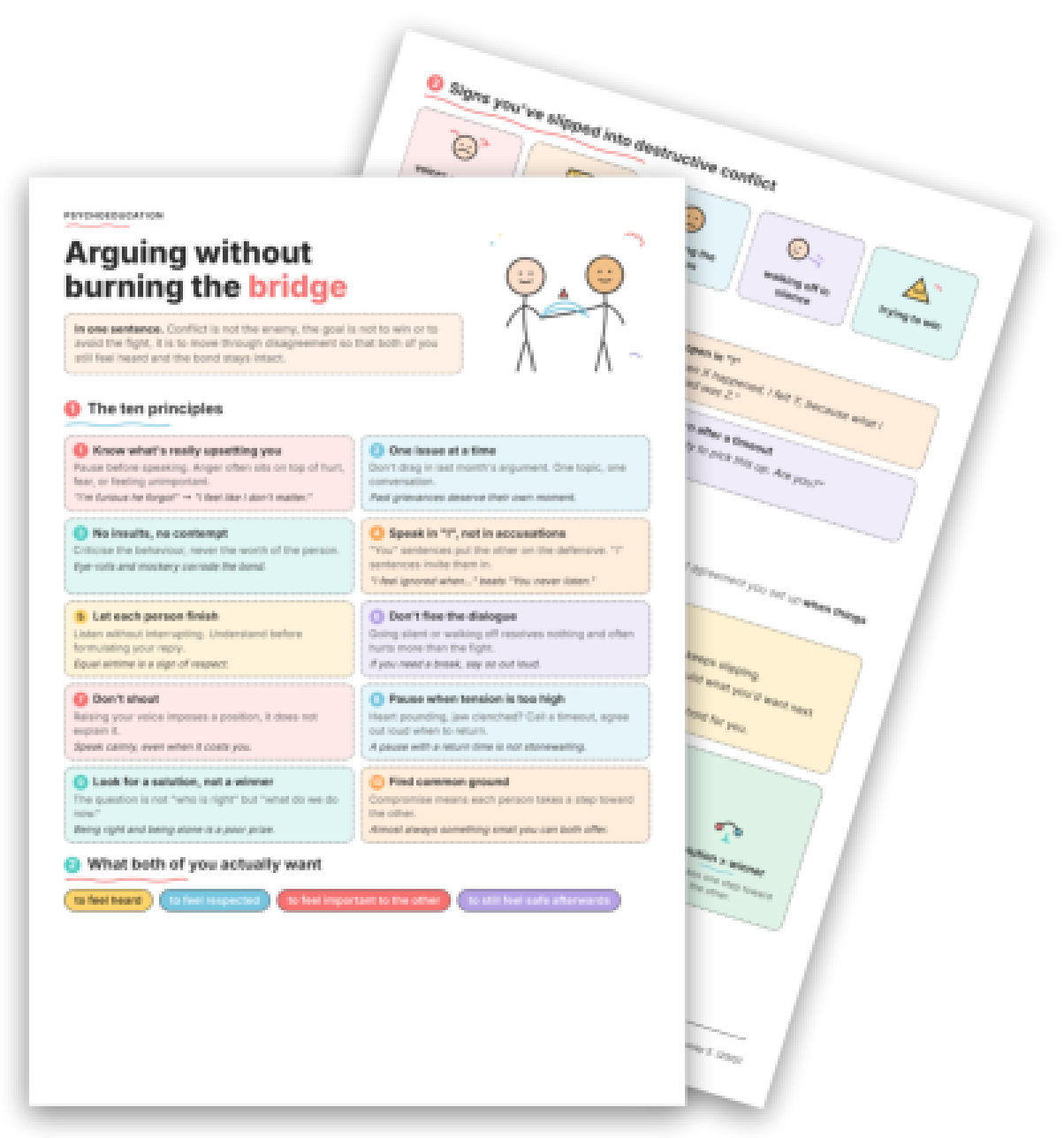
The sheet is organised across five distinct panels, all grounded in Gottman, Markman, and Stanley's work on relationship conflict.
The centrepiece is the ten numbered principles, each carried by a concrete behavioural instruction and a one-line clinical rationale. The phrasing is deliberately spare: "Criticise the behaviour, never the worth of the person" or "Heart pounding, jaw clenched? Call a timeout, agree out loud when to return." That level of granularity is what distinguishes this from generic conflict advice. Patients can match each principle to a specific moment in their last argument.
Alongside the principles, the fiche names the four underlying needs both partners usually share (feeling heard, respected, important, and safe), a panel on signs of destructive conflict (voices rising, dragging up the past, attacking the person, walking off, trying to win), and a ready-to-use phrases section with four scripted de-escalation lines for distinct moments: pausing, opening in "I," repairing after a slip, and re-entering after a timeout.
That last panel connects directly to what you may already be teaching with I-message assertive communication or nonviolent communication for couples. The visual layout makes the parallel explicit without you having to repeat it.
The fiche also includes a short "To discuss in session" section with three clinical prompts, explicitly framed for use with you present, not as solo homework.
> Key point: this fiche is a visual support that facilitates the explanation of healthy conflict in session. It is not a self-help checklist the patient works through alone; it is the printed scaffold you hold alongside them to build shared vocabulary, reduce cognitive load, and leave a tangible anchor.
750+ clinical tools
A library built with and for clinicians, ready to use in session and extend between appointments.
Access all the toolsWhen and How to Introduce It
The optimal window is after a conflict pattern has been named and mapped but before technique drilling begins, typically from the second or third session. For couple work, introduce it during a calm session rather than immediately following a crisis disclosure, when relational trust is too fragile for structured learning.
For individual work with patients navigating repeated interpersonal conflict or those whose need to be right dominates the presenting pattern, the fiche can be introduced as psychoeducation without requiring a partner in the room.
A low-pressure introduction: "I'd like to show you a framework some people find useful. We can go through it together and you tell me which of these ten ring true for your situation." That framing positions the fiche as collaborative exploration, not prescription.
To debrief: ask which principle keeps slipping, and which one the patient wishes their partner understood. Those two answers often locate the work for the next three sessions. Pair with active listening skills, fair fighting rules, or the four horsemen and their antidotes depending on where the case formulation points.
One contraindication: where there is an active power imbalance or coercive dynamic, the mutual-compromise framing of the fiche is premature. Prioritise safety and recognising the cycle of abuse before introducing shared conflict agreements.
The fiche does not replace the clinical frame. It makes the explanation cleaner, the vocabulary shared, and the principles retrievable outside the room.
Use it with your patients
Share this tool in the mobile app and follow the work between sessions.
Sources
- Gottman, J. M., & Silver, N. (1995). Why Marriages Succeed or Fail: And How You Can Make Yours Last. Simon & Schuster.
- Gottman, J. M., & Silver, N. (1999). The Seven Principles for Making Marriage Work. Crown / Harmony (Penguin Random House).
- The Gottman Institute. The Four Horsemen: Criticism, Contempt, Defensiveness, and Stonewalling.
- Gordon, T. (2000). Parent Effectiveness Training: The Proven Program for Raising Responsible Children. Three Rivers Press.
Your session continues in your patients' pocket
Use with a patientYour resources, available everywhere
The handouts, exercises, programs and audios above: you choose which ones to make available to your patients, in the mobile app dedicated to them.
And far more than a library
The app goes well beyond resources, to support your patients every day:
Related categories
Explore other clinical resources by category.
Relationships
Clinical worksheets and tools on relational functioning: attachment, schemas, assertiveness, and communication skills for therapists. Printable PDF resources.

Understand
Clinical hub for the therapeutic aim 'Understand': worksheets and tools to build patient insight across CBT, ACT, schema therapy and more.

Build skills
Skill-building resources for clinicians: printable worksheets and exercises for coping, assertiveness, and communication skills training in therapy.

Integrative
Integrative therapy clinical resources: worksheets, psychoeducation programs, and exercises for eclectic, multimodal practice across orientations.

Anxiety
Clinical hub for anxiety disorders: CBT and ACT worksheets, psychoeducation sheets, and exercises for assessment and treatment across the anxiety spectrum.
Trauma
Clinical hub on trauma and PTSD: assessment, differential diagnosis, treatment phases, and printable resources for practitioners. 155 chars.