
Clinical picture. A couple in their late thirties, referred after a brief separation, described a recurring cycle in which disagreements about household responsibilities escalated within minutes to shouting and days of withdrawal. Both partners acknowledged wanting to repair the relationship but felt helpless once conflict started. The clinician introduced the Fair Fighting Rules informational sheet in session, walking through the distinction between "unfair" moves such as kitchen-sinking and contempt cues, and the corresponding fair alternatives. Each partner was asked to identify one destructive move they recognised in themselves, rather than in the other, which shifted the tone of the discussion noticeably. By the following session they reported one argument that had stayed contained to a single issue, which both described as unusual and somewhat encouraging.
Fair Fighting Rules: PDF Worksheet, Tools and Exercises for Clinical Practice
A visual PDF worksheet clinicians can use in session to give couples a shared language for conflict, grounded in concrete behavioral contrasts and ready-to-use phrases.
Clinical vignettes
Naming the Pattern Before the Next Argument
Softening the Start in Individual Therapy
Clinical picture. A 44-year-old man seen individually for adjustment difficulties following a difficult professional period also raised persistent conflict with his partner as a secondary concern, noting that most arguments ended with one of them sleeping in another room. The clinician shared the Fair Fighting Rules sheet as psychoeducation and drew his attention to the "same trigger, two paths" example, asking him to map a recent argument onto that framework. He identified his own use of "always" and "never" statements and, on reflection, acknowledged that these tended to produce immediate counter-attacks rather than dialogue. He brought the sheet home and later reported that showing it to his partner had opened a brief, calmer conversation about how they both wanted disagreements to go, which had not happened before.
In couples work, explaining the mechanics of constructive conflict at the verbal level rarely survives contact with two people who are still half-flooded from the argument they had on the way to the session. This PDF worksheet on Fair Fighting Rules gives you a visual anchor to walk through with both partners in real time, building a shared vocabulary before the next escalation happens rather than after.
Use this resource with your patients
Handout, exercises and materials ready to use, right inside SessionFuel.
Why Fair Fighting Is Hard to Explain Without a Visual Support
When you describe the fair/unfair distinction verbally, each partner is filtering your words through their own grievance narrative. Confirmatory bias does its work in real time: the one who tends to escalate hears the description as aimed at them; the one who stonewalls hears it as vindication. The oral explanation dissolves before it lands.
The specificity problem makes it worse. Telling a couple to "use I-messages" or "stick to one topic" is cognitively too thin to produce behavioral change. Without a side-by-side concrete contrast, the guidance blurs into the other half-absorbed advice they've collected from apps, prior couples work, and well-meaning friends. A visual support that names the exact behaviors, column by column, sidesteps the filtering and gives both partners something neutral to look at together rather than at each other.
There is also the nervous system dimension. Partners who chronically reach high arousal during conflict have limited access to prefrontal processing precisely when you need them to be learning. A printed, structured reference they can hold and revisit between sessions extends the psychoeducation beyond the session's 50 minutes, which is when it is most needed.
What the Fiche Contains: A Session-Ready Visual Tool
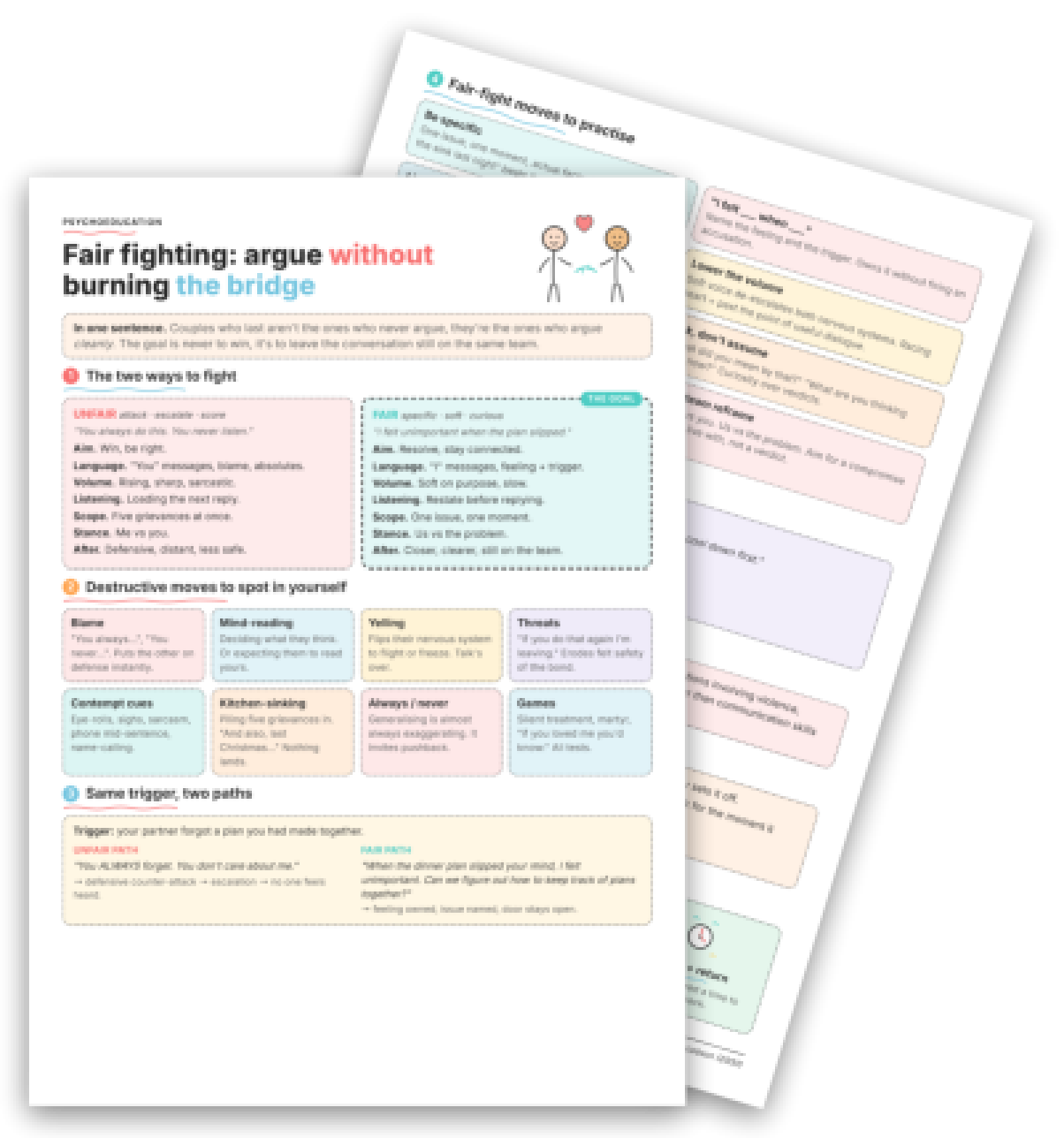
The worksheet is organized in five numbered panels, designed to be walked through in session rather than sent home as reading homework.
Panel 1 presents a direct two-column contrast between unfair and fair fighting across seven dimensions: aim, language, volume, listening quality, scope, relational stance, and aftermath. Seeing "Scope: Five grievances at once" under Unfair alongside "Scope: One issue, one moment" under Fair is more arresting than any verbal paraphrase. Couples frequently identify themselves in one column without prompting, which opens the clinical conversation cleanly.
Panel 2 names eight destructive moves to self-monitor: blame, mind-reading, yelling, threats, contempt cues, kitchen-sinking, always/never generalisations, and relational games (silent treatment, martyrdom). Each is paired with a short behavioral descriptor. This list pairs naturally with work on aggressive communication patterns or with the Anger Iceberg worksheet when dysregulation is the presenting dynamic.
Panel 3 shows the same trigger, a forgotten shared plan, producing two entirely divergent paths. One leads to a defensive counter-attack spiral; the other, using the "I felt unimportant when..." formula, keeps the door open. The split-path visual does something narrative explanation cannot: it makes the fork visible and locatable in time.
Panel 4 lists eight fair-fight moves to practise, including the structured "I felt ___ when ___" formula (which maps directly onto I-message skills), restate-before-replying as a form of active listening, volume de-escalation tied explicitly to nervous system state, and the time-out with a committed return time. Panel 5 gives five verbatim phrases couples can borrow immediately, which is useful when behavioral rehearsal is part of your session plan.
The safety caveat printed at the bottom of the fiche is clinically load-bearing. It states clearly that these rules assume both partners are safe and willing, and that they are not appropriate where violence, intimidation, or coercive control are present. That disclaimer is already on the sheet; you do not have to insert it yourself mid-session.
> To retain: the fiche is a visual support that facilitates the explanation of fair conflict in session; it leaves both partners with a shared concrete reference, not a questionnaire to complete alone.
750+ clinical tools
A library built with and for clinicians, ready to use in session and extend between appointments.
Access all the toolsWhen and How to Propose the Fiche
Introduce the worksheet once you have a working formulation of the couple's conflict cycle, typically the second or third session, after the initial alliance is established. Too early and it reads as didactic; too late and both partners may have entrenched positions that make self-recognition harder.
For couples working through the couple conflict psychoeducation program or the communication in couples program, the fiche works well as an in-session visual recap of the core concepts. For couples with a high contempt pattern (Gottman's Four Horsemen framework is the relevant reference here), Panel 2's explicit naming of contempt cues, eye-rolls, sighs, phone use mid-sentence, tends to produce recognition that verbal confrontation on the same behavior would only produce defensiveness.
You can introduce it with something like: "I want to show you a chart that maps two different ways the same argument can go. Have a look at both columns and tell me what you notice." That framing keeps both partners in an observational rather than accusatory stance. Debrief by asking which panel 3 path looks more familiar, and which move in panel 2 is each partner's default under pressure, the session discussion prompts at the bottom of the fiche scaffold exactly that conversation.
One clinical limit worth holding: for couples where one partner's fear of abandonment or attachment style drives the conflict pattern, the behavioral skills on this sheet are a necessary but insufficient layer. Pair it with schema-level or EFT-informed work as appropriate. The fiche opens the conversation; it does not close the formulation.
The sheet does not replace the therapeutic frame, but it makes a genuinely difficult psychoeducation task faster, clearer, and more likely to transfer outside the consulting room.
Use it with your patients
Share this tool in the mobile app and follow the work between sessions.
Sources
- Bach, G. R., & Wyden, P. (1969). The Intimate Enemy: How to Fight Fair in Love and Marriage. William Morrow.
- Gottman, J. M., & Silver, N. (1995). Why Marriages Succeed or Fail: And How You Can Make Yours Last. Simon & Schuster.
- The Gottman Institute. The Four Horsemen: Criticism, Contempt, Defensiveness, and Stonewalling.
- McKay, M., Davis, M., & Fanning, P. (1995). Messages: The Communication Skills Book. New Harbinger.
Your session continues in your patients' pocket
Use with a patientYour resources, available everywhere
The handouts, exercises, programs and audios above: you choose which ones to make available to your patients, in the mobile app dedicated to them.
And far more than a library
The app goes well beyond resources, to support your patients every day:
Related categories
Explore other clinical resources by category.

Emotions
Clinical resources on emotion regulation: worksheets, coping tools, CBT, REBT, and ACT exercises for therapists working across diagnoses and age groups.
Relationships
Clinical worksheets and tools on relational functioning: attachment, schemas, assertiveness, and communication skills for therapists. Printable PDF resources.

Build awareness
Clinical worksheets and tools to build awareness in therapy: cognitive distortions, schemas, emotions, ACT and CBT resources for practitioners.

Regulate
Clinical resources for emotion regulation: worksheets, ACT exercises, and psychoeducation tools for affect regulation across diagnoses. For clinicians.

Build skills
Skill-building resources for clinicians: printable worksheets and exercises for coping, assertiveness, and communication skills training in therapy.
CBT
CBT worksheets, cognitive restructuring exercises & behavioral tools for clinicians. Evidence-based resources for every phase of cognitive behavioral therapy.