
M., a 41-year-old project manager, was referred following a formal complaint by a junior colleague. He described his communication style as "direct" and expressed genuine surprise that others found it intimidating. In session, the clinician introduced the vicious-cycle diagram from the worksheet, and M. was asked to map his last workplace conflict onto each step. He recognised, with some discomfort, that the colleague's surface agreement had not resolved the underlying task dispute, which had resurfaced two weeks later in a more entrenched form. This concrete mapping shifted the focus from the colleague's behaviour to the short-term payoff M. was inadvertently reinforcing in himself.
Aggressive Communication: PDF Worksheet, Tools and Exercises for Clinical Practice
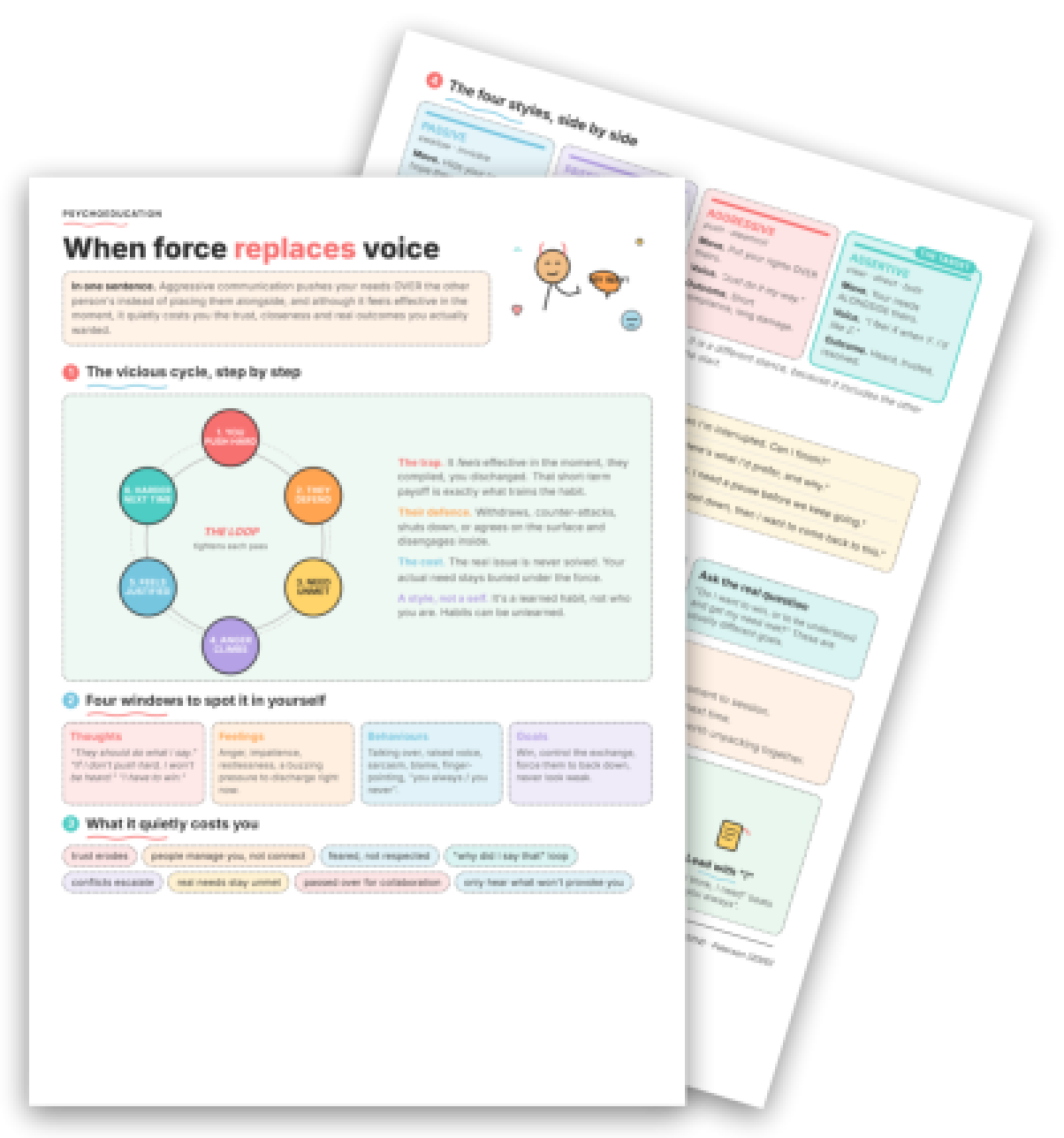
A visual PDF worksheet clinicians can use in session to map the aggressive communication cycle, contrast it with assertiveness, and give patients a concrete reference to keep.
Clinical vignettes
Recognising the Cycle at Work
Distinguishing Style From Identity
P., a woman in her mid-thirties presenting with relationship difficulties, described escalating arguments with her partner in which she would raise her voice, interrupt, and use sweeping generalisations she later regretted. She had begun to frame this as a character flaw, telling the clinician, "I'm just an aggressive person." The clinician used the four-styles table to distinguish a learned behavioural pattern from a fixed trait, noting that the same person could show passive communication in professional settings and aggressive communication at home. P. found this reframe credible rather than reassuring, and it opened a practical conversation about which situational triggers preceded the shift in style. Subsequent sessions focused on identifying the unmet need beneath the discharge rather than on suppressing the anger itself.
When patients present with relational conflict, the hardest psychoeducation move is often convincing them that their aggressive style is a learned habit rather than a fixed character trait, and that the short-term relief it provides is precisely the mechanism that maintains it. Oral explanation alone rarely gets there. This PDF worksheet on aggressive communication gives you a structured visual to do that work in session, panel by panel.
Use this resource with your patients
Handout, exercises and materials ready to use, right inside SessionFuel.
Why Aggressive Communication Resists Explanation in Session
The central difficulty is the payoff problem. Patients who rely on aggressive communication report that it works: the other person backs down, the tension discharges. Naming this in session without a map tends to produce intellectualised agreement that doesn't touch the behaviour. The patient nods, then does it again Tuesday.
A second sticking point is the style vs. self confusion. Many patients hear "you communicate aggressively" as a character indictment. Without a concrete schema to look at, there's no shared language for separating the pattern from the person. The same problem arises when patients conflate assertiveness with aggression turned down a notch, a conflation the fiche addresses directly and that verbal explanation alone rarely untangles cleanly.
This is also the moment where understanding the anger iceberg becomes relevant: what looks like dominance at the surface often maps onto unmet needs underneath, and the visual support helps you make that link explicit.
What the Fiche Contains: Six Panels, One Coherent Visual Arc
The worksheet is structured across six numbered sections, each serving a distinct psychoeducation function you can sequence over one or two sessions.
- The vicious cycle diagrams six linked steps: push hard → they defend → need unmet → anger climbs → feels justified → harder next time, with the explicit note that "the loop tightens each pass." This panel alone tends to interrupt the usual justification narrative.
- Four windows to spot it in yourself maps the pattern across thoughts ("I have to win"), feelings, behaviours (raised voice, blame, "you always / you never" formulations), and goals, giving patients a multi-channel self-monitoring structure you can return to in debrief.
- What it costs lists eight relational consequences, including "people manage you, not connect" and "only hear what won't provoke you", costs patients rarely articulate unprompted.
- The four communication styles side by side (passive, passive-aggressive, aggressive, assertive) includes the key distinction the fiche states plainly: "Assertive is not aggressive turned down a notch. It is a different stance, because it includes the other person's rights from the start." This is the conceptual hinge of the whole tool.
- Concrete language swaps offer four direct before/after examples patients can borrow immediately, including "I'm getting frustrated. I need a pause before we keep going."
- Try this week closes with three between-session exercises: finding a body cue stop signal, buying three seconds before speaking, and asking "Do I want to win, or to be understood?"
> Key point: the fiche is a visual support that facilitates the explanation in session. It is not a self-administered questionnaire. The sequential layout lets you move through the mechanism step by step with the patient in the room, then hand them a reference they can actually use.
Pair it naturally with anger warning signs work and the Assertiveness worksheet for patients ready to move from recognising the pattern to practising an alternative.
Clinical library
750+ clinical tools
A library built with and for clinicians, ready to use in session and extend between appointments.
Access all the toolsSeveral resource types
Psychoeducation handouts
Understand at a glance
Interactive exercises
To do and fill in
Interactive programs
A structured path
Audios
Meditation and relaxation
Psychometric tests
Automatic scoring
When and How to Introduce the Fiche
This worksheet fits best in mid-early sessions, once the presenting complaint is clear and a working alliance is established, but before the patient has entrenched a "this is just who I am" position. It is well-suited to individual work with interpersonal conflict, couples referred for communication difficulties, and anger-focused presentations where the six-session Anger Psychoeducation Program is part of the care plan.
A low-threshold introduction: "I want to show you something that maps a pattern I think we've been circling around. It's not a label, it's a mechanism." That framing separates description from judgment before the patient has a chance to become defensive.
On debrief, the "Try this week" section gives you three specific targets to review at the following session, including the body cue and the reflective question about winning versus being understood. For patients who tend toward rigid all-or-nothing demands in conflict, or who struggle with overgeneralised "you always / you never" accusations, those debrief points are especially productive.
One limit worth noting: for patients with an active trauma history where dominance behaviour is deeply schema-driven, the fiche is a useful entry point but insufficient alone. Consider it a bridge toward assertive rights work, the Assertiveness Ladder, or deeper schema-level work on beliefs that damage relationships.
The fiche does not replace the therapeutic frame; it makes the explanation sharper and leaves the patient with something concrete to return to between sessions.
Use it with your patients
Share this tool in the mobile app and follow the work between sessions.
Sources
- Jakubowski, P., & Lange, A. J. (1978). The Assertive Option: Your Rights and Responsibilities. Research Press Company.
- Rakos, R. F. (1991). Assertive Behavior: Theory, Research, and Training. Routledge.
- McKay, M., Davis, M., & Fanning, P. (2018). Messages: The Communication Skills Book (4th ed.). New Harbinger Publications.
Patient mobile app
Your session continues in your patients' pocket
Use with a patientYour resources, available everywhere
The handouts, exercises, programs and audios above: you choose which ones to make available to your patients, in the mobile app dedicated to them.
Psychoeducation handoutsInteractive exercisesInteractive programsAudiosPsychometric tests
And far more than a library
The app goes well beyond resources, to support your patients every day:
Standardized tests
Therapy journal
Gamification
Wellbeing challenges
Introspection prompts
Therapist homework
Related categories
Explore other clinical resources by category.

Identity
Clinical resources for self-identity work in therapy: CBT, ACT, schema tools for clinicians addressing self-concept, core beliefs, and identity disruption.

Emotions
Clinical resources on emotion regulation: worksheets, coping tools, CBT, REBT, and ACT exercises for therapists working across diagnoses and age groups.

Relationships
Clinical worksheets and tools on relational functioning: attachment, schemas, assertiveness, and communication skills for therapists. Printable PDF resources.

Understand
Clinical hub for the therapeutic aim 'Understand': worksheets and tools to build patient insight across CBT, ACT, schema therapy and more.

Build awareness
Clinical worksheets and tools to build awareness in therapy: cognitive distortions, schemas, emotions, ACT and CBT resources for practitioners.
CBT
CBT worksheets, cognitive restructuring exercises & behavioral tools for clinicians. Evidence-based resources for every phase of cognitive behavioral therapy.